Showing posts with label HAYLEY LEVER. Show all posts

08 Classic Works of Art, Marine Paintings - With Footnotes, #39

Charles Edward Dixon, (British, 1872-1934)
'Oak, Hemp, and Powder, Trafalgar, 1805' , c. /1920' (lower right)
Gouache
118.5 x 241cm (46 5/8 x 94 7/8in)
Private collection

The Battle of Trafalgar (21 October 1805) was a naval engagement fought by the British Royal Navy against the combined fleets of the French and Spanish Navies, during the War of the Third Coalition (August–December 1805) of the Napoleonic Wars (1803–1815).

Twenty-seven British ships of the line led by Admiral Lord Nelson aboard HMS Victory defeated thirty-three French and Spanish ships of the line under the French Admiral Villeneuve in the Atlantic off the southwest coast of Spain, just west of Cape Trafalgar, in Caños de Meca. The Franco-Spanish fleet lost twenty-two ships, without a single British vessel being lost. It was the most decisive naval battle of the war, conclusively ending French plans to invade England.

The British victory spectacularly confirmed the naval supremacy that Britain had established during the eighteenth century and was achieved in part through Nelson's departure from the prevailing naval tactical orthodoxy. 

Nelson was shot by a French musketeer during the battle and died shortly after, becoming one of Britain's greatest war heroes. Villeneuve was captured along with his ship Bucentaure. Admiral Federico Gravina, the senior Spanish flag officer, escaped with the remnant of the fleet and succumbed months later to wounds sustained during the battle. Villeneuve attended Nelson's funeral while a captive on parole in Britain. The Battle of Trafalgar

Charles Edward Dixon (8 December 1872 - 12 September 1934) was a British maritime painter of the late nineteenth and early twentieth centuries, whose work was highly successful and regularly exhibited at the Royal Academy. Several of his paintings are held by the National Maritime Museum and he was a regular contributing artist to magazines and periodicals. He lived at Itchenor in Sussex and died in 1934. More on Charles Edward Dixon
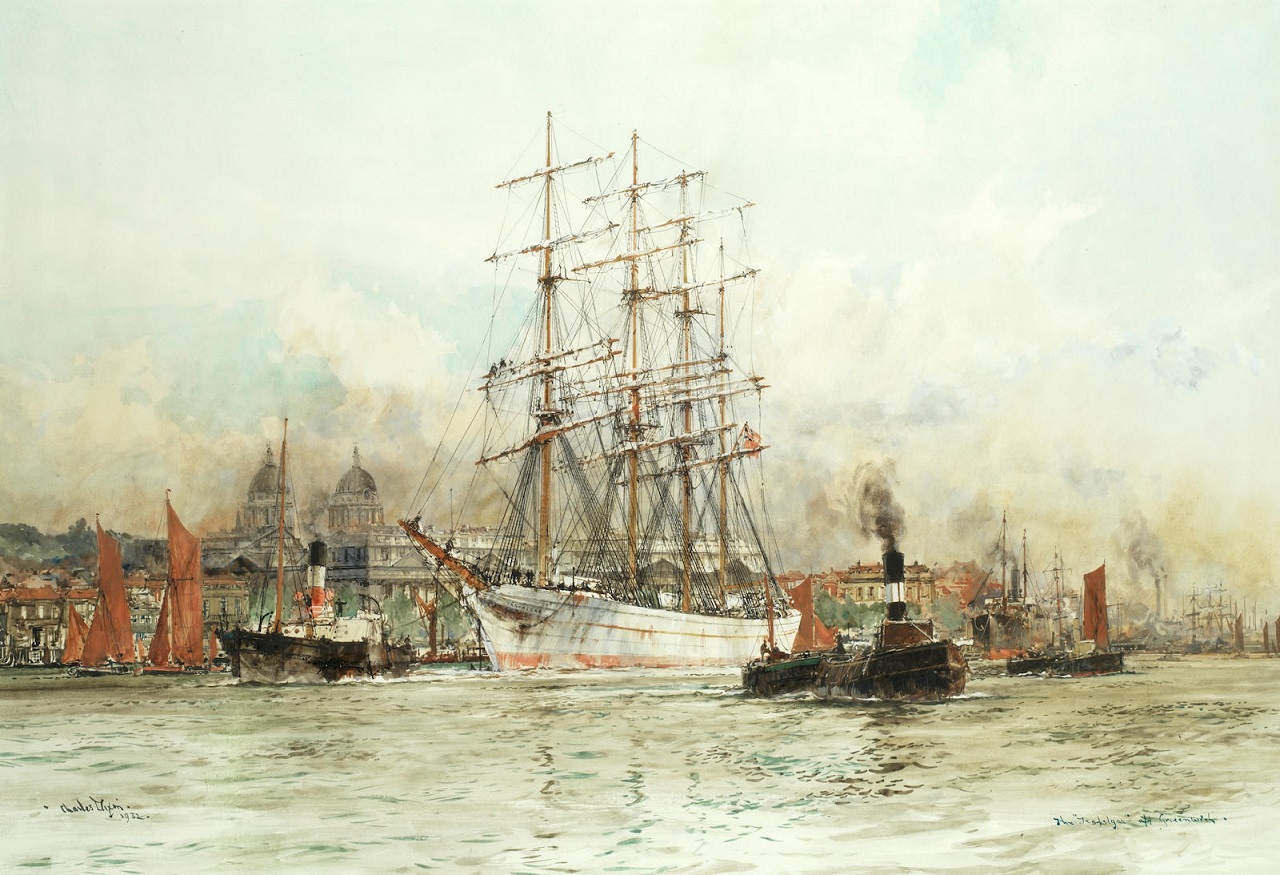
Charles Edward Dixon, (British, 1872-1934)
The Trafalgar off Greenwich , 1932
Watercolour and bodycolour
52 x 75.5cm
Private collection

Greenwich is located within the Royal Borough of Greenwich, to which it lends its name. Notable for its maritime history and for giving its name to the Greenwich Meridian and Greenwich Mean Time. 

The town became a popular resort in the 18th century. The maritime connections of Greenwich were celebrated in the 20th century, with the siting of the Cutty Sark and Gipsy Moth IV next to the river front, and the National Maritime Museum in the former buildings of the Royal Hospital School in 1934. Greenwich formed part of Kent until 1889 when the County of London was created. More on Greenwich

Charles Edward Dixon, (British, 1872-1934), see above


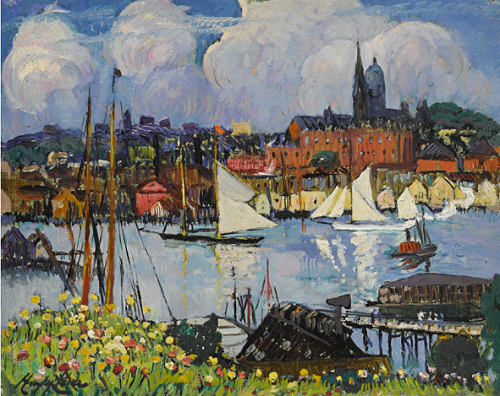
Hayley Lever, 1876 - 1958
GLOUCESTER HARBOR
Oil on canvas laid down on Masonite
13 by 16 inches, (33 by 40.6 cm)
Private collection

Gloucester, on Cape Ann in Essex County, Massachusetts, in the United States. It is part of Massachusetts' North Shore.  An important center of the fishing industry and a popular summer destination, Gloucester consists of an urban core on the north side of the harbor and the outlying neighborhoods. More on Gloucester

Richard Hayley Lever (28 September 1875 – 6 December 1958) was an Australian-American painter, etcher, lecturer and art teacher. Lever was born in Bowden, South Australia. He excelled in painting classes at Prince Alfred College, and on leaving school continued to study at his Norwood art school. He was a charter member of the Adelaide Easel Club in 1892.
An inheritance was sufficient for Lever to finance a trip to England in 1899 to further his career in painting. He moved to St. Ives. The town's reputation as a centre for marine painting. He studied painting techniques under the Impressionists Olsson and Algernon Talmage. Lever also painted in the French port villages of Douarnenez and Concarneau, Brittany.

In late 1904 Lever made a trip back to Adelaide, where he staged several exhibitions, painted seascapes and taught. In 1906 he returned to Europe 

In 1911, an Impressionist painter, persuaded Lever to move to America, saying he would have greater success there. From 1919 to 1931, Lever taught art classes at the Art Students League of New York. Lever went to Pittsburgh in 1922 as an art juror for the Carnegie International exhibition.
In 1924, Lever was commissioned to paint a portrait of the presidential yacht, Mayflower, which was subsequently presented to President Calvin Coolidge. By 1930, Lever had moved to Caldwell, New Jersey, staying there until 1938, when he moved to Mount Vernon, New York. While living in New York, Lever painted marines and landscapes in New Jersey, Vermont, New England, New York and the Canadian Maritimes. Throughout his life, he traveled and painted extensively, including Nova Scotia and Grand Manan Island in Canada, the Bahamas and Florida, while often returning to Europe. In 1933, Hayley was named Director of the Green Mountains summer art school at Smugglers Notch, Stowe Vermont. Lever also taught painting classes at the Forum School of Art in Bronxville, New York from 1934 to 1935. More on Richard Hayley Lever


Louis Charles Moeller, 1855 - 1930
DISCUSSING THE CATCH
Oil on canvas
12 by 16 inches, (30.5 by 40.6 cm)
Private collection

Louis Charles Moeller (born in New York City, 5 August 1855; died in Weehawken, New Jersey, 1930) was a United States genre painter. He was the son of a decorative painter, with whom he served a three years' apprenticeship. He then studied painting in New York, and in Munich. His meager resources obligated him to return from Munich back home to New York in 1883, where he again devoted himself to decorative painting.

The year of his return, he sent “A Girl in a Snow-Storm” to the National Academy of Design. His second work, “Puzzled,” gained him the Hallgarten Prize, and election as an associate to the National Academy in 1884. He was made a National Academician in 1895. More on Louis Charles Moeller


William Trost Richards, 1833 - 1905
EBBING TIDE, c. 1891
 oil on canvas
20 1/2 by 40 1/2 inches, (52.1 by 102.9 cm)
Private collection

William Trost Richards (June 3, 1833 – November 8, 1905) was an American landscape artist. He was associated with both the Hudson River School and the American Pre-Raphaelite movement. He was born in Philadelphia, Pennsylvania. Between 1850 and 1855 he studied part-time with the German artist Paul Weber while working as designer and illustrator of ornamental metalwork. Richards first public showing was part of an exhibition in New Bedford, Massachusetts, organized by artist Albert Bierstadt in 1858.

In 1862 he was elected honorary member of the National Academy of Design and Academician in 1871. In 1863, he became a member of the Association of the Advanced of Truth in Art, an American Pre-Raphaelite group. In 1866, he departed for Europe for one year. Upon his return and for the following six years he spent the summers on the East Coast.

In the 1870s, he produced many acclaimed watercolor views of the White Mountains, several of which are now in the collection of the Metropolitan Museum of Art. Richards exhibited at the National Academy of Design from 1861 to 1899, and at the Brooklyn Art Association from 1863 to 1885. He was elected a full member of the National Academy in 1871.

He died on April 17, 1905 in Newport, Rhode Island. More on William Trost Richards


Francis Augustus Silva, 1835 - 1886
LATE AFTERNOON
Oil on canvas
18 by 30 inches, (45.8 by 76.2 cm)
Private collection

Francis Augustus Silva, 1835 - 1886; was born in New York City in 1835. Silva never received formal training as an artist but manifested artistic talent from an early age. At thirteen he exhibited ink drawings at the Annual Fair of the American Institute of the City of New York. He set up his first studio in 1858, but his career as a painter was put on hold when he joined the New York militia and served in the Civil War. In 1868, Silva was discharged from the military. The same year, he had his first exhibit at the National Academy of Design, which marked the start of his painting career. 

Throughout most of the 1870s Silva kept a studio in New York City and took frequent painting trips along the East Coast. He developed his brand of dramatically lit, atmospheric Luminism from painting marine subjects  His fondness for harbor views surrounding his native city was evidenced in the boat and shipwreck scenes of Brooklyn and Long Island he exhibited at the Brooklyn Art Association exhibitions (1869–1885). Around 1880 Silva moved to Long Branch, New Jersey but kept a studio in the famous Tenth Street Studio Building in New York City. He painted scenes along the New Jersey coasts until his death in 1886. More on Francis Augustus Silva


Francis Augustus Silva, 1835 - 1886
EARLY MOONRISE, CONEY ISLAND
Oil on canvas
12 by 20 inches
(30.5 by 50.8 cm)
Private collection

Francis Augustus Silva, 1835 - 1886, see above


Emil Carlsen, 1853 - 1932
BREAKERS, c. 1908
Oil on canvas
28 by 34 inches, (71.1 by 86.3 cm)
Private collection

Soren Emil Carlsen (October 19, 1853 – January 2, 1932, New York City, U.S.) was an American Impressionist painter who emigrated to the United States from Denmark. He became known for his still lifes. In an era when many artists succumbed to the pressure resulting from The Armory Show to follow modernistic "developments" Carlsen remained faithful to his inborn aesthetic sense. Later in his career Carlsen expanded his range of subjects and becoming known for landscapes and marines as well.


During his long career he won many of the most important honors in American art and was elected to membership in the National Academy of Design. For more than forty years he was also a respected teacher in Chicago, San Francisco and New York. More on Soren Emil Carlsen


Acknowledgement: Sotheby’s, and others

Images are copyright of their respective owners, assignees or others

We do not sell art, art prints, framed posters or reproductions. Ads are shown only to compensate the hosting expenses.

If you enjoyed this post, please share with friends and family.

10 Classic Works of Art, Marine Paintings - With Footnotes, #34

Montague Dawson, 1890 - 1973
Ships That Pass
oil on canvas
28.25 x 42 in
Private collection

Montague Dawson RMSA, FRSA (1890–1973) was a British painter who was renowned as a maritime artist. His most famous paintings depict sailing ships, usually clippers or warships of the 18th and 19th centuries. Montague was the son of a keen yachtsman and the grandson of the marine painter Henry Dawson (1811–1878), born in Chiswick, London. Much of his childhood was spent on Southampton Water where he was able to indulge his interest in the study of ships. For a brief period around 1910 Dawson worked for a commercial art studio in Bedford Row, London, but with the outbreak of the First World War he joined the Royal Navy. Whilst serving with the Navy in Falmouth he met Charles Napier Hemy (1841–1917), who considerably influenced his work. In 1924 Dawson was the official artist for an Expedition to the South Seas by the steam yacht St.George. During the expedition he provided illustrated reports to the Graphic magazine.

After the War, Dawson established himself as a professional marine artist, concentrating on historical subjects and portraits of deep-water sailing ships. During the Second World War, he was employed as a war artist. Dawson exhibited regularly at the Royal Society of Marine Artists, of which he became a member, from 1946 to 1964, and occasionally at the Royal Academy between 1917 and 1936. By the 1930s he was considered one of the greatest living marine artists, whose patrons included two American Presidents, Dwight D Eisenhower and Lyndon B Johnson, as well as the British Royal Family. Also in the 1930s, he moved to Milford-Upon-Sea in Hampshire, living there for many years. Dawson is noted for the strict accuracy in the nautical detail of his paintings which often sell for six figures.

The work of Montague Dawson is represented in the National Maritime Museum, Greenwich and the Royal Naval Museum, Portsmouth. More on Montague Dawson

Edward William Cooke, 1811 - 1880
DUTCH FISHING BOATS IN CHOPPY COASTAL WATERS
Oil on canvas
54 x 79cm
Private collection

Edward William Cooke, R.A., F.R.S., F.Z.S., F.S.A., F.G.S. (27 March 1811 – 4 January 1880) was an English landscape and marine painter, and gardener. Cooke was born in Pentonville, London. He was raised in the company of artists. He was a precocious draughtsman and a skilled engraver from an early age, displayed an equal preference for marine subjects and published his "Shipping and Craft" – a series of accomplished engravings – when he was 18, in 1829. Cooke began painting in oils in 1833, and first exhibited at the Royal Academy and British Institution in 1835, by which time his style was essentially formed.

He went on to travel and paint with great industry at home and abroad, indulging his love of the 17th-century Dutch marine artists with a visit to the Netherlands in 1837. He returned regularly over the next 23 years, studying the effects of the coastal landscape and light, as well as the works of the country's Old Masters, resulting in highly successful paintings. He went on to travel in Scandinavia, Spain, North Africa and, above all, to Venice. In 1858, he was elected into the National Academy of Design as an Honorary Academician. . More Edward William Cooke


Willem van de Velde the Younger, LEIDEN 1633 - 1707 LONDON
THE ENGLISH ROYAL YACHT MARY ABOUT TO FIRE A SALUTEc. 1660
Oil on canvas

126.5 x 178 cm.; 49 3/4  x 70 in.
Private collection


 King Charles II’s Royal Yacht Mary, the subject of this picture, occupies the centre of the composition, about to fire a salute. The Master can be seen ringing a bell to give the order, and the gunner (wearing a fisherman’s hat) can be seen with his lighted spill held aloft. The yacht is moored by its starboard anchor, while a sailor holds the stock of the port anchor, which is unshipped, perhaps as he prepares to stow it. The foresail is up and the mainsail is gathered, ready to be released, and it looks as if the Mary is making ready to depart. Her salute is presumably in answer to one fired by the unidentified Dutch ship beyond and to the left. Further Dutch ships are to be seen in the distance to the centre, including one flying the flag of the Fore Squadron, and another the flag and pennant of an Admiral of the Main. Nearer, to the right, is the Amsterdam ship Hollandia, her stern towards the viewer, smoke visible above her deck suggesting that she to her stern towards the viewer, smoke visible above her deck suggesting that she too has just fired a salute. Beyond the Hollandia is an unidentified ship with a haloed saint on her tafferel.

Van de Velde depicted the Mary in several other paintings, though never so prominently as here. More on this painting

Willem van de Velde the Younger (bapt. 18 December 1633; died 6 April 1707) was a Dutch marine painter. A son of Willem van de Velde the Elder, also a painter of sea-pieces, he was instructed by his father, and afterwards by Simon de Vlieger, a marine painter of repute at the time, and had achieved great celebrity by his art before he came to London. By 1673 he had moved to England, where he was engaged by Charles II, at a salary of £100, to aid his father in "taking and making draughts of sea-fights", his part of the work being to reproduce in color the drawings of the elder Van de Velde. He was also patronized by the Duke of York and by various members of the nobility. More on Willem van de Velde the Younger

Willem van de Velde the Younger, LEIDEN 1633 - 1707 LONDON
THE ENGLISH ROYAL YACHT MARY ABOUT TO FIRE A SALUTE, c. 1660
Detail

Willem van de Velde the Younger (bapt. 18 December 1633; died 6 April 1707) was a Dutch marine painter. A son of Willem van de Velde the Elder, also a painter of sea-pieces, he was instructed by his father, and afterwards by Simon de Vlieger, a marine painter of repute at the time, and had achieved great celebrity by his art before he came to London. By 1673 he had moved to England, where he was engaged by Charles II, at a salary of £100, to aid his father in "taking and making draughts of sea-fights", his part of the work being to reproduce in color the drawings of the elder Van de Velde. He was also patronized by the Duke of York and by various members of the nobility. More on Willem van de Velde the Younger


Edward William Cooke, 1811 - 1880
DUTCH FISHING BOATS IN CHOPPY COASTAL WATERS
Detail

Edward William Cooke, see above


HAYLEY LEVER, 1876 - 1958
Returning Fisherman, The Jetties, Manasquan, NJ, c. 1938
Oil on canvas 
30 by 36 inches (76.2 by 91.4 cm)
Private collection

The Manasquan Inlet is an inlet that connects the Atlantic Ocean with the Manasquan River, in the state of New Jersey. Passage to Bay Head Harbor and the Barnegat Bay is possible via the Point Pleasant Canal.

The Manasquan inlet historically had always been shallow, which made it difficult for large boats to navigate. When the Point Pleasant Canal was dug in 1926, the Manasquan river's water rapidly flowed through the man-made opening disrupting the natural flow of the river, this caused the inlet to completely close with sand for several years. In 1930 work begun to reopen the inlet. The Army Corps of Engineers put up temporary piers and began building jetties. The jetties were constructed with rock excavation from the Second Avenue Subway in Manhattan. The inlet was officially reopened on August 29, 1931. More on The Manasquan Inlet

Richard Hayley Lever (28 September 1875 – 6 December 1958) was an Australian-American painter, etcher, lecturer and art teacher. He excelled in painting classes at Prince Alfred College under James Ashton and on leaving school continued to study under Ashton at his Norwood art school. He was a charter member of the Adelaide Easel Club in 1892.

Lever left to England in 1899 to further his career in painting. He moved to St. Ives, a fishing port and artistic colony on the Cornish coast. In St. Ives, Lever shared a studio with Frederick Waugh, and studied painting techniques under the Impressionists Olsson and Algernon Talmage. Lever also painted in the French port villages of Douarnenez and Concarneau, Brittany, directly across the English Channel from St. Ives.

Lever arrived in New York City in 1912 and painted views of the Hudson River, Times Square and Central Park. Upon discovering the American east coast, he painted in Gloucester, MA for several summers and at Marblehead, MA. From 1919 to 1931, Lever taught art classes at the Art Students League of New York where he maintained a Gloucester studio and often traveled to paint on Nantucket and Martha's Vineyard. In 1924, Lever was commissioned to paint a portrait of the presidential yacht, Mayflower, which was subsequently presented to President Calvin Coolidge in the Cabinet Room of the White House. 

In later life, Lever was inflicted with arthritis in his right hand, which prevented him from further travel and forced him to concentrate on still-life subjects instead. As his arthritis advanced, he taught himself to paint with his left hand. However, following the death of his wife Aida in 1949, Lever was confined to his home, where he continued to paint from 1953 until his death. More on Richard Hayley Lever


Irma Stern (1894 - 1966)
Madeira Scene, 1931
Gouache
28.5 x 22 cm
Private collection

Madeira is a Portuguese archipelago situated in the north Atlantic Ocean, southwest of Portugal. Its total population was estimated in 2011 at 267,785. The capital of Madeira is Funchal, located on the main island's south coast.

Madeira was claimed by Portuguese sailors in the service of Prince Henry the Navigator in 1419 and settled after 1420. The archipelago is considered to be the first territorial discovery of the exploratory period of the Portuguese Age of Discovery, which extended from 1415 to 1542. More on Madeira


Irma Stern (1894, Schweizer-Reneke, Transvaal – 23 August 1966, Cape Town, South Africa) was born in Schweizer-Reneke, a small town in the Transvaal. Her father was interned in a concentration camp by the British during the South African War because of his pro-Boer leanings. Irma and her younger brother, Rudi, were thus taken to Cape Town by their mother. After the war, the family returned to Germany and constant travel. This travel would influence Irma's work.

Irma Stern, (1894 - 1966)
Boats, Madeira, c. 1951
Gouache and charcoal on paper
37 x 27.5 cm
Private collection

In 1913 Stern studied art in Germany at the Weimar Academy. She was associated with the German Expressionist painters of this period. She held her first exhibition in Berlin in 1919. In 1920 Stern returned to Cape Town with her family where she was first derided and dismissed as an artist before becoming an established artist by the 1940s.

In 1926 she married Dr Johannes Prinz, her former tutor, who subsequently became professor of German at the University of Cape Town. They were divorced in 1934.

Irma Stern travelled extensively in Europe and explored Southern Africa, Zanzibar and the Congo region. These trips provided a wide range of subject matter for her paintings and gave her opportunities to acquire and assemble a collection of artifacts. In 1931 she visited Madeira and Dakar, Senegal, in 1937 and 1938. These expeditions resulted in a wealth of artistic creativity and energy as well as the publication of two illustrated journals; Congo published in 1943 and Zanzibar in 1948.

The Irma Stern Museum was established in 1971 and is the house the artist lived in for almost four decades. She moved into The Firs in Rondebosch in 1927 and lived there until her death. Several of the rooms are furnished as she arranged them while upstairs there is a commercial gallery used by contemporary South African artists. More on Irma Stern


Liza Yashyna, Russia
«Evening»
Oil on canvas
35.4 H x 23.6 W x 0.8 in

Elizabeth Yashyna was born on 2-nd of August 1987 in Simferopol (Ukraine) in artists' family. In 2007 graduated from Crimean College of Art of N.S. Samokish. In 2013 graduated from Kiev National Academy of Fine Art and Architecture (Faculty of Sacred and Monumental Art; studio of N.A. Storozhenko). Exhibition activity began in 2003 - held more than 30 personal and group exhibitions. Member of National Union of Artists of Ukraine and National Union of Artists of Russia. Works are presented in private collections in France, Italy, USA, Hungary, Montenegro, Australia, Russia, Ukraine and others. Since 2008 - member of the Creative Union of Professional Artists of Russia. Since 2013 - Member of the Creative Union of Professional Artists of Ukraine. More on Elizabeth Yashyna


FRANK MYERS BOGGS, 1855 - 1926
Fish Market, Copenhagen, c. 1924
Oil on canvas 
22 1/8 by 20 1/8 inches (56.1 by 51.1 cm)
Private collection

Copenhagen, originally a Viking fishing village founded in the 10th century, Copenhagen became the capital of Denmark in the early 15th century. Beginning in the 17th century it consolidated its position as a regional centre of power with its institutions, defences and armed forces. More on Copenhagen 

Frank Myers Boggs (* 6. December 1855 in Springfield , Ohio ; † August 8, 1926 in Meudon , Hauts-de-Seine )  was active, and naturalized in France .  He was a painter of urban landscapes, marine. Watercolorist , engraver , draftsman.

Mixing tonalist and impressionist elements, Frank Myers Boggs forged a novel artistic style at the juncture of fin-de-siècle American and European traditions. Born in Ohio, Boggs trained at the École des Beaux-Arts under Jean Léon Gerôme and spent the majority of his life in Paris. There, he accomplished the rare feat of gaining prominence in both the French and American art worlds. By the end of his life, Boggs had essentially transformed himself into a French impressionist: he became a French citizen in 1923 and earned the French Legion of Honor three years later. 

Boggs won a prize from the American Art Association in 1884 and silver medals from the Paris Universal Exposition of 1889 and the Chicago World’s Columbian Exposition of 1893. His paintings are now in the Metropolitan Museum of Art, Brooklyn Museum of Art, and Museum of Fine Arts, Boston, as well as the Réunion des Musées Nationaux of Paris, Luxembourg Museum, and Museum of Nantes in France. More on Frank Myers Boggs


Anders Zorn, 1860 - 1920
Summer Entertainment/ Sommarnoje, c. 1886
Watercolor, paper
76 x 54 cm
Private Collection


Anders Leonard Zorn (18 February 1860 – 22 August 1920) was one of Sweden's foremost artists. He obtained international success as a painter, sculptor and etcher. From 1875 to 1880 Zorn studied at the Royal Swedish Academy of Arts in Stockholm. Members of Stockholm society approached him with commissions. Zorn traveled extensively to London, Paris, the Balkans, Spain, Italy and the United States, becoming an international success as one of the most acclaimed painters of his era. It was primarily his skill as a portrait painter that gained Zorn international acclaim based principally upon his incisive ability to depict the individual character of his model. At 29, he was made a Chevalier de la Légion d'honneur at the Exposition Universelle 1889 Paris World Fair. More Anders Leonard Zorn


Acknowledgement: Sotheby's and others

Images are copyright of their respective owners, assignees or others

We do not sell art prints, framed posters or reproductions. Ads are shown only to compensate the hosting expenses.

If you enjoyed this post, please share with friends and family.

A note to the readers of Zaidan Gallery

      A note to the readers of Zaidan Gallery It is with great sadness that we share the news that the author of this blog,  Henry Zaidan (1...