Showing posts with label Edward William Cooke. Show all posts

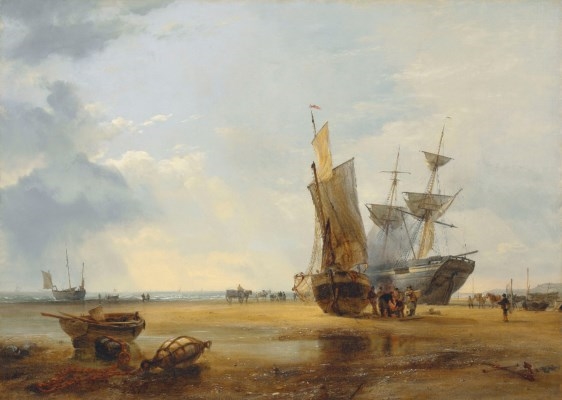
01 Marine Painting, Edward William Cook's Zuider Zee fishing craft drying nets in the harbour of Spaarndam, with Footnotes #286

Edward William Cooke, RA (BRITISH, 1811-1880)
Detail; Zuider Zee fishing craft drying nets in the harbour of Spaarndam, c. 1847
Oil on canvas
46 x 91.5cm (18 1/8 x 36in)
Private collection

Edward William Cooke, RA (BRITISH, 1811-1880)
Zuider Zee fishing craft drying nets in the harbour of Spaarndam, c. 1847
Oil on canvas
46 x 91.5cm (18 1/8 x 36in)
Private collection

Sold for £12,562.50 in June 2020

Zuider Zee fishing craft were to feed the population in the surrounding areas. From 1850 onward, the market increased in size and Zuiderzee fishing became economically important to the Netherlands. Around 1900 there were about 2000 fishing boats, mostly small businesses with one boat per family. 

During the same period, substantial companies were on the rise in North sea fishing, threatening to outstrip the Zuiderzee fishermen.  The increasingly serious plans to close off and partly impolder the Zuiderzee discouraged the fishermen to make investments and modernize their ships. When in 1920 the Zuiderzee Works started, this spelled the end of Zuiderzee fishing.

There were many different types of fishing boats. Fishing methods, local sailing conditions, and local ship building traditions determined the appearance of the boats, of which the most well-known is the 'botter'. More on Zuider Zee


Spaarndam is a small village in the province of North Holland, the Netherlands, on the Spaarne river and the IJ lake. Spaarndam was created around a dam where the river Spaarne flows into the IJ. This dam was built here by count Floris V of Holland in 1285. The village collected toll at this dam, and people made their living from fishing. From 1812 to 1927, the western part of Spaarndam was an independent municipality. More on Spaarndam


Edward William Cooke, R.A., F.R.S., F.Z.S., F.S.A., F.G.S. (27 March 1811 – 4 January 1880) was an English landscape and marine painter, and gardener. Cooke was born in Pentonville, London. He was raised in the company of artists. He was a precocious draughtsman and a skilled engraver from an early age, displayed an equal preference for marine subjects and published his "Shipping and Craft" – a series of accomplished engravings – when he was 18, in 1829. Cooke began painting in oils in 1833, and first exhibited at the Royal Academy and British Institution in 1835, by which time his style was essentially formed.

He went on to travel and paint with great industry at home and abroad, indulging his love of the 17th-century Dutch marine artists with a visit to the Netherlands in 1837. He returned regularly over the next 23 years, studying the effects of the coastal landscape and light, as well as the works of the country's Old Masters, resulting in highly successful paintings. He went on to travel in Scandinavia, Spain, North Africa and, above all, to Venice. In 1858, he was elected into the National Academy of Design as an Honorary Academician. . More Edward William Cooke


Please visit my other blogs: Art Collector, Mythology, Marine Art, Portrait of a Lady, The Orientalist, Art of the Nude and The Canals of Venice, Middle East Artists, 365 Saints, 365 Days, and Biblical Icons, also visit my Boards on Pinterest

Images are copyright of their respective owners, assignees or others. Some Images may be subject to copyright

I don't own any of these images - credit is always given when due unless it is unknown to me. if I post your images without your permission, please tell me.

I do not sell art, art prints, framed posters or reproductions. Ads are shown only to compensate the hosting expenses.

If you enjoyed this post, please share with friends and family.

Thank you for visiting my blog and also for liking its posts and pages.

Please note that the content of this post primarily consists of articles available from Wikipedia or other free sources online.

05 Marine Paintings - Edward William Cooke, Joseph Edward Southall, Henry Bernahl, J. M. W. Turner and Edward William Cooke. With Footnotes, #51

Edward William Cooke, 1811 - 1880
Brig on Sands: Vessels on the Sands at Hastings
oil on canvas
21 ½ x 30 in. (54.6 x 76.2 cm.)
Private collection

Hastings and the sea. In the 13th century Hastings had suffered over the years from the lack of a natural harbour. Attempts were made to build a stone harbour during the reign of Elizabeth I, but the foundations were destroyed by the sea in terrible storms. The fishing boats were stored on and launched from the beach.

Edward William Cooke, R.A., F.R.S., F.Z.S., F.S.A., F.G.S. (27 March 1811 – 4 January 1880) was an English landscape and marine painter, and gardener. Cooke was born in Pentonville, London. He was raised in the company of artists. He was a precocious draughtsman and a skilled engraver from an early age, displayed an equal preference for marine subjects and published his "Shipping and Craft" – a series of accomplished engravings – when he was 18, in 1829. Cooke began painting in oils in 1833, and first exhibited at the Royal Academy and British Institution in 1835, by which time his style was essentially formed.

He went on to travel and paint with great industry at home and abroad, indulging his love of the 17th-century Dutch marine artists with a visit to the Netherlands in 1837. He returned regularly over the next 23 years, studying the effects of the coastal landscape and light, as well as the works of the country's Old Masters, resulting in highly successful paintings. He went on to travel in Scandinavia, Spain, North Africa and, above all, to Venice. In 1858, he was elected into the National Academy of Design as an Honorary Academician. . More Edward William Cooke

J. M. W. Turner,  (1775–1851)
The Fish Market at Hastings Beach, c. 1810
Oil on canvas
Height: 908.05 mm (35.75 in). Width: 1,206.5 mm (47.5 in)
Nelson-Atkins Museum of Art,  Kansas City, Missouri

Joseph Mallord William Turner, RA (baptised 14 May 1775 – 19 December 1851) was an English Romanticist landscape painter. Turner was considered a controversial figure in his day, but is now regarded as the artist who elevated landscape painting to an eminence rivalling history painting.

Although renowned for his oil paintings, Turner is also one of the greatest masters of British watercolour landscape painting. He is commonly known as "the painter of light" and his work is regarded as a Romantic preface to Impressionism. More on Joseph Mallord William Turner

Henry Bernahl, (1900 - 1984) 
Beached boat
Oil on board
23.5 x 35.5 in
Private collection

Henry Bernahl (1900-1984) was born in England on November 10, 1900. He moved to Australia at age eleven and soon shipped out as a seaman. While at sea, he acquainted himself with most all ocean-going craft which were later to become his painting forte. After moving to San Francisco in 1927, he worked as a towboat skipper and as a guide on the Balclutha where he maintained a studio and gallery. For health reasons, he later settled in Nevada City, California where he remained until his death on February 27, 1984. More on Henry Bernahl

Joseph Edward Southall, R.W.S., R.B.S.A., N.E.A.C., 1861-1944
THE TRIPPERS, c. 1933 l.l.
Watercolour with pencil
16 by 25.5cm., 6¼ by 10in.
Private collection

A tripper is someone who visits a place for a short time, often with a large group of people:
Thousands of day trippers flock to resorts on the coast.

Joseph Edward Southall RWS NEAC RBSA (23 August 1861 – 6 November 1944) was an English painter associated with the Arts and Crafts movement.

A leading figure in the nineteenth and early twentieth-century revival of painting in tempera, Southall was the leader of the Birmingham Group of Artist-Craftsmen—one of the last outposts of Romanticism in the visual arts, and an important link between the later Pre-Raphaelites and the turn of the century Slade Symbolists.

A lifelong Quaker, Southall was an active socialist and pacifist, initially as a radical member the Liberal Party and later of the Independent Labour Party.

Southall was elected an Associate of the Royal Birmingham Society of Artists (RBSA) in 1898 and Member in 1902. He became President of the Society in 1939 and stayed in this post until his death in 1944. More on Joseph Edward Southall

Joseph Edward Southall, R.W.S., R.B.S.A., N.E.A.C., 1861-1944
A GOLDEN EVENING, SOUTHWOLD, c. 1926 l.r.
Tempera over pencil on linen
29.5 by 37cm., 11½ by 14½in.
Private collection

Southwold is a small town on the English North Sea coast in the Waveney district of Suffolk.  Southwold's economy nowadays is mainly based on services, and particularly hotels, holiday accommodation, catering, and tourism. More on Southwold

Joseph Edward Southall, R.W.S., R.B.S.A., N.E.A.C., 1861-1944, see above


Please visit my other blogs: Art Collector, Mythology, Marine Art, Portrait of a Lady, The Orientalist, Art of the Nude and The Canals of Venice, Middle East Artists, 365 Saints and 365 Days, also visit my Boards on Pinterest

Images are copyright of their respective owners, assignees or others. Some Images may be subject to copyright

I don't own any of these images - credit is always given when due unless it is unknown to me. if I post your images without your permission, please tell me.

I do not sell art, art prints, framed posters or reproductions. Ads are shown only to compensate the hosting expenses.

If you enjoyed this post, please share with friends and family.

Thank you for visiting my blog and also for liking its posts and pages.

Please note that the content of this post primarily consists of articles available from Wikipedia or other free sources online.

01 Marine Painting, With Footnotes, #266

Edward William Cooke, RA (British, 1811-1880)
A riverside town, c. 1833
Watercolour
24.5 x 17.5cm (9 5/8 x 6 7/8in).
Private collection

Edward William Cooke, R.A., F.R.S., F.Z.S., F.S.A., F.G.S. (27 March 1811 – 4 January 1880) was an English landscape and marine painter, and gardener. Cooke was born in Pentonville, London. He was raised in the company of artists. He was a precocious draughtsman and a skilled engraver from an early age, displayed an equal preference for marine subjects and published his "Shipping and Craft" – a series of accomplished engravings – when he was 18, in 1829. Cooke began painting in oils in 1833, and first exhibited at the Royal Academy and British Institution in 1835, by which time his style was essentially formed.

He went on to travel and paint with great industry at home and abroad, indulging his love of the 17th-century Dutch marine artists with a visit to the Netherlands in 1837. He returned regularly over the next 23 years, studying the effects of the coastal landscape and light, as well as the works of the country's Old Masters, resulting in highly successful paintings. He went on to travel in Scandinavia, Spain, North Africa and, above all, to Venice. In 1858, he was elected into the National Academy of Design as an Honorary Academician. . More Edward William Cooke


Images are copyright of their respective owners, assignees or others. Some Images may be subject to copyright

I don't own any of these images - credit is always given when due unless it is unknown to me. if I post your images without your permission, please tell me.

I do not sell art, art prints, framed posters or reproductions. Ads are shown only to compensate the hosting expenses.

If you enjoyed this post, please share with friends and family.

Thank you for visiting my blog and also for liking its posts and pages.


Please note that the content of this post primarily consists of articles available from Wikipedia or other free sources online.

01 Classic Works of Art, Marine Paintings - With Footnotes, #51a

Montague Dawson, RMSA, FRSA (1890–1973)
GLEAMING FOAM, CHARIOT OF FAME
Oil on canvas
61 by 91.5cm., 24 by 36in
Private collection

Chariot of Fame, a handsome clipper of 1639 tons built in America and flying the flag of the famous White Star Company. She had excellent accommodation for passengers, and before she was chartered by the Government to bring troops out to New Zealand to quell the Maori disturbances she had been in the Australian trade. She made several smart passages while in that trade, and on one occasion she did the run from London to Melbourne in 67 days.

the Chariot of Fame arrived in Auckland on January 8, 1864, under command of Captain Clark. After an uneventful passage of 92 days she landed 520 rank and file of the 58th, 70th, 18th, 40th, 57th, and 65th Regiments, and 64 women and 67 children. Many of these men were killed in the Waikato war. During the passage out a private of the 70th was washed overboard and drowned, and there were eight deaths—one adult and seven children.

The year before she was at Auckland the Chariot of Fame visited Lyttelton, where she arrived on January 29, 1863, with 460 passengers, of whom 430 were Government immigrants. She left London on October 29, 1862, and notwith-standing a detention of several days in the Channel she sighted the Snares on the eighty-first day out. On the coast she was further delayed by light winds and calms, and did not reach her destination until the ninety-second day out from the docks. More on Chariot of Fame

It is said that she came to her end in January, 1876, being abandoned when bound from Chincha Islands to Cork. 

Montague Dawson RMSA, FRSA (1890–1973) was a British painter who was renowned as a maritime artist. His most famous paintings depict sailing ships, usually clippers or warships of the 18th and 19th centuries. Montague was the son of a keen yachtsman and the grandson of the marine painter Henry Dawson (1811–1878), born in Chiswick, London. Much of his childhood was spent on Southampton Water where he was able to indulge his interest in the study of ships. For a brief period around 1910 Dawson worked for a commercial art studio in Bedford Row, London, but with the outbreak of the First World War he joined the Royal Navy. Whilst serving with the Navy in Falmouth he met Charles Napier Hemy (1841–1917), who considerably influenced his work. In 1924 Dawson was the official artist for an Expedition to the South Seas by the steam yacht St.George. During the expedition he provided illustrated reports to the Graphic magazine.

After the War, Dawson established himself as a professional marine artist, concentrating on historical subjects and portraits of deep-water sailing ships. During the Second World War, he was employed as a war artist. Dawson exhibited regularly at the Royal Society of Marine Artists, of which he became a member, from 1946 to 1964, and occasionally at the Royal Academy between 1917 and 1936. By the 1930s he was considered one of the greatest living marine artists, whose patrons included two American Presidents, Dwight D Eisenhower and Lyndon B Johnson, as well as the British Royal Family. Also in the 1930s, he moved to Milford-Upon-Sea in Hampshire, living there for many years. Dawson is noted for the strict accuracy in the nautical detail of his paintings which often sell for six figures.

The work of Montague Dawson is represented in the National Maritime Museum, Greenwich and the Royal Naval Museum, Portsmouth. More on Montague Dawson


Images are copyright of their respective owners, assignees or others. Some Images may be subject to copyright

I don't own any of these images - credit is always given when due unless it is unknown to me. if I post your images without your permission, please tell me.

I do not sell art, art prints, framed posters or reproductions. Ads are shown only to compensate the hosting expenses.

If you enjoyed this post, please share with friends and family.

Thank you for visiting my blog and also for liking its posts and pages.

Please note that the content of this post primarily consists of articles available from Wikipedia or other free sources online.

06 Classic Works of Art, Marine Paintings - With Footnotes, #51b

Edward William Cooke, 1811 - 1880
Brig on Sands: Vessels on the Sands at Hastings
oil on canvas
21 ½ x 30 in. (54.6 x 76.2 cm.)
Private collection

Hastings and the sea. In the 13th century Hastings had suffered over the years from the lack of a natural harbour. Attempts were made to build a stone harbour during the reign of Elizabeth I, but the foundations were destroyed by the sea in terrible storms. The fishing boats were stored on and launched from the beach.

Edward William Cooke, R.A., F.R.S., F.Z.S., F.S.A., F.G.S. (27 March 1811 – 4 January 1880) was an English landscape and marine painter, and gardener. Cooke was born in Pentonville, London. He was raised in the company of artists. He was a precocious draughtsman and a skilled engraver from an early age, displayed an equal preference for marine subjects and published his "Shipping and Craft" – a series of accomplished engravings – when he was 18, in 1829. Cooke began painting in oils in 1833, and first exhibited at the Royal Academy and British Institution in 1835, by which time his style was essentially formed.

He went on to travel and paint with great industry at home and abroad, indulging his love of the 17th-century Dutch marine artists with a visit to the Netherlands in 1837. He returned regularly over the next 23 years, studying the effects of the coastal landscape and light, as well as the works of the country's Old Masters, resulting in highly successful paintings. He went on to travel in Scandinavia, Spain, North Africa and, above all, to Venice. In 1858, he was elected into the National Academy of Design as an Honorary Academician. . More Edward William Cooke


Please visit my other blogs: Art Collector, Mythology, Marine Art, Portrait of a Lady, and The Canals of Venice

Images are copyright of their respective owners, assignees or others. Some Images may be subject to copyright

I don't own any of these images - credit is always given when due unless it is unknown to me. if I post your images without your permission, please tell me.

I do not sell art, art prints, framed posters or reproductions. Ads are shown only to compensate the hosting expenses.

If you enjoyed this post, please share with friends and family.

Thank you for visiting my blog and also for liking its posts and pages.

01 Classic Works of Art, Marine Paintings - With Footnotes, #83

Edward William Cooke
A pilot boat off the North Foreland
Oil on board
18 x 29cm; 7 x 11½in
Private collection

A pilot boat is used to transport maritime pilots between land and the inbound or outbound ships that they are piloting.

North Foreland[ is a chalk headland on the Kent coast of southeast England; it forms the eastern end of the Isle of Thanet. It presents a bold cliff to the sea, and commands views over the southern North Sea.


Edward William Cooke, R.A., F.R.S., F.Z.S., F.S.A., F.G.S. (27 March 1811 – 4 January 1880) was an English landscape and marine painter, and gardener. Cooke was born in Pentonville, London. He was raised in the company of artists. He was a precocious draughtsman and a skilled engraver from an early age, displayed an equal preference for marine subjects and published his "Shipping and Craft" – a series of accomplished engravings – when he was 18, in 1829. Cooke began painting in oils in 1833, and first exhibited at the Royal Academy and British Institution in 1835, by which time his style was essentially formed.


He went on to travel and paint with great industry at home and abroad, indulging his love of the 17th-century Dutch marine artists with a visit to the Netherlands in 1837. He returned regularly over the next 23 years, studying the effects of the coastal landscape and light, as well as the works of the country's Old Masters, resulting in highly successful paintings. He went on to travel in Scandinavia, Spain, North Africa and, above all, to Venice. In 1858, he was elected into the National Academy of Design as an Honorary Academician. . More Edward William Cooke


Images are copyright of their respective owners, assignees or others. Some Images may be subject to copyright

We do not sell art, art prints, framed posters or reproductions. Ads are shown only to compensate the hosting expenses.


If you enjoyed this post, please share with friends and family.


04 Classic Works of Art, Marine Paintings - With Footnotes, #56

J. M. W. Turner,  (1775–1851)
The Fish Market at Hastings Beach, c. 1810
Oil on canvas
Height: 908.05 mm (35.75 in). Width: 1,206.5 mm (47.5 in).
Nelson-Atkins Museum of Art,  Kansas City, Missouri

Hastings is a town and borough in East Sussex on the south coast of England. It gives its name to the Battle of Hastings, which took place in 1066. The town later became one of the medieval Cinque Ports, and a popular seaside resort in the 19th century with the coming of the railway. Hastings is a fishing port with a beach-based fishing fleet.

The fishing fleet is Europe's largest beach-launched fishing fleet and has recently won accreditation for its sustainable methods. The fleet has been based on the same beach, below the cliffs at Hastings, for at least 400, possibly 600, years. Its longevity is attributed to the prolific fishing ground of Rye Bay nearby.  More on Hastings

Joseph Mallord William Turner, RA (baptised 14 May 1775 – 19 December 1851) was an English Romanticist landscape painter. Turner was considered a controversial figure in his day, but is now regarded as the artist who elevated landscape painting to an eminence rivalling history painting.

Although renowned for his oil paintings, Turner is also one of the greatest masters of British watercolour landscape painting. He is commonly known as "the painter of light" and his work is regarded as a Romantic preface to Impressionism. More on Joseph Mallord William Turner


Jean Baptiste Olive, (1848-1936) 
Landing in heavy weather 
Oil on canvas; signed lower left 
23 5/8 x 36 3/16 in.
Private collection

Jean-Baptiste Olive (July 31, 1848- 1936) was a French painter. The son of a wine merchant. Étienne Cornellier, a decorator, encouraged him to register at École des beaux-arts de Marseille. There he received several awards including, in 1871, the live model class's first prize. While training as a decorator, he painted many scenes of Marseille, its Vieux-Port, its islands, and its seashore. In 1874 he travelled to Italy, mainly to Genoa and Venice. He occasionally participated in some of Provence's exhibitions at the time.

From 1874 onward he exhibited repeatedly at Salon de Paris and was awarded several prizes there. In 1881 he became a member of Société des Artistes Français. In 1882 he relocated to Paris. 


In 1930, aged 82, he was awarded the Léon Bonnat prize. More on Jean-Baptiste Olive


Louise d'Aussy Pintaud 
Port of Luerca, 1967 
Oil on canvas 
90 x 59 cm 
Private collection

The main village of Luarca is known locally as the White Village because its gracefulness and tidiness. Luarca was a very important whaling port which brought a lot of wealth to the area. The port of Luarca is the Centre of Giant Squid which is one of the largest and most important collections of cephalopods of the world. Luarca (Valdes) is also home to some of the best beaches in Asturias. More on Port of Luerca

Louise d’Aussy-Pintaud, 1900-1990 was a painter and sculptor. She was born in Bordeaux, France in 1900. Her primary areas of focus were nudes, landscapes, and busts. She exhibited at the Salon des Artistes Français in Paris from 1934.


D’Aussy-Pintaud began painting under the influence of her grandfather, an avid - albeit amateur - painter. She becam a student of sculptor M. A. Seysse, also in Bordeaux. Later, she would study under painter and mentor Biloul while attending the Gustave Moreau School in Paris.


Her earlier work is her best known, for her ability to observe the naked form in a refined and what has been described as an even chaste manner. D’Aussy-Pintaud’s painting of figures is classic and purist, while the very expressive backgrounds and landscapes are handled with expressionistic vigor.


Her work was exhibited in the Salon des Artistes Français between 1934 and 1942. In 1944, D’Aussy-Pintaud would ultimatlely settle with her husband in the city of Ciboure (Lapurdi) until the time of her death in 1990. More on Louise d’Aussy-Pintaud


Augustus Koopman, (American, 1869-1914)
Le petit bateau à la voile/ The small sailing boat, c. 1904
Oil on canvas
32 x 39-1/2 inches (81.3 x 100.3 cm)
Private collection

Augustus B. Koopman (1869-1914), American,  is known for painting scenes of France and the American West. As part of a large community of American expatriate artists in turn-of-the century Paris, Koopman spent a great deal of time at the coast in Etaples near Belgium, where the great Eugene Boudin frequented. It is along this coast that Koopman painted many scenes of the marine activities and people at their roles.

The first steps of his art education took him through the Pennsylvania Academy of Fine Arts, and then on to several Parisian groups. While in France, he did travel widely to other countries, but he recorded his belief that the Boulogne coast of Northern France was the most picturesque in the world. He would rather late in his cut-short life and career, visit the Grand Canyon, and his painting of it is in the Santa Fe Railroad Collection, while several of his images are in the collections of the Congressional Library and New York Public libraries.  More on Augustus Koopman


Please visit my other blogs: Art Collector, Mythology, Marine Art, Portrait of a Lady, The Orientalist, Art of the Nude and The Canals of Venice, Middle East Artists, 365 Saints and 365 Days, also visit my Boards on Pinterest

Images are copyright of their respective owners, assignees or others. Some Images may be subject to copyright

I don't own any of these images - credit is always given when due unless it is unknown to me. if I post your images without your permission, please tell me.

I do not sell art, art prints, framed posters or reproductions. Ads are shown only to compensate the hosting expenses.

If you enjoyed this post, please share with friends and family.

Thank you for visiting my blog and also for liking its posts and pages.

Please note that the content of this post primarily consists of articles available from Wikipedia or other free sources online.

05 Classic Works of Art, Marine Paintings - With Footnotes, #47

Edward William Cooke, RA (British, 1811-1880)
'French Sloop entering the harbour of Tréport' , c. 1869
Oil on canvas
81.3 x 134.6cm (32 x 53in).
Private collection

Le Tréport is a commune in the Seine-Maritime department in the Normandy region in north-eastern France.

A small fishing port and light industrial town situated in the Pays de Caux, some 21 miles (34 km) northeast of Dieppe. The mouth of the Bresle river meets the English Channel here, in between the high chalk cliffs and the pebbly beach. More on Le Tréport 

Edward William Cooke, R.A., F.R.S., F.Z.S., F.S.A., F.G.S. (27 March 1811 – 4 January 1880) was an English landscape and marine painter, and gardener. Cooke was born in Pentonville, London. He was raised in the company of artists. He was a precocious draughtsman and a skilled engraver from an early age, displayed an equal preference for marine subjects and published his "Shipping and Craft" – a series of accomplished engravings – when he was 18, in 1829. Cooke began painting in oils in 1833, and first exhibited at the Royal Academy and British Institution in 1835, by which time his style was essentially formed.

He went on to travel and paint with great industry at home and abroad, indulging his love of the 17th-century Dutch marine artists with a visit to the Netherlands in 1837. He returned regularly over the next 23 years, studying the effects of the coastal landscape and light, as well as the works of the country's Old Masters, resulting in highly successful paintings. He went on to travel in Scandinavia, Spain, North Africa and, above all, to Venice. In 1858, he was elected into the National Academy of Design as an Honorary Academician. . More Edward William Cooke

William Thornley, (active 1857-1898)
Rochester from Strood
Oil on canvas 
40.7 x 30.5cm (16 x 12in)
Private collection

Strood is a town in South East England. It lies on the northwest bank of the River Medway at its lowest bridging point. Strood's history has been dominated by the river, the bridges and the road and rail links they carried. More on Strood

Rochester is a town and historic city in Kent, England. It is at the lowest bridging point of the River Medway.

Rochester was for many years a favourite of Charles Dickens, basing many of his novels on the area. The Diocese of Rochester, the second oldest in England, is centred on Rochester Cathedral and was responsible for the founding the second oldest continuously running school in the world. Rochester Castle, built by Bishop Gundulf of Rochester, has one of the best preserved keeps in either England or France.

Rochester and its neighbours, Chatham and Gillingham, Strood and a number of outlying villages form a single large urban area known as the Medway Towns. More on Rochester

William Thornley, (active 1857-1898), see below

William Thornley, (active 1857-1898)
Unknown
Oil on canvas 
40.7 x 30.5cm (16 x 12in)
Private collection

Georges William Thornley (1857–1935) was a French painter and printmaker. A student of the French landscape painters Eugène Ciceri and Edmond Yon, Thornley became a successful artist remembered for his seascapes from Normandy and his landscapes from the French and Italian Rivieras. He was the son of a Welsh immigrant Morgan Thornley.

He was also a talented watercolorist, engraver, and lithographer. His lithographs after the works of Corot, Pissarro, Degas and Puvis de Chavannes were acclaimed by his peers and awarded at the Salon de Paris.

His paintings were exhibited beginning in 1878. He won the Mention of Honor in 1881 and a Third Class medal in 1888. Thornley embraced the Impressionist movement early in his career, which brought him much success.

His style characteristically has bold brushwork and thick "impasto." It recreates the "impression of a panorama", capturing the fleeting moment in its inner light and color. This open landscape is an example of what the artist excelled at: successful color effects which are highly decorative but stay true to nature. More on Georges William Thornley

Thomas Bush Hardy, (British 1842-1897)
Shipping in the English Channel, c. 1891
Watercolour heightened in white
47cm x 73cm
Private collection

Thomas Bush Hardy (1842, Sheffield – 1897, Maida Vale, London) was a British marine painter and watercolourist. As a young man he travelled in the Netherlands and Italy. In 1884 Hardy was elected a Member of the Royal Society of British Artists. He exhibited with the Society and also at the Royal Academy.
His paintings feature coastal scenes in England and the Netherlands, the French Channel ports and the Venetian Lagoon.
Hardy had nine children. His son Dudley Hardy was a painter, illustrator and poster designer. His daughter Dorothy received an MBE after working as a nurse in the First World War. He died on 15 December 1897 in Maida Vale, London. More on Thomas Bush Hardy

Karl Boehme, (1866 - 1939)
Sea surf on the coast of Rapallo. c. 1922
Oil on canvas
27.9 x 39.4 cm
Private collection

Rapallo is a municipality of City of Genoa, located in the Liguria region of northern Italy. It is situated on the Ligurian Sea coast, on the Tigullio Gulf, between Portofino and Chiavari.

The climate is moderate. Many of the villas are built in the hills that rise immediately behind the city, protecting them from strong northern winds.

Conquered by the Lombards in 643, the village of Rapallo was included in the county of Genoa under Charlemagne. The town became a Genoese dominion in 1229, remaining under that aegis until the Napoleonic Wars. 

During the 16th century it was attacked and sacked by the Ottomans and Barbary pirates. To help defend the village against such attacks a castle was built on the seafront. 

In the late 18th century it was captured by the French who, after several clashes against Austro-Russian troops, in 1805 annexed it to the Apennins region. In 1814 the English freed it, and the following year the city was given to the Kingdom of Sardinia-Piedmont as part of the Duchy of Genoa.

Rapallo has been known for its climate that made it the winter residence of preference for most of the affluent Italians living in the North West of Italy. More on Rapallo

Karl Theodor Boehme (born June 9, 1866 in Hamburg , † October 13, 1939 in Munich) was a German marine and landscape painter .

Boehme studied from 1884 to 1892 at the State Academy of Fine Arts in Karlsruhe. His first major study trips were to Norway (1888 Stavanger , 1890 Lofoten , 1891 Skomvær , 1899 Lofoten, 1907 Lofoten, 1925 Stavanger).

He had success with the coastal motifs that emerged during his sometimes longer stays in Italy . Since 1891 he participated in exhibitions in Munich , Vienna , Berlin , Salzburg and Buenos Aires . He has received numerous awards. In 1902 he received a gold medal at the Great Berlin Art Exhibition . At the Great German Art Exhibition in the Munich House of Art in 1937, he was represented with five works, including three from Capri.

His landscape paintings usually show rocky sea formations and the powerful forces of nature. They are often free of humans, ships and other signs of civilization. Water and clouds appear in violent motion. He painted outdoors . Rarely do you find portraits of his hand. More on Karl Boehme


Images are copyright of their respective owners, assignees or others

We do not sell art, art prints, framed posters or reproductions. Ads are shown only to compensate the hosting expenses.


If you enjoyed this post, please share with friends and family.

A note to the readers of Zaidan Gallery

      A note to the readers of Zaidan Gallery It is with great sadness that we share the news that the author of this blog,  Henry Zaidan (1...