Showing posts with label Sailing. Show all posts

01 Painting - Marine Art, Frank Henry Mason's Unloading barges in Bristol harbour, With Footnotes, #321

Frank Henry Mason RBA, RI, RSMA (1875-1965)
Unloading barges in Bristol harbour
Watercolour heightened in white
22cm by 34cm)
Private collection

Sold for £750 in Nov, 2018

Bristol Harbour covers an area of 70 acres (28 hectares). It is the former natural tidal river Avon through the city but was made into its current form in 1809 when the tide was prevented from going out permanently. A tidal by-pass was dug for 2 miles through the fields of Bedminster for the river, known as the "River Avon New Cut", "New Cut", or simply "The Cut". It is often called the Floating Harbour as the water level remains constant and it is not affected by the state of the tide on the river in the Avon Gorge, The New Cut or the natural river southeast of Temple Meads to its source. More on Bristol Harbour

Frank Henry Mason (1 October 1875 – 24 February 1965), RBA, RI, RSMA was an artist best known for his maritime, shipping, coastal and harbour paintings, and as a creator of art deco travel and railway posters. His style is described as 'light impressionist' and he was a founder member of the Staithes Art Club whose members are known today as the Staithes group of artists, or the Northern Impressionists. More on Frank Henry Mason


Please visit my other blogs: Art CollectorMythologyMarine ArtPortrait of a Lady, The OrientalistArt of the Nude and The Canals of VeniceMiddle East Artists365 Saints365 Days, and Biblical Icons, also visit my Boards on Pinterest and my art stores at  deviantart and Aaroko

Images are copyright of their respective owners, assignees or others. Some Images may be subject to copyright

I don't own any of these images - credit is always given when due unless it is unknown to me. if I post your images without your permission, please tell me.

Ads are shown only to compensate the hosting expenses.

If you enjoyed this post, please share with friends and family.

Thank you for visiting my blog and also for liking its posts and pages.

Please note that the content of this post primarily consists of articles available from Wikipedia or other free sources online.

01 Photograph - Marine Art, Kasia Derwinska's Melancholy has the scent of sea, With Footnotes, #323

Kasia Derwinska, Spain
Melancholy has the scent of sea - Limited Edition of 20
Photography
15.7 W x 15.7 H x 0 in
Private collection

For sale for C$1,095 in May 2025

Kasia Derwinska "Photography is my way of communicating with the world. In my work, I talk about own experiences, thoughts, doubts, fears and hopes trying to reflect my own life's path. In addition to my experiences, my creations are inspired by night dreams as since childhood I remember most of them and I believe that dreams are the most simbolic language of our subconscious, a guide to navigate in the modern world. I am autodidactic and I don´t recognize myself as a photographer. I use photography as a tool, like a brush for painting or an instrument to play music. My work is an attempt to connect substantiality of the world that surrounds us with elusiveness of feelings and thoughts. For that reason I describe my creations as building a bridge between the visible and the invisible. My works are divided in four basic series: fairytales and fantasies, conceptual black and white, night dreams, and the color serie called "who sings, frightens away his fears"  More on Kasia Derwinska


Please visit my other blogs: Art CollectorMythologyMarine ArtPortrait of a Lady, The OrientalistArt of the Nude and The Canals of VeniceMiddle East Artists365 Saints365 Days, and Biblical Icons, also visit my Boards on Pinterest and my art stores at  deviantart and Aaroko

Images are copyright of their respective owners, assignees or others. Some Images may be subject to copyright

I don't own any of these images - credit is always given when due unless it is unknown to me. if I post your images without your permission, please tell me.

Ads are shown only to compensate the hosting expenses.

If you enjoyed this post, please share with friends and family.

Thank you for visiting my blog and also for liking its posts and pages.

Please note that the content of this post primarily consists of articles available from Wikipedia or other free sources online.

01 Marine Painting, Antonio Nicolo Gasparo Jacobsen's Portrait of the Fluminense - With Footnotes, #369

Antonio Nicolo Gasparo Jacobsen, (Danish/American, 1850-1921)
Portrait of the Fluminense
Oil on canvas
22 x 36in (56 x 91.5cm)
Private collection

Sold for $2,400 USD in Feb 2020

Antonio Nicolo Gasparo Jacobsen (November 2, 1850 – February 2, 1921) was a Danish-born American maritime artist known as the "Audubon of Steam Vessels". He was born in Copenhagen, Denmark where he attended the Royal Academy of Design before heading across the Atlantic Ocean. He arrived in the United States in August 1873 and settled in West Hoboken, New Jersey (now Union City, New Jersey), across the Hudson River from Manhattan and New York Harbor. Jacobsen got his start painting pictures of ships on safes, and as his reputation grew, he was asked to do portraits of ships by their owners, captains and crew members, with many of his works sold for five dollars.

Jacobsen painted more than 6,000 portraits ofAntonio Nicolo Gasparo Jacobsen's Portrait of the Fluminenses, making him "the most prolific of marine artists". Many of his commissions came from sea captains, and Jacobsen was chosen both for the accuracy of his work and his low fee. More Antonio Nicolo Gasparo Jacobsen


Please visit my other blogs: Art CollectorMythologyMarine ArtPortrait of a Lady, The OrientalistArt of the Nude and The Canals of VeniceMiddle East Artists365 Saints365 Days, and Biblical Icons, also visit my Boards on Pinterest and my art stores at  deviantart and Aaroko

Images are copyright of their respective owners, assignees or others. Some Images may be subject to copyright

I don't own any of these images - credit is always given when due unless it is unknown to me. if I post your images without your permission, please tell me.

Ads are shown only to compensate the hosting expenses.

If you enjoyed this post, please share with friends and family.

Thank you for visiting my blog and also for liking its posts and pages.

Please note that the content of this post primarily consists of articles available from Wikipedia or other free sources online.

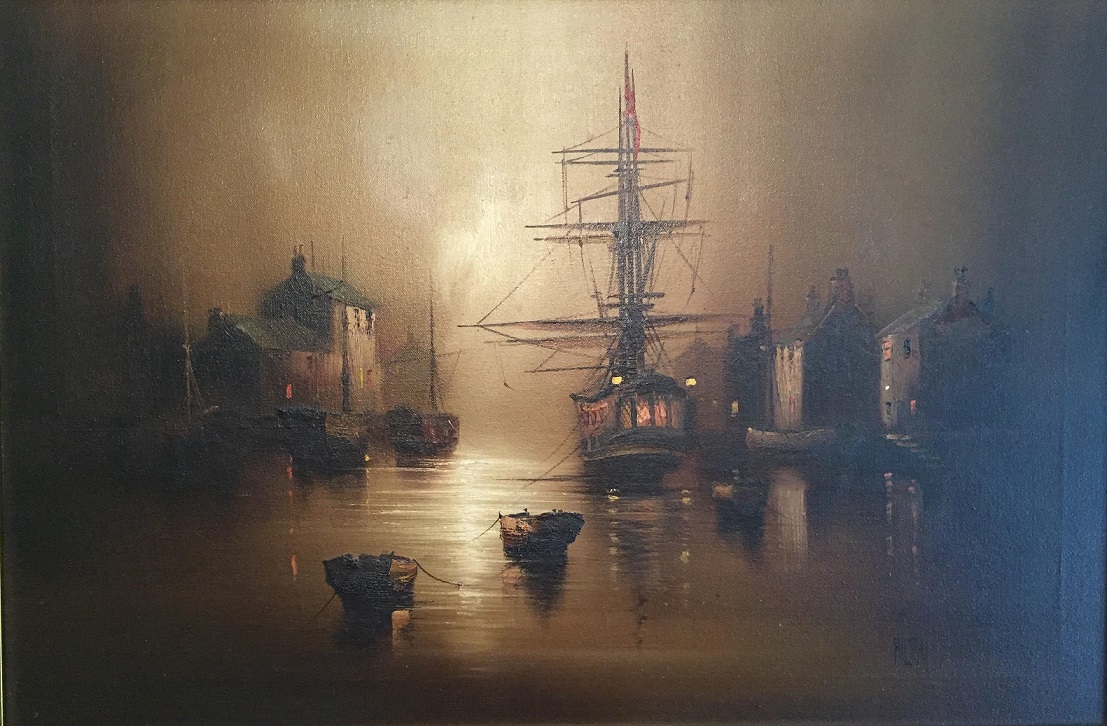
01 Work, Marine Art, Barry Hilton's Sleeping Galleons, With Footnotes, #316

Barry Hilton, (b. 1941)
Sleeping Galleons
Oil on canvas
L 64cm x W 90cm
Private collection

A traditionally serene example of Barry Hilton’s marine artworks, often depicting large Galleons of the 18th century in a similarly traditional style. The artwork conveys a tranquil tone with a mysterious tone that underlies the large scale oil on canvas. Barry’s dark and earthy tones and muted palette convey an eeriness that he seamlessly captures in the overarching tone and dark atmosphere. More on this painting

Barry Hilton was born 1941 in Manchester UK. Whilst having no formal training, he moved to Cornwall in 1979 where the experience of working alongside a group of extremly active artists helped in the development of his artistic abilities. His love of nostalgia which he captures in his paintings of Gas Light Streets and Marine scenes are much sought after and are well represented in privat galleries throughout the UK.

Drawing inspiration from the land and the Northwest coastal regions with regular visits to Cornwall where he lived for 3 years, he paints in style which he has perfected over a number of years with finely painted skies in sharp contrast with a heavy textured foregrounds.

Colour is used more as a tool with which to interpret a scene, these can vary from vibrant reds and yellows, to almost apocalyptic greys, indigo blues and dark greens. The work does not duplicate the actual colours of the landscape, but rather conveys the creative imagination of a genuine and artistic talent.

Barry says: “I still operate on the less is more principle. My subject matter of coastal and interior countryside is largely derived from where I live but I am now making trips to very different areas, recently back to Cornwall, and the Yorkshire Dales which will he believes will lead him into a more abstract approach to his paintings. More on Barry Hilton


Please visit my other blogs: Art CollectorMythologyMarine ArtPortrait of a Lady, The OrientalistArt of the Nude and The Canals of VeniceMiddle East Artists365 Saints365 Days, and Biblical Icons, also visit my Boards on Pinterest and my art stores at  deviantart and Aaroko

Images are copyright of their respective owners, assignees or others. Some Images may be subject to copyright

I don't own any of these images - credit is always given when due unless it is unknown to me. if I post your images without your permission, please tell me.

Ads are shown only to compensate the hosting expenses.

If you enjoyed this post, please share with friends and family.

Thank you for visiting my blog and also for liking its posts and pages.

Please note that the content of this post primarily consists of articles available from Wikipedia or other free sources online.

01 Marine Art, James Browning Wyeth's Surf Watchers, with Footnotes #308

Jamie Wyeth, b.1946
Surf Watchers, c. 1976
Watercolor on paper
26½ by 40 in., 67.3 by 101.6 cm.
Private collection

Sold for 151,200 USD in May 2022

Surf Watchers depicts the artist’s wife, Phyllis Mills Wyeth, leaning out of the Dutch door at the front of their house on Monhegan Island in Maine, where the work was painted. More on this painting

James Browning Wyeth (born July 6, 1946) is a contemporary American realist painter, son of Andrew Wyeth, and grandson of N.C. Wyeth. He was raised in Chadds Ford Township, Pennsylvania, and is artistic heir to the Brandywine School tradition.

Early on, Wyeth became interested in oil painting. What inspired Wyeth most was not the subject matter or technique of his grandfather, but Jamie adopted a wider palette of colors.

Wyeth excels in drawing, lithography, etching, egg tempera, watercolor, and mixed media. Though grounded in this family’s artist tradition and subjects, and bound by the same solitude of his art, his wider travels and experiences have shaped a more rounded artist. In travels to Europe, he studied the Flemish and Dutch masters, and learned the intricate and exacting process of lithography, producing a substantial amount of graphic work.

Since the 1970s, Wyeth has often painted on corrugated cardboard, and now uses "archival" versions of the surface. He likes the rough striated effect it gives to his paintings, and he has also portrayed the material with great fidelity in depictions on conventional canvas. More on James Browning Wyeth


Please visit my other blogs: Art CollectorMythologyMarine ArtPortrait of a Lady, The OrientalistArt of the Nude and The Canals of VeniceMiddle East Artists365 Saints365 Days, and Biblical Icons, also visit my Boards on Pinterest

Images are copyright of their respective owners, assignees or others. Some Images may be subject to copyright

I don't own any of these images - credit is always given when due unless it is unknown to me. if I post your images without your permission, please tell me.

I do not sell art, art prints, framed posters or reproductions. Ads are shown only to compensate the hosting expenses.

If you enjoyed this post, please share with friends and family.

Thank you for visiting my blog and also for liking its posts and pages.

Please note that the content of this post primarily consists of articles available from Wikipedia or other free sources online.

01 Marine Painting - Johan Tirén's Return of the Fishermen, with Footnotes, #385

Johan tirén, "amatörfiskare på hemfärd" (return of the "fishermen").
Johan Tirén, (1853-1911)
Return of the Fishermen
Oil on canvas
81 x 65 cm.
Private collection

Sold for 5,300 USD in June 2020

Johan Tirén (12 October 1853, Själevad - 24 August 1911, Länna Parish, Uppland) was a Swedish painter who specialized in scenes of the rural life in Northern Sweden.

He originally attended the Tekniska skolan in Stockholm then spent the years 1877 to 1880 at the Royal Swedish Academy of Fine Arts, where he won a Royal Medal in 1880. 

After studying in Norrland in 1881, he was able to obtain a scholarship and used it to make a study trip; visiting the Netherlands, Belgium, Paris and Upper Bavaria. While in Rome, he received orders from the Academy Director to begin studies in Munich. Instead he returned to Paris and studied with Jean-Léon Gérôme, but found himself uninspired to paint by what he saw there. When his travel allowance was not extended, he settled in Jämtland, where he painted landscapes and scenes from the lives of the Sami people. More on Johan Tirén


Please visit my other blogs: Art CollectorMythologyMarine ArtPortrait of a Lady, The OrientalistArt of the Nude and The Canals of VeniceMiddle East Artists365 Saints365 Days, and Biblical Icons, also visit my Boards on Pinterest

Images are copyright of their respective owners, assignees or others. Some Images may be subject to copyright

I don't own any of these images - credit is always given when due unless it is unknown to me. if I post your images without your permission, please tell me.

I do not sell art, art prints, framed posters or reproductions. Ads are shown only to compensate the hosting expenses.

If you enjoyed this post, please share with friends and family.

Thank you for visiting my blog and also for liking its posts and pages.

Please note that the content of this post primarily consists of articles available from Wikipedia or other free sources online.


01 Marine Painting - Philip Lodewijk Jacob Frederik Sadée's Bringing in the catch, with Footnotes #383

Philip Lodewijk Jacob Frederik Sadée, (DUTCH, 1837-1904)
Bringing in the catch
Oil on canvas
81 x 130.5cm (31 7/8 x 51 3/8in)
Private collection

Estimated for £30,000 - £50,000 in June 2020

Philip Lodewijk Jacob Frederik Sadée (7 February 1837 The Hague – 14 December 1904 The Hague) was an artist who belonged to the Hague School.

Sadée started painting at the age of 20. He studied in The Hague both at the Academy and in the studio of J E J van den Berg (1802–1861). In 1866 with his fellow student Julius van de Sande Bakhuyzen. Sadée travelled to Düsseldorf where he studied for some months. He began painting biblical scenes and history paintings and later he focused on daily life. In Scheveningen he came into contact with the fisherman's life. Here he was fascinated with the beach and the dunes, which were a source of inspiration for him. Typical of Sadée are the bright colors.

Sadée travelled widely, he painted in the Pas de Calais and travelled in France, Germany, Belgium and Italy. Sadée exhibited in Amsterdam, Rotterdam and The Hague in the years 1853–1903, and was elected to the Arte et Amicitiae in Amsterdam. He taught at the Academy in The Hague and numbered Hendrikus M. Horrix (1845–1923) amongst his pupils. More on Philip Lodewijk Jacob Frederik Sadée


Please visit my other blogs: Art CollectorMythologyMarine ArtPortrait of a Lady, The OrientalistArt of the Nude and The Canals of VeniceMiddle East Artists365 Saints and 365 Days, also visit my Boards on Pinterest

Images are copyright of their respective owners, assignees or others. Some Images may be subject to copyright

I don't own any of these images - credit is always given when due unless it is unknown to me. if I post your images without your permission, please tell me.

I do not sell art, art prints, framed posters or reproductions. Ads are shown only to compensate the hosting expenses.

If you enjoyed this post, please share with friends and family.

Thank you for visiting my blog and also for liking its posts and pages.

Please note that the content of this post primarily consists of articles available from Wikipedia or other free sources online.


01 Marine Painting - Newell Convers Wyeth's The Raft of Odysseus, with Footnotes #381

Newell Convers Wyeth (1882-1945)
The Raft of Odysseus (Neptune Battles with Odysseus), c. 1929
Oil on canvas
48 x 38 in. (121.9 x 96.5 cm.)
Private collection

Sold for USD 425,000 in May 2016

A vivid jewel tone palette covers much of the canvas, with striking turquoises, emeralds and violets applied in brushwork that suggests movement in both the intense swelling of the sea and storm clouds swarming above. The ominous dark clouds are a stark contrast to the white foam of the wave that looms over Odysseus. The composition echoes Pyle’s teachings as well; Odysseus, the main protagonist in the story, is in the foreground as he clings to the raft with its broken mast jutting out from the water, while Neptune is positioned at a diagonal that continues from Odysseus through the wave to the upper right. The result of Wyeth’s adept work in The Raft of Odysseus (Neptune Battles with Odysseus) is a powerful image that brings to life for readers the mythical drama of this significant piece of literature. More on this painting

Newell Convers Wyeth (October 22, 1882 – October 19, 1945), known as N. C. Wyeth, was an American artist and illustrator. He was the pupil of artist Howard Pyle and became one of America's greatest illustrators. During his lifetime, Wyeth created more than 3,000 paintings and illustrated 112 books, 25 of them for Scribner's, the Scribner Classics, which is the work for which he is best known. The first of these, Treasure Island, was one of his masterpieces and the proceeds paid for his studio. Wyeth was a realist painter at a time when the camera and photography began to compete with his craft. Sometimes seen as melodramatic, his illustrations were designed to be understood quickly. Wyeth, who was both a painter and an illustrator, understood the difference, and said in 1908, "Painting and illustration cannot be mixed—one cannot merge from one into the other."

He is the father of Andrew Wyeth and the grandfather of Jamie Wyeth, both well-known American painters. More on Newell Convers Wyeth


Please visit my other blogs: Art CollectorMythologyMarine ArtPortrait of a Lady, The OrientalistArt of the Nude and The Canals of VeniceMiddle East Artists365 Saints365 Days, and Biblical Icons, also visit my Boards on Pinterest

Images are copyright of their respective owners, assignees or others. Some Images may be subject to copyright

I don't own any of these images - credit is always given when due unless it is unknown to me. if I post your images without your permission, please tell me.

I do not sell art, art prints, framed posters or reproductions. Ads are shown only to compensate the hosting expenses.

If you enjoyed this post, please share with friends and family.

Thank you for visiting my blog and also for liking its posts and pages.

Please note that the content of this post primarily consists of articles available from Wikipedia or other free sources online.


01 Marine Painting - Raoul Dufy's THE PIER IN LE HAVRE, with Footnotes, #379

Raoul Dufy, 1877 - 1953,
THE PIER IN LE HAVRE, circa 1924-25.
Oil on canvas
65.1 x 81 cm; 25⅝ x 31⅞ in.
Private collection

Sold for 200,000 EUR in June 2020

In 1885, the Florentine father named Guéroult installed the Bains de la Falaise on the current site of the regatta palace. The establishment was very popular with residents. They took advantage of beach huts, canvas tents and the pier that allowed high tide to reach the sea without stepping on the pebbles. The Sainte-Adresse pier was a source of inspiration for many painters at the start of the 20th century. 

Raoul Dufy was born in Le Havre, a city that remained a constant source of inspiration for his painting. While he continued to paint the harbour and its activity between 1900 and 1904, Dufy also began showing interest in seaside recreation as early as 1901. The busy pier with people strolling out to the sea remained a focus of his work until the 1920s. While the early versions on this subject are marked by lively strokes similar to certain works by Boudin, Dufy soon turned his attention to the geometry of wood constructions, the shapes of which could be conveyed by variations in colour. More on this painting

Raoul Dufy (3 June 1877 – 23 March 1953) was a French Fauvist painter, brother of Jean Dufy. He developed a colorful, decorative style that became fashionable for designs of ceramics and textiles, as well as decorative schemes for public buildings. He is noted for scenes of open-air social events. He was also a draftsman, printmaker, book illustrator, scenic designer, a designer of furniture, and a planner of public spaces. More on Raoul Dufy


Please visit my other blogs: Art CollectorMythologyMarine ArtPortrait of a Lady, The OrientalistArt of the Nude and The Canals of VeniceMiddle East Artists365 Saints365 Days, and Biblical Icons, also visit my Boards on Pinterest

Images are copyright of their respective owners, assignees or others. Some Images may be subject to copyright

I don't own any of these images - credit is always given when due unless it is unknown to me. if I post your images without your permission, please tell me.

I do not sell art, art prints, framed posters or reproductions. Ads are shown only to compensate the hosting expenses.

If you enjoyed this post, please share with friends and family.

Thank you for visiting my blog and also for liking its posts and pages.

Please note that the content of this post primarily consists of articles available from Wikipedia or other free sources online.

01 Marine Painting - Willem Hendrik Eickelberg's BUSY FISHERFOLK, with Footnotes #380

Willem Hendrik Eickelberg, Dutch, 1845 - 1920
BUSY FISHERFOLK 
Oil on canvas
21⅜ by 28½in.; 54.3 by 72.4 cm
Private collection

Estimated for 6,000 - 8,000 USD in October 2020

Willem Hendrik Eickelberg was born in Amsterdam, The Netherlands in 1845. Although he never obtained the recognition he deserved from a larger public, we know a lot of works from his hand have survived the years. He recieved his education at the Royal Academy of Arts in Amsterdam, after which he started working on landscapes, cityviews and beaches in an impressionistic style. Occasionally his winter landscapes can be viewed as highly idealized and even romantic. His cityscapes and beach scenes are depicted in a more realistic way and tend to give an impression of his time of living perfectly. Until 1878 Eickelberg lived and worked as a painter in Amsterdam. After having lived in a number of other cities, he settled down in Blaricum(1904) and eventually in Hilversum. More on Willem Hendrik Eickelberg


Images are copyright of their respective owners, assignees or others. Some Images may be subject to copyright

I don't own any of these images - credit is always given when due unless it is unknown to me. if I post your images without your permission, please tell me.

I do not sell art, art prints, framed posters or reproductions. Ads are shown only to compensate the hosting expenses.

If you enjoyed this post, please share with friends and family.

Thank you for visiting my blog and also for liking its posts and pages.

Please note that the content of this post primarily consists of articles available from Wikipedia or other free sources online.

04 Marine Photographs - Kasia Derwinska's Neighborhood, House with the ocean view, Summer shelter and Now or never, with Footnotes #377

Kasia Derwinska, Spain
Neighborhood
Color, Digital, Manipulated, Photo, Paint on Paper
19.7 W x 19.7 H x 0 in

Priced at C$1,280 as of May, 2023

Kasia Derwinska, Spain
House with the ocean view
Photography, Color on Paper
33.5 W x 33.5 H x 0 D in

Priced at C$1,663 as of May, 2023

Kasia Derwinska, Spain
Summer shelter
Mixed Media, Digital on Paper
15.7 W x 15.7 H x 0 D in

Priced at C$1,003 as of May, 2023

Kasia Derwinska, Spain
Now or never
Photography, Color on Paper
15.7 W x 15.7 H x 0 D in

Priced at C$977 as of May, 2023

Kasia Derwinska "Photography is my way of communicating with the world. In my work, I talk about own experiences, thoughts, doubts, fears and hopes trying to reflect my own life's path. In addition to my experiences, my creations are inspired by night dreams as since childhood I remember most of them and I believe that dreams are the most simbolic language of our subconscious, a guide to navigate in the modern world. I am autodidactic and I don´t recognize myself as a photographer. I use photography as a tool, like a brush for painting or an instrument to play music. My work is an attempt to connect substantiality of the world that surrounds us with elusiveness of feelings and thoughts. For that reason I describe my creations as building a bridge between the visible and the invisible. My works are divided in four basic series: fairytales and fantasies, conceptual black and white, night dreams, and the color serie called "who sings, frightens away his fears"  More on Kasia Derwinska


Please visit my other blogs: Art CollectorMythologyMarine ArtPortrait of a Lady, The OrientalistArt of the Nude and The Canals of VeniceMiddle East Artists365 Saints365 Days, and Biblical Icons, also visit my Boards on Pinterest

Images are copyright of their respective owners, assignees or others. Some Images may be subject to copyright

I don't own any of these images - credit is always given when due unless it is unknown to me. if I post your images without your permission, please tell me.

I do not sell art, art prints, framed posters or reproductions. Ads are shown only to compensate the hosting expenses.

If you enjoyed this post, please share with friends and family.

Thank you for visiting my blog and also for liking its posts and pages.

Please note that the content of this post primarily consists of articles available from Wikipedia or other free sources online.


01 Marine Painting - Pierre Puvis de Chavannes' Le pauvre pêcheur/ The Poor Fisherman, with Footnotes #376

Pierre Puvis de Chavannes, (1824–1898) 
Le pauvre pêcheur/ The Poor Fisherman, c. 1881
Oil on canvas
Height: 155.5 cm (61.2 in); Width: 192.5 cm (75.7 in)
Musée d'Orsay

The Poor Fisherman was the first of Puvis de Chavannes' paintings to be bought by the State. But the work sparked a lively reaction at the Salon of 1881 and was not bought until 1887 when it was again shown to the public. It took six years for a national museum to dare to show this radical painting that was so unrealistic in the light of the conventions of the time.

Without recourse to literal description, Puvis intended to give a view of desolation and resignation by painting a widower and his two children in a bleak landscape. The choice of the fisherman has obvious Biblical resonances. In 1881, the synthetic nature of the painting, its refusal of any modelling and traditional perspective, and its range of greenish hues, ranged most of the critics against the artist.

The writer Huysmans compared it to a picture from missal or the dull, flat frescoes of the past. On the other hand, some artists of the younger generation, from Seurat to Gauguin and Maurice Denis, not to mention Picasso, were enthusiastic over the extreme, poignant bareness of this silent image. Puvis became the leading light of the new style of painting. More on this painting

Pierre Puvis de Chavannes (14 December 1824 – 24 October 1898) was a French painter best known for his mural painting, who came to be known as 'the painter for France'. He became the co-founder and president of the Société Nationale des Beaux-Arts, and his work influenced many other artists, notably Robert Genin. Puvis de Chavannes was a prominent painter in the early Third Republic. Émile Zola described his work as "an art made of reason, passion, and will" More on Pierre Puvis de Chavannes


Please visit my other blogs: Art CollectorMythologyMarine ArtPortrait of a Lady, The OrientalistArt of the Nude and The Canals of VeniceMiddle East Artists365 Saints365 Days, and Biblical Icons, also visit my Boards on Pinterest

Images are copyright of their respective owners, assignees or others. Some Images may be subject to copyright

I don't own any of these images - credit is always given when due unless it is unknown to me. if I post your images without your permission, please tell me.

I do not sell art, art prints, framed posters or reproductions. Ads are shown only to compensate the hosting expenses.

If you enjoyed this post, please share with friends and family.

Thank you for visiting my blog and also for liking its posts and pages.

Please note that the content of this post primarily consists of articles available from Wikipedia or other free sources online.

A note to the readers of Zaidan Gallery

      A note to the readers of Zaidan Gallery It is with great sadness that we share the news that the author of this blog,  Henry Zaidan (1...