01 Classic Works of Art, Marine Paintings - With Footnotes, #76

Charles Edward Dixon
'An Elizabethan Trader'
Watercolour
19 x 13in.
Private collection

European exploration of other continents began well before the Elizabethan Era, the period associated with the reign of Queen Elizabeth I (1558–1603) that is often considered to be a golden age in English history. Since Italian explorer Marco Polo (1254–1324) first ventured to Asia in 1266, Europe had enjoyed the exotic merchandise and foods of the faraway lands of China (then called Cathay), India, and the Spice Islands (the Moluccas). For centuries Europeans traveled to these distant markets by land, but in the early 1400s, Middle Eastern natives denied Europeans access to the overland route. Unable to acquire valued goods, Europeans had but one option: to turn to the uncharted oceans. They embarked upon the most significant period of ocean exploration in history.


England was a latecomer to overseas exploration. When Elizabeth (1533–1603) became queen in 1558, the island nation had no available routes for trading in Africa, Asia, or the New World, and it ruled no overseas colonies. Soon, however, independent traders and adventurers of Elizabethan England challenged the great European sea powers and claimed for England a growing, international trade route extending across the known limits of the world. More on An Elizabethan Traders

Charles Edward Dixon (8 December 1872 - 12 September 1934) was a British maritime painter of the late nineteenth and early twentieth centuries, whose work was highly successful and regularly exhibited at the Royal Academy. Several of his paintings are held by the National Maritime Museum and he was a regular contributing artist to magazines and periodicals. He lived at Itchenor in Sussex and died in 1934. More on Charles Edward Dixon


Images are copyright of their respective owners, assignees or others. Some Images may be subject to copyright

We do not sell art, art prints, framed posters or reproductions. Ads are shown only to compensate the hosting expenses.

If you enjoyed this post, please share with friends and family.

01 Classic Works of Art, Marine Paintings - With Footnotes, #74

Raymond Massey, British/American, b. 1938 
Ferry to Brooklyn, New Amsterdam in 1660, 1981 
Oil on Masonite 
25 7/8 x 42 inches (65.8 x 106.6 cm) 
Private collection

New Amsterdam was a 17th-century Dutch settlement established at the southern tip of Manhattan Island that served as the seat of the colonial government in New Netherland. The fort was situated on the strategic southern tip of the island of Manhattan and was meant to defend the fur trade operations of the Dutch West India Company in the North River (Hudson River). In 1624, it became a provincial extension of the Dutch Republic and was designated as the capital of the province in 1625.

New Amsterdam was renamed New York on September 8, 1664, in honor of the Duke of York, in whose name the English had captured it. After the Second Anglo-Dutch War of 1665–1667, England and the United Provinces of the Netherlands agreed to the status quo in the Treaty of Breda. The English kept the island of Manhattan, the Dutch giving up their claim to the town and the rest of the colony, while the English formally abandoned the island of Run in the East Indies to the Dutch, confirming their control of the valuable Spice Islands. Today much of what was once New Amsterdam is New York City. More on New Amsterdam

Born in Newscastle-on-Tyne, England, Raymond A. Massey is a self-taught artist who came to the United States when he was 10 and made his home in Buffalo, New York since the age of 14. A member of the Nautical Research Guild, he was elected an artist member of the American Society of Marine Artists, which was established in 1978 to encourage the preservation and appreciation of maritime history through art. 

Massey’s works have appeared in numerous art shows and galleries from coast-to-coast in the United Stares, and Canada. 


He is also published a number of books, and once wrote about historic Buffalo for the Buffalo Courier Express and illustrated historic Buffalo features in that newspaper. More on Raymond A. Massey 


Images are copyright of their respective owners, assignees or others. Some Images may be subject to copyright

We do not sell art, art prints, framed posters or reproductions. Ads are shown only to compensate the hosting expenses.

If you enjoyed this post, please share with friends and family.

04 Classic Works of Art, Marine Paintings - With Footnotes, #95

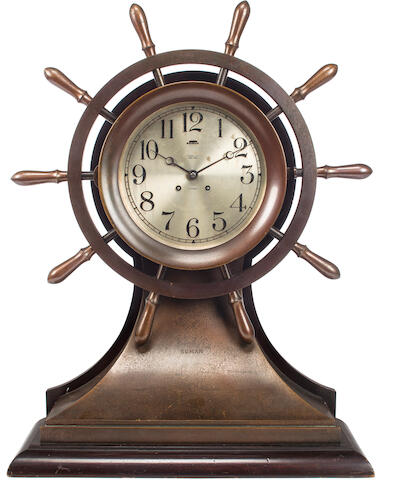
A 8-1/2 inch "Mariner" clock for the yacht Sumar circa 1926 25 x 20 x 8-1/2 in. (63.5 x 50.8 x 21.5 cm.), height x width x depth.
A 8-1/2 inch "Mariner" clock for the yacht Sumar
Chelsea Clock Co., Boston, MA., for Tiffany and Co., circa 1926
25 x 20 x 8-1/2 in. (63.5 x 50.8 x 21.5 cm.), height x width x depth

Signed below the "12" on the dial "Tiffany & Co.", a Chelsea "Mariner" ship strike, with silvered face, Arabic numerals, slow/fast adjustment, double barrel key wind for the movement and strike, hinged face with a bronzed ten-spoke "ship's wheel" fiited to the casement, with supporting pedestal on a mahogany base.

Luca Papaluca (Italian, 1890-1934) The American steam yacht Sumar of the New York Yacht Club 16 x 26 in. (40.6 x 66 cm.) [not examined out of the frame]
Luca Papaluca (Italian, 1890-1934)
The American steam yacht Sumar of the New York Yacht Club
inscribed at the center "-Sumar.N.Y.Y.C.-"
signed lower right: "L. Papaluca"
watercolor, pastel, and gouache on paper
16 x 26 in. (40.6 x 66 cm.)

The yacht Sumar was commissioned by David C. Whitney (1865-1942) of Grosse Point, Detroit Michigan and named for his wife Susan Marshall. It was built of steel by the Todd Shipyards Corporation in Brooklyn NY.

The vessel was built in 1926 and was 160 feet long. Propulsion was by twin diesel engines which turned two propellers and produced 13 knots. The naval architect was Henry J. Gielow. Her beam was 26 feet and tonnage 319. The engines were built by Cooper-Bessemer and developed 420 horsepower. The vessel was manned by a crew of 21. In 1927 her captain was B. Madsen and in May she was in transit from Manila to Colombo Sri Lanka via Singapore.

By April 1931 the Sumar had logged 85,000 nautical miles of cruising, including a circumnavigation of the planet. She ranged from the east and west coasts of the Americas, the Mediterranean and Black Seas, the British Isles, Scandinavia, and the Caribbean. The first part of her route took her to Port of Spain, Rio, Montevideo, then to Hammerfest Norway. Her captain in 1930 was Barney, who had skippered the British war prize Germania and been responsible for 104 idle Hog Island-built ships for two years.

Sometime before June 1942 the Sumar was sold to the British and commissioned as HMS Sumar. In Bermuda she was listed as an anti-submarine vessel and was at one point under the command of Lieutenant Commander C. A. King, DSC, RNR. In July 1941 she was simply fitting out in Bermuda, but appears to have stayed there. The Sumar was based at Her Majesty’s Dockyard in Bermuda.

HMS Sumar’s commander was Lieutenant Gordon Emerson Kernohan of the Royal Canadian Naval Voluntary Reserve. A 1926 graduate of Upper Canada College. He was one of the survivors when the armed merchant cruiser (AMC) HMS Forfar (F 30) was sunk on the 2nd of December 1940 by Otto Kretschmer in U-99 west of Ireland. 172 of her complement of 193 perished.

Rear Admiral Jules James, officer in charge of the Naval Operating Base, Bermuda, ordered the USS Gannet and HMS Sumar to rescue the 65 survivors. Several aircraft were sent to the site of the sinking from Bermuda as well.


USS Gannet (AVP 8), 
built in 1918 and sunk on 7 June 1942 by U-653 under Gerhard Feiler.

The USS Gannet was expecting a corvette to rendezvous with her five nautical miles east of what is now Gibbs Hill Light. Instead was unpleasantly surprised to find the converted yacht Sumar. It had no common communications signals, or working sonar, and both the radio and compass on the Sumar were defective. The resultant erratic changes in course made the Sumar yaw so much that Nuessle wryly observed she might has well have been zig zagging.

The converted yacht could only make 10 knots, and so the USS Gannet took up station, laboriously trying to stay within 500 yards of its companion during the voyage northwards. In order to stay in contact with each other, both ships rigged lights for the other to see, making them easier prey to lurking submarines. Since the airplanes found no survivors from the Westmoreland (they had already been rescued), at 1:00 pm on the 6th of June both navy ships were ordered back to Bermuda. By then they had sailed into the sites of a German U-boat, U-653 under Kapitänleutnant (later Korvettenkapitän) Gerhard Feiler.

Feiler was a determined adversary, however he underestimated the draft of the two ships he was aiming for. He lined up his torpedo shots at 4:20 am on the 7th of June. Remarkably, all four shots missed the mark. He fired another pair of torpedoes, set for just 2 meters depth. After 38 seconds he wrote that “Tender blows up immediately, presumably the magazine. Once the explosion cloud has cleared we can see only small pieces of sinking wreckage, debris from the blast is spread far and wide.” He noted that the HMS Sumar turned and headed towards the U-boat and observed seeing “emergency signals for about 10 min.”

Apparently HMS Sumar didn’t see the emergency signals, or mistook them for more mundane communications from her escort, as the ship motored on for Bermuda, arriving there without the USS Gannet the following day and causing a damaging rift between the American and British navies.

HMS Sumar was used as a training ship in 1944 and sold out of the service in 1946.


Luca Papaluca, The Elder (1890-1932). An Italian pier-head painter, working primarily in Port Naples, Italy. His works are primarily in gouache with the ship's name in print centered.  Mt. Vesuvius is a common background element. Sometimes he painted a pair of paintings depicting the same vessel in fair and stormy weather.

“The David C. Whitney Yacht ‘Sumar’ named after his wife, Susan Marshall Whitney." 
Grosse Pointe (Michigan) 
Historical Society 


Acknowledgment: Uboats Bermuda,

Images are copyright of their respective owners, assignees or others. Some Images may be subject to copyright

I do not sell art, art prints, framed posters or reproductions. Ads are shown only to compensate the hosting expenses.


If you enjoyed this post, please share with friends and family.


01 Classic Works of Art, Marine Paintings - With Footnotes, #73

Franz HĂĽnten Hamburg, 1822 - Hamburg 1887 
The W. Schernikau off Heligoland, c. 1860
Oil/canvas
50,5 x 71,5 cm
Private collection

Heligoland is a small German archipelago in the North Sea. The islands were at one time Danish and later British possessions.

The islands are located in the Heligoland Bight are in the southeastern corner of the North Sea. They are the only German islands not in the immediate vicinity of the mainland. They lie approximately 69 kilometres from Cuxhaven at the mouth of the River Elbe. More on Heligoland

Franz Johann Wilhelm HĂĽnten (born May 2, 1822 in Hamburg , † March 2, 1887 ibid) was a German marine painter of the DĂĽsseldorf School .

After an apprenticeship as a decorative painter, HĂĽnten became a student of Friedrich Heimerdinger in Hamburg. Thanks to a scholarship, he attended the Kunstakademie DĂĽsseldorf , where he was a student in the landscape class of Johann Wilhelm Schirmer in the years 1847/1848 . He was a private pupil of the slightly older DĂĽsseldorf marine painter Hermann Mevius , with whom he went on study trips to the North Sea coast. In 1850 he returned to Hamburg. From there he undertook study trips to Scandinavia, England, Scotland, the Atlantic and the Orient. In 1887 he died in Hamburg-EimsbĂĽttel . More on Franz Johann Wilhelm HĂĽnten


Images are copyright of their respective owners, assignees or others. Some Images may be subject to copyright

We do not sell art, art prints, framed posters or reproductions. Ads are shown only to compensate the hosting expenses.

If you enjoyed this post, please share with friends and family.
01 Classic Works of Art, Marine Paintings - With Footnotes, #72

Cezary Kielar, Netherlands
Girl at the seaside
Oil on Canvas
19.7 H x 23.6 W x 0.8 in

Cezary Kielar, Netherlands: "I take pictures, draw and paint ... At the moment I paint portraits, but there is a kind of ambiguity in it. The appearance of the figures has often symbolic value, so there are no faces, no eyes, they are "backside" portraits, there are not "real" portraits. Painting is my language, though my paintings are based on photography. But it is very important that my work is "made by hand" and not only by hand - it involves everything in me: receptivity, feeling, thought, sensibility and the painting skill. The artificial image, as the photograph, is just really not sufficient for me to express the vulnerability of being. As I paint fairly intuitive, I newer know what will be end of the process. The formal solutions I choose for the images, are kept simple to intensify the impact. I'm deliberately "slowing down" formally, in search for the simple stable elements to facilitate sincere focus. I use quiet colors in limited palette to support the image and not to distract from it. In the matter of fact, the paintings are about human condition, the essence of all creation. That is how it is looks from my side, the other side of the painting's life is in the eye of the beholder. More on Cezary Kielar


Images are copyright of their respective owners, assignees or others. Some Images may be subject to copyright

We do not sell art, art prints, framed posters or reproductions. Ads are shown only to compensate the hosting expenses.

If you enjoyed this post, please share with friends and family.

01 Classic Works of Art, Marine Paintings - With Footnotes, #71

Zena Holloway, United Kingdom
Sea Dance 1
Photography
23.2 H x 16.5 W x 0.1 in

Haenyeo (sea women) are female divers in the Korean province of Jeju. Known for their independent spirit, iron will and determination, the haenyeo are representative of the semi-matriarchal family structure of Jeju.

Jeju’s diving tradition dates back to 434 A.D. Originally, diving was an exclusively male profession, with the exception of women who worked alongside their husbands. The first mention of female divers in literature does not come until the 17th century when a monograph of Jeju geography describes them as jamnyeo (“diving women").

In the 17th century, a significant number of men died at sea due to war or deep-sea fishing accidents, meaning that diving became the work of women. Physiologically, women have more subcutaneous fat and a higher shivering threshold than men, making them more equipped to withstand cold waters. An 18th-century document records that taxes of dried abalone were imposed on ordinary people, forcing many women to dive in cold waters while pregnant.

As sea diving became a female-dominated industry, many of the haenyeo subsequently replaced their husbands as the primary laborer. This trend was especially prominent after the Japanese colonized Korea in 1910 and diving became much more lucrative. Up until this point, much of what the haenyeo harvested was given to the Choson government as tribute. When the Japanese took over, however, they abolished this tradition, allowing haenyeo to sell their catch at market and make a profit.[ Additionally, Japanese and Korean merchants hired haenyeo to work for them in Japan and on the Korean mainland as wage-laborers. More on the Haenyeo

Zena Holloway (born 1973 in Bahrain) is an underwater photographic artist living in London. Her work deviates from the stereotypical imagery associated with underwater photography. For Holloway the underwater landscape serves as a backdrop, using cinematic drama and painterly aesthetics, she directs her models along themes of universal human experiences: love, loss, intimacy and romance. Her recent work Flowers for Jeju : The Last Mermaids focuses on the historical and spiritual tradition of the Haenyeo of South Korea. Alongside her dedication to long-term personal projects, she is a regular contributor to editorial, for publications such as The Sunday Times Magazine, Paris Match and the FT. Her work is exhibited globally and she has been the recipient of many international photographic and film awards. More on Zena Holloway


Please visit my other blogs: Art CollectorMythologyMarine ArtPortrait of a Lady, The OrientalistArt of the Nude and The Canals of VeniceAnd visit my Boards on Pinterest

Images are copyright of their respective owners, assignees or others. Some Images may be subject to copyright

I don't own any of these images - credit is always given when due unless it is unknown to me. if I post your images without your permission, please tell me.

I do not sell art, art prints, framed posters or reproductions. Ads are shown only to compensate the hosting expenses.

If you enjoyed this post, please share with friends and family.


Thank you for visiting my blog and also for liking its posts and pages.

01 Classic Works of Art, Marine Paintings - With Footnotes, #70

JOY LAVILLE
Figures on sand bar and fish, c. 1984
Gouache on paper
43 x 64 cm / 16 x 25 inches. 
Private Collection

Joy Laville (born September 8, 1923) is an English/Mexican artist whose art career began and mostly developed in Mexico when she came to the country to take art classes in San Miguel de Allende. While there she met Mexican writer Jorge IbargĂĽengoitia, whom she married in 1973. During this time her art career developed mostly in pastels with a reflective quality. In 1983, IbargĂĽengoitia died in a plane crash in Spain and Laville’s painting changed dramatically. Since that time, her work has focused on the loss of her husband, directly or indirectly with themes of finality, eternity and wondering what more is there. Her work has been exhibited in Mexico and abroad including the Palacio de Bellas Artes and the Museo de Arte Moderno. In 2012, she received the Bellas Artes Medal for her life’s work. More on Joy Laville


Images are copyright of their respective owners, assignees or others. Some Images may be subject to copyright

We do not sell art, art prints, framed posters or reproductions. Ads are shown only to compensate the hosting expenses.

If you enjoyed this post, please share with friends and family.

01 Classic Works of Art, Marine Paintings - With Footnotes, #75

Kasia Derwinska, Spain
The wait was long
Photography
15.7 H x 15.7 W x 0.4 in

Kasia Derwinska "Photography is my way of communicating with the world. In my work, I talk about own experiences, thoughts, doubts, fears and hopes trying to reflect my own life's path. In addition to my experiences, my creations are inspired by night dreams as since childhood I remember most of them and I believe that dreams are the most simbolic language of our subconscious, a guide to navigate in the modern world. I am autodidactic and I don´t recognize myself as a photographer. I use photography as a tool, like a brush for painting or an instrument to play music. My work is an attempt to connect substantiality of the world that surrounds us with elusiveness of feelings and thoughts. For that reason I describe my creations as building a bridge between the visible and the invisible. My works are divided in four basic series: fairytales and fantasies, conceptual black and white, night dreams, and the color serie called "who sings, frightens away his fears"  More on Kasia Derwinska


Images are copyright of their respective owners, assignees or others. Some Images may be subject to copyright

We do not sell art, art prints, framed posters or reproductions. Ads are shown only to compensate the hosting expenses.

If you enjoyed this post, please share with friends and family.

01 Classic Works of Art, Marine Paintings - With Footnotes, #69

Backhuysen, Ludolf, Dutch, 1630 - 1708
Ships in Distress off a Rocky Coast, c. 1667
Oil on canvas
114.3 x 167.3 cm (45 x 65 7/8 in.)
National Gallery of Art

The three cargo ships in this large painting are the type of wide-bellied, seagoing vessels used to transport much of the commodities that generated the wealth of the Dutch in the seventeenth century. Flying the red, white, and blue flag of the Dutch Republic. Each ship has already lost a mast, and flotsam bobbing in the steely gray water in the foreground reveals that at least one ship has been wrecked. All is not yet lost, as the sun breaks through the clouds. More on this painting


Ludolf Bakhuizen (28 December 1630 – 17 November 1708) was a German-born Dutch painter, draughtsman, calligrapher and printmaker. He was the leading Dutch painter of maritime subjects after Willem van de Velde the Elder and Younger left for England in 1672. He also painted portraits of his family and circle of friends.

Bakhuizen was born in Emden, East Frisia, and came to Amsterdam in about 1650, working as a merchant's clerk and a calligrapher. He discovered so strong a genius for painting that he relinquished the business and devoted himself to art from the late 1650s, initially in pen drawings. He studied first under Allart van Everdingen and then under Hendrik Dubbels, two eminent masters of the time, and soon became celebrated for his sea-pieces, which often had rough seas.

During his life Bakhuizen was visited by Cosimo III de' Medici, Peter the Great and also worked for various German princes. In 1699 he opened a gallery on the top floor of the famous Amsterdam townhall. After a visit to England he died in Amsterdam on 17 November 1708. More on Ludolf Bakhuizen


Images are copyright of their respective owners, assignees or others. Some Images may be subject to copyright

We do not sell art, art prints, framed posters or reproductions. Ads are shown only to compensate the hosting expenses.

If you enjoyed this post, please share with friends and family.

01 Classic Works of Art, Marine Paintings, Battle of Lepanto - With Footnotes, #68

Unknown 
Battle of Lepanto of 1571
Oil on canvas
1270 mm x 2324 mm;
, National Maritime Museum, Greenwich, London.

The Battle of Lepanto was a naval engagement that took place on 7 October 1571 when a fleet of the Holy League, of which the Venetian Empire and the Spanish Empire were the main powers, inflicted a major defeat on the fleet of the Ottoman Empire in the Gulf of Patras, where Ottoman forces sailing westward from their naval station in Lepanto met the fleet of the Holy League sailing east from Messina, Sicily. The Holy League was a coalition of European Catholic maritime states arranged by Pope Pius V and led by Adm. John of Austria, as agreed between Philip II of Spain—who largely financed the League—and the Venetian Republic (main contributor of ships).

In the history of naval warfare, Lepanto marks the last major engagement in the Western world to be fought entirely, or almost entirely, between rowing vessels, the galleys and galeasses that were still the direct descendants of the ancient trireme warships. The battle was in essence an "infantry battle on floating platforms". It was the largest naval battle in Western history since classical antiquity, involving more than 400 warships. 


The victory of the Holy League is of great importance in the history of Europe and of the Ottoman Empire, marking the turning-point of Ottoman military expansion into the Mediterranean. More on The Battle of Lepanto


Images are copyright of their respective owners, assignees or others. Some Images may be subject to copyright

We do not sell art, art prints, framed posters or reproductions. Ads are shown only to compensate the hosting expenses.

If you enjoyed this post, please share with friends and family.

RELIGIOUS ART, Bible, Zaidan, Mythology, Religion, Jesus, Christ, 

01 Classic Works of Art, Marine Paintings - With Footnotes, #67

Kasia Derwinska, Spain
He promised to come back
Photography
Size: 15.7 H x 15.7 W x 0.4 in

Kasia Derwinska "Photography is my way of communicating with the world. In my work, I talk about own experiences, thoughts, doubts, fears and hopes trying to reflect my own life's path. In addition to my experiences, my creations are inspired by night dreams as since childhood I remember most of them and I believe that dreams are the most simbolic language of our subconscious, a guide to navigate in the modern world. I am autodidactic and I don´t recognize myself as a photographer. I use photography as a tool, like a brush for painting or an instrument to play music. My work is an attempt to connect substantiality of the world that surrounds us with elusiveness of feelings and thoughts. For that reason I describe my creations as building a bridge between the visible and the invisible. My works are divided in four basic series: fairytales and fantasies, conceptual black and white, night dreams, and the color serie called "who sings, frightens away his fears"  More on Kasia Derwinska


Images are copyright of their respective owners, assignees or others. Some Images may be subject to copyright

We do not sell art, art prints, framed posters or reproductions. Ads are shown only to compensate the hosting expenses.

If you enjoyed this post, please share with friends and family.

A note to the readers of Zaidan Gallery

      A note to the readers of Zaidan Gallery It is with great sadness that we share the news that the author of this blog,  Henry Zaidan (1...