Showing posts with label Charles Edward Dixon. Show all posts

01 Marine Painting - Charles Edward Dixon's The lady, She's a Liner, with Footnotes, #356

Charles Edward Dixon, (1872-1934)
The lady, She's a Liner, c. 1920
Pencil, watercolour and bodycolour, heightened with white on paper
26 5/8 x 52 in. (67.8 x 132 cm.)
Private collection

Charles Edward Dixon (8 December 1872 - 12 September 1934) was a British maritime painter of the late nineteenth and early twentieth centuries, whose work was highly successful and regularly exhibited at the Royal Academy. Several of his paintings are held by the National Maritime Museum and he was a regular contributing artist to magazines and periodicals. He lived at Itchenor in Sussex and died in 1934. More on Charles Edward Dixon


Please visit my other blogs: Art CollectorMythologyMarine ArtPortrait of a Lady, The OrientalistArt of the Nude and The Canals of VeniceMiddle East Artists365 Saints and 365 Days, also visit my Boards on Pinterest

Images are copyright of their respective owners, assignees or others. Some Images may be subject to copyright

I don't own any of these images - credit is always given when due unless it is unknown to me. if I post your images without your permission, please tell me.

I do not sell art, art prints, framed posters or reproductions. Ads are shown only to compensate the hosting expenses.

If you enjoyed this post, please share with friends and family.

Thank you for visiting my blog and also for liking its posts and pages.

Please note that the content of this post primarily consists of articles available from Wikipedia or other free sources online.


01 Classic Works of Art, Marine Paintings - With Footnotes, #76

Charles Edward Dixon
'An Elizabethan Trader'
Watercolour
19 x 13in.
Private collection

European exploration of other continents began well before the Elizabethan Era, the period associated with the reign of Queen Elizabeth I (1558–1603) that is often considered to be a golden age in English history. Since Italian explorer Marco Polo (1254–1324) first ventured to Asia in 1266, Europe had enjoyed the exotic merchandise and foods of the faraway lands of China (then called Cathay), India, and the Spice Islands (the Moluccas). For centuries Europeans traveled to these distant markets by land, but in the early 1400s, Middle Eastern natives denied Europeans access to the overland route. Unable to acquire valued goods, Europeans had but one option: to turn to the uncharted oceans. They embarked upon the most significant period of ocean exploration in history.


England was a latecomer to overseas exploration. When Elizabeth (1533–1603) became queen in 1558, the island nation had no available routes for trading in Africa, Asia, or the New World, and it ruled no overseas colonies. Soon, however, independent traders and adventurers of Elizabethan England challenged the great European sea powers and claimed for England a growing, international trade route extending across the known limits of the world. More on An Elizabethan Traders

Charles Edward Dixon (8 December 1872 - 12 September 1934) was a British maritime painter of the late nineteenth and early twentieth centuries, whose work was highly successful and regularly exhibited at the Royal Academy. Several of his paintings are held by the National Maritime Museum and he was a regular contributing artist to magazines and periodicals. He lived at Itchenor in Sussex and died in 1934. More on Charles Edward Dixon


Images are copyright of their respective owners, assignees or others. Some Images may be subject to copyright

We do not sell art, art prints, framed posters or reproductions. Ads are shown only to compensate the hosting expenses.

If you enjoyed this post, please share with friends and family.

03 Classic Works of Art, Marine Paintings - With Footnotes, #64

Joe Selby, (American, 1893-1960)
Steamship Mary Weems, c. 1926
Oil on board
18 x 25 in
Private collection

The Mary Weems was the first passenger steamer to enter the Port of Palm Beach, and a big deal was made of the event. She was greeted by the mayors of West Palm Beach, Palm Beach, Lake Worth, Riviera Beach and Kelsey City (now Lake Park), together with leaders of area clubs and organizations, “bathing girls, airplanes, yachts and bands,” and a seaplane carrying a reporter and photographer from the Palm Beach Daily News. 

After one day in port, the Mary Weems left for Miami. The Mary Weems made the three-day run from Philadelphia and Baltimore, charging $75.21 for the round trip including “meals and berth.” The ship sported “best cuisine and service” and “every modern convenience” — rooms with twin beds, showers and baths, and hot and cold running water. Built in 1918 at Elizabeth, New Jersey, this ship was originally named the “Plainfield.” She was purchased at some point prior to 1925 by the Baltimore and Carolina Steamship Company and operated as the “Mary Weems”, apparently named after a relative of the owner of the company. She was sold to the Portland California Steamship Company in late 1927, renamed the “Admiral Peopl,” and was operated by the Admiral Line on a Portland to California route between late 1927 and 1933. She was again sold, in 1934, to Northland Transportation Company, who renamed her the “North Sea”. She met her demise when she was stranded on the coast of British Columbia in 1947. More on Steamship Mary Weems,


Charles Edward Dixon
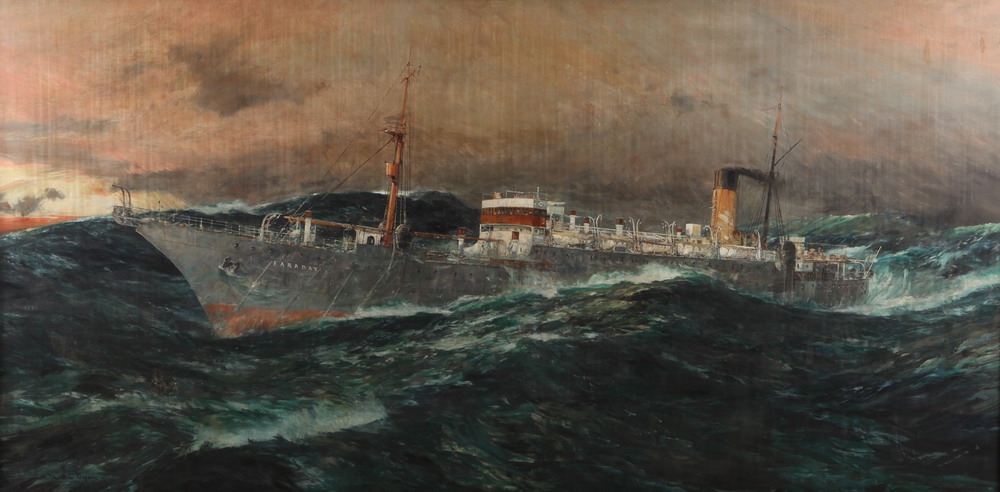
C.S. Faraday in a Gale , 1929
Oil on canvas
48 x 96 in.
Private collection

The CS Faraday was a cable ship built for Siemens Brothers and launched in 1874.

Faraday was specially designed for ocean cable-laying by William Siemens in collaboration with his friend William Froude, the pioneer of hull design. Faraday spent the next 50 years laying an estimated total of 50,000 nautical miles (93,000 km) of cable for Siemens Brothers, including several transatlantic cables. She was sold for scrap in 1924 but proved to be too difficult to break up and was resold to the Anglo-Algiers Coaling Company for use as a coal hulk, being renamed Analcoal. She was moved to Gibraltar in 1931 to store coal and then to become a Royal Navy storeship in Sierra Leone in 1941. She was towed to a South Wales breakers yard for scrap in 1950. More on the CS Faraday 


Charles Edward Dixon (8 December 1872 - 12 September 1934) was a British maritime painter of the late nineteenth and early twentieth centuries, whose work was highly successful and regularly exhibited at the Royal Academy. Several of his paintings are held by the National Maritime Museum and he was a regular contributing artist to magazines and periodicals. He lived at Itchenor in Sussex and died in 1934. More on Charles Edward Dixon


CHEN JUNDE (b.1937, Chinese)
Shandong Beach, c. 2001
Oil on canvas
50 x 70 cm
Private collection

Shandong is home of the legendary Yellow Emperor, the mythical founder of the Chinese empire, Shandong offers a whole spectrum of cultural sites combined with scenic nature. Ancient terra cotta warriors and impressive temples provide an unparalleled insight into the rich history that has unfolded here, with the UNESCO-protected birthplace of Confucius and sacred Mount Tai adding further interest to the area. With a 3,000 km (1,900 mi) long rocky coastline, the province offers great opportunities for water sports, with swimming and sailing among the best things to do in Shandong. Sampling the wine-producing region's local varieties of grape and visiting the capital city, with its 72 famous springs, also add to the experience. More on Shandong

CHEN Junde, Taiwanese, 1937, is from Zhenhai, Zhejiang province. In 1960, he graduated from the School of Art of Shanghai Theatre Academy and now is a professor at the art graduate school of Shanghai Theatre Academy. He is a member of the Oil Painting Committee of the Chinese Artists Association, the managing director of the Chinese Oil Painting Society, and a specially invited painter of the Chinese Fine Arts Creation Academy. He has published many personal oil painting albums. His works are collected by American museums in the Asian-Pacific region, the Japanese Prime Ministers, Shanghai Art Museum and various collectors and institutions from home and abroad. He has held personal exhibitions in China, Hong Kong, Japan, Paris, Singapore, Malaysia, etc and participated in key exhibitions in recent years and has won awards in the second Chinese Oil Painting Exhibition, the eighth and tenth National Fine Arts Exhibition. More on CHEN Junde


Images are copyright of their respective owners, assignees or others

We do not sell art, art prints, framed posters or reproductions. Ads are shown only to compensate the hosting expenses.


If you enjoyed this post, please share with friends and family.


04 Classic Works of Art, Marine Paintings - With Footnotes, #60

Charles Edward Dixon, 1872 - 1934
OFF NEW BRIGHTON , 1899
Watercolour
37 x 55.5cm
Private collection

New Brighton is a seaside resort forming part of the town of Wallasey within the Metropolitan Borough of Wirral in Merseyside. Up to the 19th century, the area had a reputation for smuggling and wrecking, and secret underground cellars and tunnels are still rumoured to exist. It also had a strategic position at the entrance to the Mersey Estuary.

In 1830, a Liverpool merchant, James Atherton, purchased 170 acres (69 ha) of land at Rock Point, which enjoyed views out to sea and across the Mersey and had a good beach. His aim was to develop it as a desirable residential and watering place for the gentry.

During the latter half of the 19th century, New Brighton developed as a very popular seaside resort serving Liverpool and the Lancashire industrial towns, and many of the large houses were converted to inexpensive hotels. A pier was opened in the 1860s, More on New Brighton

Charles Edward Dixon (8 December 1872 - 12 September 1934) was a British maritime painter of the late nineteenth and early twentieth centuries, whose work was highly successful and regularly exhibited at the Royal Academy. Several of his paintings are held by the National Maritime Museum and he was a regular contributing artist to magazines and periodicals. He lived at Itchenor in Sussex and died in 1934. More on Charles Edward Dixon

John Atkinson Grimshaw,  (1836–1893)
Glasgow, Saturday Night
Oil on canvas
60 × 91 cm (23.6 × 35.8 in)
Private collection

Glasgow  is the largest city in Scotland, and third-largest in the United Kingdom. It is situated on the River Clyde in the country's West Central Lowlands. Glasgow is the fourth most visited city in the UK.

Glasgow grew from a small rural settlement on the River Clyde to become the largest seaport in Britain. Expanding from the medieval bishopric and royal burgh, and the later establishment of the University of Glasgow in the fifteenth century, it became a major centre of the Scottish Enlightenment in the eighteenth century. From the eighteenth century onwards, the city also grew as one of Great Britain's main hubs of transatlantic trade with North America and the West Indies. More on Glasgow


John Atkinson Grimshaw (6 September 1836 – 13 October 1893) was an English Victorian-era artist, a "remarkable and imaginative painter" known for his city night-scenes and landscapes.

He was born in Leeds to Mary and David Grimshaw. In 1856 he married his cousin Frances Hubbard (1835–1917). In 1861, at the age of 24, to the dismay of his parents, he left his job as a clerk for the Great Northern Railway to become a painter. He first exhibited in 1862, mostly paintings of birds, fruit and blossom, under the patronage of the Leeds Philosophical and Literary Society. He became successful in the 1870s and rented a second home in Scarborough, which became a favourite subject.


Grimshaw's primary influence was the Pre-Raphaelites. True to the Pre-Raphaelite style, he created landscapes of accurate colour and lighting, vivid detail and realism, often typifying seasons or a type of weather. Moonlit views of city and suburban streets and of the docks in London, Hull, Liverpool and Glasgow also figured largely in his art. His careful painting and his skill in lighting effects meant that he captured both the appearance and the mood of a scene in minute detail. His "paintings of dampened gas-lit streets and misty waterfronts conveyed an eerie warmth as well as alienation in the urban scene. More on John Atkinson Grimshaw


HAMADI MHAMED, b. 1950, Tunisia
Old-port of Bizerte
Oil on canvas
15.7 H x 23.6 W x 0.8 in
Private collection


Bizerte is known as the oldest and most European city in Tunisia. It was founded around 1100 BC by Semitic Phoenicians from Tyre. It is also known as the last town to remain under French control after the rest of the country won its independence from France. More on Bizerte

Hamadi MHAMED is a Tunisian artist born in Bizerte - Tunisia in 19/06/1950. Hamadi has a Diploma in Fine Arts from National Institute of Arts & Technology of Tunis and has worked in different fields of media publishing & interactive events from 1978 until 2011. More on Hamadi MHAMED


Montague Dawson, R.S.M.A., F.R.S.A., 1895-1973
THE PACKET DEVONSHIRE 
Oil on canvas laid down on board 
36 by 28 in., 91.4 by 71.1 cm
Private collection

The present work depicts the packet ship Devonshire. Named for the Duke of Devonshire, it was built in New York in 1848 by Westervelt & Mackey. The first packet ships were built in the eighteenth century and were designed to transport mail between Great Britain and her colonies, as well as passengers and freight. In her first year of frequent sailing between New York and London, Devonshire transported the largest number of cabin passengers ever to cross the Atlantic and garnered much attention as one of the finest examples of naval engineering. More on the  Devonshire

Montague Dawson RMSA, FRSA (1890–1973) was a British painter who was renowned as a maritime artist. His most famous paintings depict sailing ships, usually clippers or warships of the 18th and 19th centuries. Montague was the son of a keen yachtsman and the grandson of the marine painter Henry Dawson (18111878), born in Chiswick, London. Much of his childhood was spent on Southampton Water where he was able to indulge his interest in the study of ships. For a brief period around 1910 Dawson worked for a commercial art studio in Bedford Row, London, but with the outbreak of the First World War he joined the Royal Navy. Whilst serving with the Navy in Falmouth he met Charles Napier Hemy (18411917), who considerably influenced his work. In 1924 Dawson was the official artist for an Expedition to the South Seas by the steam yacht St.George. During the expedition he provided illustrated reports to the Graphic magazine.

After the War, Dawson established himself as a professional marine artist, concentrating on historical subjects and portraits of deep-water sailing ships. During the Second World War, he was employed as a war artist. Dawson exhibited regularly at the Royal Society of Marine Artists, of which he became a member, from 1946 to 1964, and occasionally at the Royal Academy between 1917 and 1936. By the 1930s he was considered one of the greatest living marine artists, whose patrons included two American Presidents, Dwight D Eisenhower and Lyndon B Johnson, as well as the British Royal Family. Also in the 1930s, he moved to Milford-Upon-Sea in Hampshire, living there for many years. Dawson is noted for the strict accuracy in the nautical detail of his paintings which often sell for six figures.

The work of Montague Dawson is represented in the National Maritime Museum, Greenwich and the Royal Naval Museum, Portsmouth. More on Montague Dawson


Images are copyright of their respective owners, assignees or others

We do not sell art, art prints, framed posters or reproductions. Ads are shown only to compensate the hosting expenses.


If you enjoyed this post, please share with friends and family.


04 Classic Works of Art, Marine Paintings - With Footnotes, #57

Charles Edward Dixon, 1872 - 1934
Greenwich , 1905
Watercolour heightened with bodycolour
20.5 x 27 cm
Private collection

Greenwich is located within the Royal Borough of Greenwich, to which it lends its name. Notable for its maritime history and for giving its name to the Greenwich Meridian and Greenwich Mean Time. 

The town became a popular resort in the 18th century. The maritime connections of Greenwich were celebrated in the 20th century, with the siting of the Cutty Sark and Gipsy Moth IV next to the river front, and the National Maritime Museum in the former buildings of the Royal Hospital School in 1934. Greenwich formed part of Kent until 1889 when the County of London was created. More on Greenwich

Charles Edward Dixon (8 December 1872 - 12 September 1934) was a British maritime painter of the late nineteenth and early twentieth centuries, whose work was highly successful and regularly exhibited at the Royal Academy. Several of his paintings are held by the National Maritime Museum and he was a regular contributing artist to magazines and periodicals. He lived at Itchenor in Sussex and died in 1934. More on Charles Edward Dixon

Ralph Hedley, (British, 1851-1913)
Working on the Tyne, Newcastle, 1905
Oil on canvas
40-1/2 x 50 inches (102.9 x 127 cm)
Private collection

Newcastle upon Tyne, commonly known as Newcastle, is a city in Tyne and Wear, North East England. The city developed around the Roman settlement Pons Aelius and was named after the castle built in 1080 by Robert Curthose, William the Conqueror's eldest son. The city grew as an important centre for the wool trade in the 14th century, and later became a major coal mining area. The port developed in the 16th century and, along with the shipyards lower down the River Tyne, was amongst the world's largest shipbuilding and ship-repairing centres. More on Newcastle

Ralph Hedley (31 December 1848 – 14 June 1913) was a realist painter, woodcarver and illustrator, best known for his paintings portraying scenes of everyday life in the North East of England.

Born in Gilling West near Richmond, North Yorkshire, Ralph and his parents moved to Newcastle upon Tyne around 1850, on the wave of industrial opportunity. Aged about 13, he was apprenticed to Thomas Tweedy in his carving workshops, simultaneously studying art and design at the 'Government school' in Newcastle, and attending evening classes at the Life School under William Bell Scott. At the age of 14 he was awarded a bronze medal by government's Department of Art and Science.


After concluding his apprenticeship, Hedley established a successful woodcarving business, whilst also producing lithographs for the local press and taking every opportunity to work as an artist. He had the first of many paintings accepted for exhibition at the Royal Academy in 1879. Joining with Henry Hetherington Emmerson and Robert Jobling, they founded the Bewick Club which encouraged and exhibited the work of the local artists of the North East, staging the first exhibition in 1884. More on Ralph Hedley


Charles Malfroy, (French, 1862-1951)
Vue de Martigues
Oil on canvas
24 x 36-1/4 inches (61.0 x 92.1 cm)
Private collection

Martigues is a commune northwest of Marseilles. It is part of the Bouches-du-Rhône department in the Provence-Alpes-Côte d'Azur region on the eastern end of the Canal de Caronte.

Nicknamed the "Provençale Venice", Martigues is a point of passage between the Mediterranean Sea and the Sea of Martigues, close to the Côte d'Azur. More on Martigues


Charles Malfroy, (French, 1862-1951) was an accomplished French artist who specialized in coastal, marine and landscape painting. He was born in Lyon on the 27th March 1862 and was the father of noted marine artist Henry Malfroy (1895-1942). After completing his formal art training at the Beaux-Arts de Lyon, Malfroy embarked on his artistic career with exhibitions at the Salon in Lyon beginning in 1881.             

Charles Malfroy was an impressionist painter in the manner of important Marseille artist, John Baptiste Olive.  He was the observer of effects of light rendered with both freshness and decision combined with a subtle use of colour. 

Charles Malfroy is in the post-impressionist lineage of Jean-Baptiste Olive . Attracted by the light of the Mediterranean ports, he excels in views of the Côte d'Azur and Bouches-du-Rhône , in particular the port of Martigues . He also painted some paintings of Venice. More on Charles Malfroy

Joaquín Sorolla, 1863 - 1923, SPANISH
TARDE TORMENTOSA (STORMY AFTERNOON), b. 1904
Oil on canvas
48 by 78cm., 19 by 30¾in.
Private collection

Beneath a leaden sky, fishing boats lie grounded on the sand. Either it is the end of the day and the fisherman are preparing to go home, or the day's fishing has been called off due to the rough sea. One of a series of increasingly spontaneous scenes of the beach at Valencia, the freedom of execution and liveliness of spirit that the work exhibits are qualities that go to the heart of Sorolla's aesthetic and account for the artist's enduring popularity. More on this painting

Joaquín Sorolla y Bastida (27 February 1863 – 10 August 1923) was a Spanish painter. Sorolla excelled in the painting of portraits, landscapes, and monumental works of social and historical themes. His most typical works are characterized by a dexterous representation of the people and landscape under the sunlight of his native land. More on Joaquín Sorolla y Bastida


Please visit my other blogs: Art CollectorMythologyMarine ArtPortrait of a Lady, The OrientalistArt of the Nude and The Canals of VeniceMiddle East Artists365 Saints and 365 Days, also visit my Boards on Pinterest

Images are copyright of their respective owners, assignees or others. Some Images may be subject to copyright

I don't own any of these images - credit is always given when due unless it is unknown to me. if I post your images without your permission, please tell me.

I do not sell art, art prints, framed posters or reproductions. Ads are shown only to compensate the hosting expenses.

If you enjoyed this post, please share with friends and family.

Thank you for visiting my blog and also for liking its posts and pages.

Please note that the content of this post primarily consists of articles available from Wikipedia or other free sources online.

04 Classic Works of Art, Marine Paintings - With Footnotes, #55

Charles Edward Dixon
'Victory Opening Fire' at Trafalgar, 1907
Watercolour
18 x 28 cm
Private collection

The Battle of Trafalgar was fought on the 21st of October 1805 off Cape Trafalgar on the Spanish coast, between the combined fleets of Spain and France and the Royal Navy. It was the last great sea action of the period. 

As HMS Victory cleared the French ship she came within range of the Neptune which fired her broadside into the Victory damaging the foremast and bowsprit. Captain Hardy ordered the helm over to bring Victory alongside the Redoubtable which was on her starboard side, and as the guns came to bear she fired her starboard broadside into the French ship. More on The Battle of Trafalgar

Charles Edward Dixon (8 December 1872 - 12 September 1934) was a British maritime painter of the late nineteenth and early twentieth centuries, whose work was highly successful and regularly exhibited at the Royal Academy. Several of his paintings are held by the National Maritime Museum and he was a regular contributing artist to magazines and periodicals. He lived at Itchenor in Sussex and died in 1934. More on Charles Edward Dixon

Thomas Bush Hardy
Shipping scene in calm seas
Watercolour
Private collection

Thomas Bush Hardy (1842, Sheffield – 1897, Maida Vale, London) was a British marine painter and watercolourist. As a young man he travelled in the Netherlands and Italy. In 1884 Hardy was elected a Member of the Royal Society of British Artists. He exhibited with the Society and also at the Royal Academy.
His paintings feature coastal scenes in England and the Netherlands, the French Channel ports and the Venetian Lagoon.
Hardy had nine children. His son Dudley Hardy was a painter, illustrator and poster designer. His daughter Dorothy received an MBE after working as a nurse in the First World War. He died on 15 December 1897 in Maida Vale, London. More on Thomas Bush Hardy

Pierre Puvis de Chavannes, (1824–1898)
Young Girls on the Edge of the Sea, c. 1879
Oil on canvas
61 × 46 cm (24 × 18.1 in)
Musée d'Orsay

Pierre Puvis de Chavannes (14 December 1824 – 24 October 1898) was a French painter best known for his mural painting, who came to be known as 'the painter for France'. He became the co-founder and president of the Société Nationale des Beaux-Arts, and his work influenced many other artists, notably Robert Genin. Puvis de Chavannes was a prominent painter in the early Third Republic. Émile Zola described his work as "an art made of reason, passion, and will" More on Pierre Puvis de Chavannes 

Sir William Russell Flint, R.A., P.R.W.S., 1880-1969
SHRIMPING
Watercolour
33 by 24cm., 13 by 9½in.
Private collection

Shrimping is the activity of catching shrimps for eating; using a cheap butterfly net and scraping along the sides of piers or docks and through the sand.

Sir William Russell Flint (4 April 1880 – 30 December 1969) was a Scottish artist and illustrator who was known especially for his watercolour paintings of women. He also worked in oils, tempera, and printmaking. He was born in Edinburgh then educated at Daniel Stewart's College and Edinburgh Institution. From 1894 to 1900 Flint apprenticed as a lithographic draughtsman while taking classes at the Royal Institute of Art, Edinburgh. From 1900 to 1902 he worked as a medical illustrator in London while studying part-time at Heatherley's Art School. He furthered his art education by studying independently at the British Museum. 

Flint was elected president of Britain’s Royal Society of Painters in Watercolours (now the Royal Watercolour Society) in 1936 to 1956, and knighted in 1947. More on Sir William Russell Flint


Please visit my other blogs: Art CollectorMythologyMarine ArtPortrait of a Lady, The OrientalistArt of the Nude and The Canals of VeniceMiddle East Artists365 Saints and 365 Days, also visit my Boards on Pinterest

Images are copyright of their respective owners, assignees or others. Some Images may be subject to copyright

I don't own any of these images - credit is always given when due unless it is unknown to me. if I post your images without your permission, please tell me.

I do not sell art, art prints, framed posters or reproductions. Ads are shown only to compensate the hosting expenses.

If you enjoyed this post, please share with friends and family.

Thank you for visiting my blog and also for liking its posts and pages.

Please note that the content of this post primarily consists of articles available from Wikipedia or other free sources online.

02 Classic Marine Paintings, The Lower Pool - With Footnotes, #52

Charles Edward Dixon, 1872 - 1934
The Lower Pool, 1902
Watercolour
27 x 78 cm.
Private collection

The Pool of London is a stretch of the River Thames from London Bridge to below Limehouse.

Part of the Tideway of the Thames, the Pool was navigable by tall-masted vessels bringing coastal and later overseas goods—the wharves there were the original part of the Port of London. The Pool of London is divided into two parts, the Upper Pool and Lower Pool. The Upper Pool consists of the section between London Bridge and the Cherry Garden Pier in Bermondsey. The Lower Pool runs from the Cherry Garden Pier to Limekiln Creek. More on The Pool of London

Charles Edward Dixon (8 December 1872 - 12 September 1934) was a British maritime painter of the late nineteenth and early twentieth centuries, whose work was highly successful and regularly exhibited at the Royal Academy. Several of his paintings are held by the National Maritime Museum and he was a regular contributing artist to magazines and periodicals. He lived at Itchenor in Sussex and died in 1934. More on Charles Edward Dixon

Keith Snow, b. 1936
High Tide, The Lower Pool, River Thames, London
Oil on canvas
Size: 12” x 20” / 50.8cm x 30.5cm
Private collection

Keith Snow was born in London in 1936. He moved to New Zealand in the early 1970s, and is now based in Auckland.

Keith is primarily a marine artist, and whilst mostly focusing on subjects of a maritime nature, he also greatly enjoys producing landscapes and portraits.

His keen interest in all things nautical began in the late 1940s, when it was still possible to spot Thames Spritsail Barges working under full sail in the Thames and around East Anglia, and the history and nostalgia of such journeys is evident in his marine works. From mist-shrouded views of London Bridge to bright-skied action images of the Auckland Regatta, his works have a quality of timelessness about them. Similarly, based on the River Crouch and later Woodbridge, Keith had the opportunity to spend his younger years sailing small boats around the South East coast of England. In so doing he developed an interest in painting the local landscape, a passion that he continues to indulge to this day form his current location in Auckland. More on Keith Snow


Please visit my other blogs: Art CollectorMythologyMarine ArtPortrait of a Lady, The OrientalistArt of the Nude and The Canals of VeniceMiddle East Artists365 Saints and 365 Days, also visit my Boards on Pinterest

Images are copyright of their respective owners, assignees or others. Some Images may be subject to copyright

I don't own any of these images - credit is always given when due unless it is unknown to me. if I post your images without your permission, please tell me.

I do not sell art, art prints, framed posters or reproductions. Ads are shown only to compensate the hosting expenses.

If you enjoyed this post, please share with friends and family.

Thank you for visiting my blog and also for liking its posts and pages.

Please note that the content of this post primarily consists of articles available from Wikipedia or other free sources online.


07 Classic Works of Art, Marine Paintings - With Footnotes, #44

Charles Edward Dixon, (British, 1872–1934) Title:
The white star liner "Cymric" steaming off the south coast of Ireland , 1918
Watercolor htnd w/ white
7.5 x 15 in. (19 x 38.1 cm.)
Private collection

White Star Line Cymric  was built by Harland and Wolff in Belfast in 1898. She saw "on and off" service as a passenger vessel and troop transport. She served as a troop transport during the Boer War in 1900 and then again in WWI. On May 8th 1916, she was sunk after being torpedoed three times by U-20, the same submarine that had sunk Lusitania a year earlier. Even after being hit by 3 torpedoes, it took Cymric 28 hours to sink. More on the White Star Line Cymric

Montague Dawson, British, 1890-1973 
In Pursuit 
Oil on canvas 
24 x 36 1/8 inches (61 x 91.8 cm)
Private collection

Montague Dawson, British, 1890-1973 
Silver Clouds: The J. N. Cushing of Newburyport, 671 Tons Built in 1853 
Oil on canvas laid to panel 
24 x 35 7/8 inches (61 x 91 cm)
Private collection

Nicholas Pocock
Early views of Bristol
Ink and watercolour over a printed base
each 24.1 x 36.9cm
Private collection

Nicholas Pocock (2 March 1740 – 9 March 1821) was a British artist known for his many detailed paintings of naval battles during the age of sail. Pocock was born in Bristol in 1740, the son of a seaman. He followed his father's profession and was master of a merchant ship by the age of 26. During his time at sea, he became a skilled artist by making ink and wash sketches of ships and coastal scenes for his log books.

In 1778, Pocock's employer, Richard Champion, became financially insolvent due to the effects of the American Revolutionary War on transatlantic trade. As a result, Pocock gave up the sea and devoted himself to painting. The first of his works were exhibited by the Royal Academy in 1782. Later that year, Pocock was commissioned to produce a series of paintings illustrating George Rodney's victory at the Battle of the Saintes. In 1789, he moved to London, where his reputation and contacts continued to grow. He was a favourite of Samuel Hood and was appointed Marine Painter to King George.

In addition to his large-scale oil paintings depicting naval battles, Pocock also produced many watercolours of coastal and ship scenes. More on Nicholas Pocock

Thomas Bush Hardy
Off Scarborough , 1891
Watercolour
64.2 x 105.4cm
Private collection

Thomas Bush Hardy (1842, Sheffield – 1897, Maida Vale, London) was a British marine painter and watercolourist. As a young man he travelled in the Netherlands and Italy. In 1884 Hardy was elected a Member of the Royal Society of British Artists. He exhibited with the Society and also at the Royal Academy.
His paintings feature coastal scenes in England and the Netherlands, the French Channel ports and the Venetian Lagoon.
Hardy had nine children. His son Dudley Hardy was a painter, illustrator and poster designer. His daughter Dorothy received an MBE after working as a nurse in the First World War. He died on 15 December 1897 in Maida Vale, London. More on Thomas Bush Hardy


Prof. Fritz Kempe,  (1898 Leipzig to 1971 Dresden),
Curonian fishermen
Oil on canvas
79 x 90.5 cm
Private collection

The Curonians or Kurs were a Baltic tribe living on the shores of the Baltic Sea in what are now the western parts of Latvia and Lithuania from the 5th to the 16th centuries, when they merged with other Baltic tribes. They gave their name to the region of Courland, and spoke the Old Curonian language. Curonian lands were conquered by the Livonian Order in 1266 and they eventually merged with other Baltic tribes. More on The Curonians

Fritz Kempe (born December 30, 1898 in Leipzig , † November 18, 1971 in Dresden ) was a German painter and graphic artist.

From 1919 he took a degree at the Academy of Graphic Arts and Book Trade in Leipzig , including in the etching class of Alois Kolb . He then worked as an art teacher and bookbinder. In 1942 he received an appointment as a professor. During the war, much of his work was destroyed. From 1952 he settled in Dresden. He was a member of the Association of Visual Artists of the GDR .


Kempe participated in GDR art exhibitions in Dresden in 1953 and 1962. His drawings, etchings and lithographs often show fishermen and coastal landscapes. More on Fritz Kempe

Clarence A. Gagnon, R.C.A. (1881-1942)
"Plage de St. Enogat, Bretagne, France", c. 1908
Oil on panel
4.3/4" x 7.1/8"
Private collection

Clarence A. Gagnon, R.C.A. (1881-1942) was a painter, draughtsman, engraver and illustrator who was born in Montreal on November 8, 1881. From 1897 to 1900, Gagnon studied drawing and painting at the Art Association of Montreal. In 1904, Gagnon left for Paris to work in the studio of Jean-Paul Laurens at the Académie Julian. He was able to distinguished himself early in his career by the fine quality of his engravings. Gagnon won a gold medal at the St. Louis Exhibition in 1904 and an honourable mention at the Salon des artistes français in Paris in 1905. From 1909 to 1914, Gagnon moved between Canada, France, and Norway; always working up the sketches he had made in Quebec.


Gagnon became a member of the Royal Society of Canada and in 1910, became an associate member of the Royal Canadian Academy of Arts and a full member in 1922. In 1923, he received the Trevor Prize of the Salmagundi Club of New York. Between 1924 and 1936, Gagnon spent time in Paris and traveled throughout Europe. It was during this period that he illustrated a number of books. Upon his return to Quebec in 1936, the Université de Montréal awarded him an honorary doctorate. More on Clarence A. Gagnon


Images are copyright of their respective owners, assignees or others

We do not sell art, art prints, framed posters or reproductions. Ads are shown only to compensate the hosting expenses.

If you enjoyed this post, please share with friends and family.


A note to the readers of Zaidan Gallery

      A note to the readers of Zaidan Gallery It is with great sadness that we share the news that the author of this blog,  Henry Zaidan (1...