01 Marine Painting, Abel Bertram's Return of the fishermen, with footnotes, #358

Abel Bertram, (1871 - 1954)
Return of the fishermen, c. 1938
Oil on canvas
65 x 81 cm
Private collection

Abel Bertram, born in Saint-Omer ( Pas-de-Calais ) on September 9 , 1871, and died in Paris on August 3 , 1954, is a French painter .

Bertram learned the basics of his art in his hometown before settling in Lille where he became a student for three years at the school of fine arts.  He was then admitted to the École des Beaux-Arts in Paris.

In 1900, he settled in Ponthieu , where he opened his workshop in 1904; while retaining links with the capital.  From 1923 to 1928 he lived in Paris.

He painted landscapes, nudes, and seascapes in Finistère. He settled permanently in Paris in 1927. He regularly returning to Saint-Omer to paint the landscapes of Picardy on the motif .

Member of the Salon d'Automne , he exhibited there regularly as well as at the Salon des Tuileries. In 1926 he participated in the retrospectives of the Indépendants with his paintings Le Livre , La petite Eva , Sortie de maison and Rue de village . At the Independants in 1927, he exhibited L'eau jaune and L'eau verte then in 1928 Baigneuse et Nu couché ...

He also exhibited at the National Society of Fine Arts. More on Abel Bertram


Please visit my other blogs: Art CollectorMythologyMarine ArtPortrait of a Lady, The OrientalistArt of the Nude and The Canals of VeniceMiddle East Artists365 Saints and 365 Days, also visit my Boards on Pinterest

Images are copyright of their respective owners, assignees or others. Some Images may be subject to copyright

I don't own any of these images - credit is always given when due unless it is unknown to me. if I post your images without your permission, please tell me.

I do not sell art, art prints, framed posters or reproductions. Ads are shown only to compensate the hosting expenses.

If you enjoyed this post, please share with friends and family.

Thank you for visiting my blog and also for liking its posts and pages.

Please note that the content of this post primarily consists of articles available from Wikipedia or other free sources online.

01 Marine Painting, Miroslava Zaharieva's Lighthouse - With Footnotes, #357

Miroslava Zaharieva, Bulgaria
Lighthouse
Watercolor on Paper
19.7 W x 13.8 H x 0 in

Miroslava Zaharieva is an academic and self-expression artist. She works in various styles: still life, landscape, portrait, figural and non-figural compositions using watercolours, oil, tempera and acrylic colours. Traditional techniques of painting and experimentation by mixing different techniques together. Collage works with various materials: paper, textile, leather and synthetics. Applied arts experience in hand drawing and stamping of textiles (silk, linen, cotton, synthetics).

Born on May 6th 1982 at Sofia, Bulgaria, Miroslava Graduated on M.A. course in Painting at the National Academy of Arts, Sofia, Bulgaria. She is a member of Union of Bulgarian Artists since 2012. She is also a member of AIAP / IAA – UNESCO. More on Miroslava Zaharieva


Please visit my other blogs: Art CollectorMythologyMarine ArtPortrait of a Lady, The OrientalistArt of the Nude and The Canals of VeniceMiddle East Artists365 Saints and 365 Days, also visit my Boards on Pinterest

Images are copyright of their respective owners, assignees or others. Some Images may be subject to copyright

I don't own any of these images - credit is always given when due unless it is unknown to me. if I post your images without your permission, please tell me.

I do not sell art, art prints, framed posters or reproductions. Ads are shown only to compensate the hosting expenses.

If you enjoyed this post, please share with friends and family.

Thank you for visiting my blog and also for liking its posts and pages.

Please note that the content of this post primarily consists of articles available from Wikipedia or other free sources online.


01 Marine Painting - Charles Edward Dixon's The lady, She's a Liner, with Footnotes, #356

Charles Edward Dixon, (1872-1934)
The lady, She's a Liner, c. 1920
Pencil, watercolour and bodycolour, heightened with white on paper
26 5/8 x 52 in. (67.8 x 132 cm.)
Private collection

Charles Edward Dixon (8 December 1872 - 12 September 1934) was a British maritime painter of the late nineteenth and early twentieth centuries, whose work was highly successful and regularly exhibited at the Royal Academy. Several of his paintings are held by the National Maritime Museum and he was a regular contributing artist to magazines and periodicals. He lived at Itchenor in Sussex and died in 1934. More on Charles Edward Dixon


Please visit my other blogs: Art CollectorMythologyMarine ArtPortrait of a Lady, The OrientalistArt of the Nude and The Canals of VeniceMiddle East Artists365 Saints and 365 Days, also visit my Boards on Pinterest

Images are copyright of their respective owners, assignees or others. Some Images may be subject to copyright

I don't own any of these images - credit is always given when due unless it is unknown to me. if I post your images without your permission, please tell me.

I do not sell art, art prints, framed posters or reproductions. Ads are shown only to compensate the hosting expenses.

If you enjoyed this post, please share with friends and family.

Thank you for visiting my blog and also for liking its posts and pages.

Please note that the content of this post primarily consists of articles available from Wikipedia or other free sources online.


01 Marine Painting - Otto Kuster's Sydney Summer, with Footnotes, #349

Otto Kuster (1941 - )
Sydney Summer
Oil on board
60 x 90cm
Private collection

Sydney is home to some of the most beautiful beaches in the world. A quick Google search tells us that Sydney has over a hundred beaches scattered across the city, and that’s just the recorded number. There are heaps of hidden beaches that manage to stay under the radar. Unsurprisingly, if you were to visit a new beach in Sydney every day, it would take you nearly four months to visit them all. More on Sydney beaches 

Otto Kuster was born in Karlsbad, Bohemia (1941) and commenced studying art at the age of 14 years at the Kempten Studio of Josef Mayer of the Munich Academy. He also studied under Joseph Konrad, the noted Bavarian sculptor, whilst attending the Kempten Technical College, obtaining his Arts Diploma in 1958.

A vision of Australia was born in Otto's boyhood and in 1960 the call of adventure brought him to our shores. His travels seen him working as a farm labourer, cane cutter, lightning ridge opal miner amongst other menial jobs before settling in Sydney and pursuing his life long passion.

This diverse and interesting time spent away from the cities created an enormous love of the bush and its people. It also created incredible inspiration for Otto, his passion for depicting the scenes he has lived in, into works of art, is stronger than ever. It has given him the ability to capture the atmosphere, the mood, the colour and the everyday life that is Australia. Otto loves the movement of water.

the oceans, the rivers with their boats and ships and this love shows in his paintings.

Otto is well known for his Sydney Harbour and Street Scenes. He is recognised, as one of Australia's foremost impressionist with his palette knife style and dramatic light effects. Otto is a member of the Royal Art Society of NSW, has had numerous one-man and group exhibitions. His work is represented in public, corporate and private collections around the world. More on Otto Kuster


Please visit my other blogs: Art CollectorMythologyMarine ArtPortrait of a Lady, The OrientalistArt of the Nude and The Canals of VeniceMiddle East Artists365 Saints and 365 Days, also visit my Boards on Pinterest

Images are copyright of their respective owners, assignees or others. Some Images may be subject to copyright

I don't own any of these images - credit is always given when due unless it is unknown to me. if I post your images without your permission, please tell me.

I do not sell art, art prints, framed posters or reproductions. Ads are shown only to compensate the hosting expenses.

If you enjoyed this post, please share with friends and family.

Thank you for visiting my blog and also for liking its posts and pages.

Please note that the content of this post primarily consists of articles available from Wikipedia or other free sources online.

01 Marine Painting, Maurice MacGonigal's CURRACHS FISHING - With Footnotes, #348

Maurice MacGonigal, PPRHA HRA HRSA (1900-1979)
CURRACHS FISHING (OFF ACHILL), c. 1936
Oil on panel
h:11.50 w:15in
Private collection

A currach is a type of Irish boat with a wooden frame, over which animal skins or hides were once stretched, though now canvas is more usual. It is sometimes anglicised as "curragh".

The currach has traditionally been both a sea boat and a vessel for inland waters. The River currach was especially well known for its shallow-draft and maneuverability. These currach were common on the rivers of South Wales, and were often referred to as Boyne currach. However, when Ireland declared the netting of salmon and other freshwater fish illegal in 1948, its once common appearance quickly dwindled. More on a currach

Maurice MacGonigal was apprenticed to his uncle Joshua Clarke’s glass studio in his hometown of Dublin at the age of fifteen. Politically active in his youth, he joined the first Na Fianna Éireann in 1917, being interned first in Kilmainhal Gaol and then Ballykinlar Camp, Co. Down. When released from internment in 1921, MacGonigal returned to the Clarke studio before he won a scholarship to the Metropolitan School of Art where he studied painting under Sean Keating, Patrick Touhy and James Sinton Sleator. He subsequently taught at the school for over thirty years (later the National College of Art) and became professor of painting. 

MacGonigal's association with the RHA began in 1924, and he exhibited annually, being elected a full member of in 1933. He succeeded his former tutor Sean Keating as president of the academy in 1962, retaining the position until two years before his death. As well as exhibiting at the RHA he showed regularly at the Dawson and Taylor Galleries, and in 1991 a posthumous retrospective was held at the Hugh Lane Gallery in Dublin.

MacGonigal was known not only for his painting but also his set designs for the Abbey Theatre, book illustrations, posters for the Irish Army and a mural he produced in 1939 for the New York World’s Fair in 1939. His works can be found the collections of the National Gallery of Ireland, Hugh Lane, Crawford Gallery and Ulster Museum. More on Maurice MacGonigal


Please visit my other blogs: Art CollectorMythologyMarine ArtPortrait of a Lady, The OrientalistArt of the Nude and The Canals of VeniceMiddle East Artists365 Saints and 365 Days, also visit my Boards on Pinterest

Images are copyright of their respective owners, assignees or others. Some Images may be subject to copyright

I don't own any of these images - credit is always given when due unless it is unknown to me. if I post your images without your permission, please tell me.

I do not sell art, art prints, framed posters or reproductions. Ads are shown only to compensate the hosting expenses.

If you enjoyed this post, please share with friends and family.

Thank you for visiting my blog and also for liking its posts and pages.

Please note that the content of this post primarily consists of articles available from Wikipedia or other free sources online.
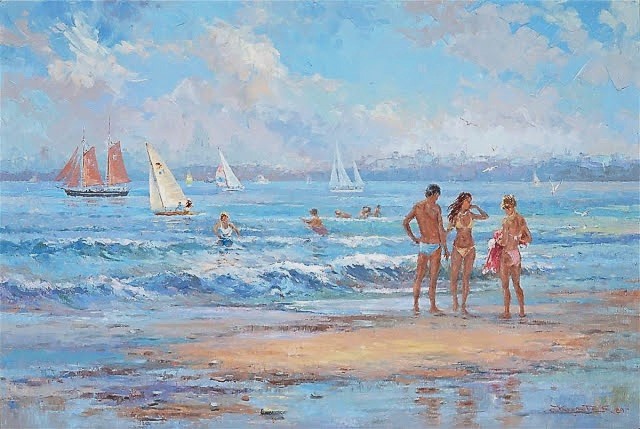

01 Marine Painting - Henry Scott's The clipper ship Light Brigade, with Footnotes, #347

Henry Scott, (British, 1911-2005)
The clipper ship 'The Light Brigade', c. 1966
Oil on canvas
24 x 36 inches (61.0 x 91.4 cm)
Private collection

Ocean Telegraph was an American clipper ship. Built in 1854 for the run between New York and San Francisco, she was later sold and renamed Light Brigade in 1863. For the next 12 years she was used predominantly to transport cargo and immigrants between London and Australia and New Zealand.

She was described as "a very sharp clipper and said to be one of the most perfect ships ever built". In common with other clipper ships of the day she was constructed from wood and with three masts. Also in common with other clipper ships of the day her hull was painted black, and the bottom of the hull lined with copper. 

From 1854 to her sale in 1863 she was involved in moving cargo and passengers between New York and San Francisco. In common with many other clippers at the time, she was sometimes unable to procure a return cargo and when this happened had to return to New York in ballast.

Each time Light Brigade had sailed to Australia and New Zealand she carried around 400 passengers, mail and a cargo of general merchandise. 

In 1883 she was condemned and sold to Gibraltar where she was converted into a coal-hulk. More on Ocean Telegraph

Henry Scott F.R.S.A, 1911-2005, British, was a painter of marines and coastal subjects strongly associated with the Royal Society of Artists. As well as painting lucrative shipping portraits for some of his wealthy clientele, he also executed a number of works of British and American clippers. His works have often been confused with those of Montague Dawson. Scott worked in a similar way to that of Dawson and captured a wonderful freshness and feel of immediacy. Scott’s palette is striking, with all surfaces and elements observed, capturing every movement in full flow. His sails are nearly always bellowed with a good stiff breeze, which is further emphasised by the spray of the water being wisped across the top of the choppy seas. Particularly notable are his skies which move the subject helping the canvas feel alive. In 1970 Scott was commissioned to paint ‘Morning Cloud’ which was skippered and owned by the then Prime Minister, The Right Honourable Edward Heath, P.C., M.B.E., M.P.. Scott exhibited at the Society of Marine Artists; The Royal Exchange, London; The Guildhall, London and The Royal Academy. He also exhibited at the St. Malo Museum, France and at Madison Square in New York. He was honoured as a Fellow of the Royal Society of Arts and awarded an honorary Life Member ‘Cape Homers’ by the International Association of Master Mariners. More on Henry Scott


Please visit my other blogs: Art CollectorMythologyMarine ArtPortrait of a Lady, The OrientalistArt of the Nude and The Canals of VeniceMiddle East Artists365 Saints and 365 Days, also visit my Boards on Pinterest

Images are copyright of their respective owners, assignees or others. Some Images may be subject to copyright

I don't own any of these images - credit is always given when due unless it is unknown to me. if I post your images without your permission, please tell me.

I do not sell art, art prints, framed posters or reproductions. Ads are shown only to compensate the hosting expenses.

If you enjoyed this post, please share with friends and family.

Thank you for visiting my blog and also for liking its posts and pages.

Please note that the content of this post primarily consists of articles available from Wikipedia or other free sources online.


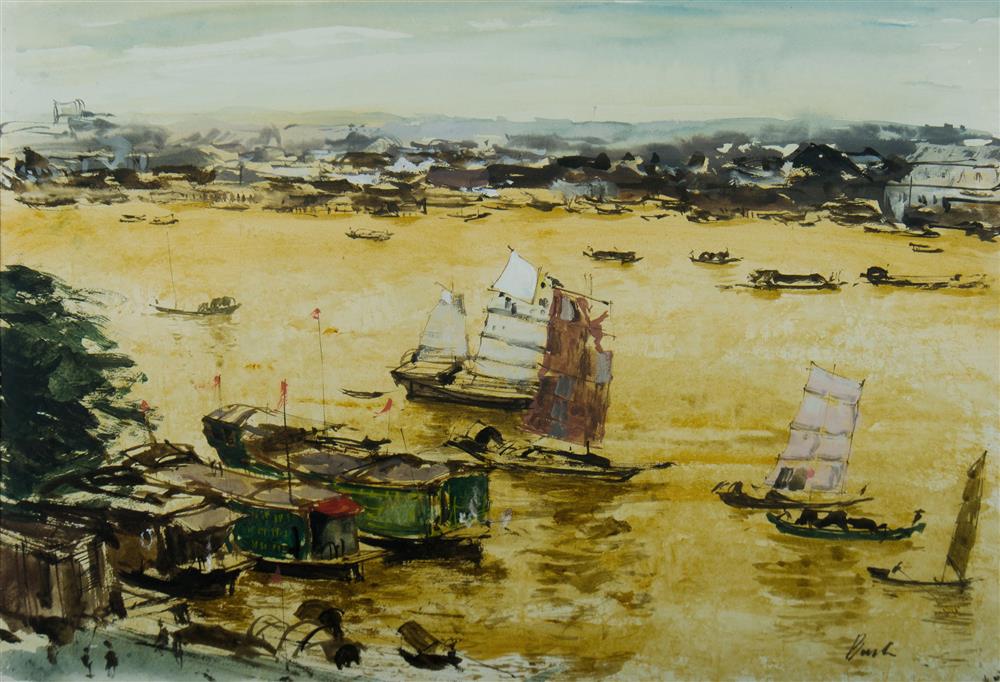
01 Marine Painting - Charles William Bush's The Pearl River - Canton China, With Footnotes, #346

Charles William Bush,  (1919-1989)
The Pearl River - Canton China
Mixed Media on Paper
34x50cm
Private collection

The Pearl River is an extensive river system in southern China. The river is so named because of the pearl-colored shells that lie at the bottom of the river in the section that flows through the city of Guangzhou. More on The Pearl River

Born in Melbourne, Charles William Bush studied under Mcinnes (q. v.) and Wheeler at the National Gallery of Victoria School, and later taught there from 1954 to 1955. After his appointment as a war artist in 1943, he studied, travelled and exhibited overseas. In partnership with his longtime companion Phyl Waterhouse, and June Davies, he established the Leveson Street Gallery, Melbourne, in 1962. Bush was equally adept with pen and brush, and won many awards for his skilful, professional paintings which included landscapes, seascapes, genre and portraits. (He was also widely known throughout Australia for his long-running weekly television programme My Fair Lady.)  More on Charles William Bush


Please visit my other blogs: Art CollectorMythologyMarine ArtPortrait of a Lady, The OrientalistArt of the Nude and The Canals of VeniceMiddle East Artists365 Saints and 365 Days, also visit my Boards on Pinterest

Images are copyright of their respective owners, assignees or others. Some Images may be subject to copyright

I don't own any of these images - credit is always given when due unless it is unknown to me. if I post your images without your permission, please tell me.

I do not sell art, art prints, framed posters or reproductions. Ads are shown only to compensate the hosting expenses.

If you enjoyed this post, please share with friends and family.

Thank you for visiting my blog and also for liking its posts and pages.

Please note that the content of this post primarily consists of articles available from Wikipedia or other free sources online.


01 Marine Painting - Frederick James 'Fred' Elliott's Shipping, Sydney Harbour with City Skyline, with Footnotes, #345

Frederick James 'Fred' Elliott, (1864-1949)
Shipping, Sydney Harbour with City Skyline
Watercolor
44x28cm
Private collection

Frederick James 'Fred' Elliott, 1864-1949, was a prolific watercolour painter and lithographer, active in Sydney from the 1890s to the 1920s, specialising in marine subjects.

Frederick James 'Fred’ Elliott was born in Paignton near Brixham, Devon, UK, son of Alfred Elliott. Fred Elliott immigrated to Queensland in 1876 when his father was appointed teacher at Humpybong School near Redcliffe, Queensland. Elliott worked as a lithographic artist in the Queensland Government Printing Office from July 1896 to about 1903. He was a prolific artist, painting almost invariably in watercolours, occasionally in oils. He specialised in marine watercolour studies, travelling up and down the coast by ship and sketching scenes that he later turned into paintings. Mainly painting Sydney Harbour, including views and individual ships. His watercolours are characterised by a high key and strong atmospheric effects. He showed his paintings infrequently in the Queensland National Association’s exhibitions and with the Queensland Art Society and the NSW Society of Artists. He signed his paintings. More on Frederick James Elliott


Please visit my other blogs: Art CollectorMythologyMarine ArtPortrait of a Lady, The OrientalistArt of the Nude and The Canals of VeniceMiddle East Artists365 Saints and 365 Days, also visit my Boards on Pinterest

Images are copyright of their respective owners, assignees or others. Some Images may be subject to copyright

I don't own any of these images - credit is always given when due unless it is unknown to me. if I post your images without your permission, please tell me.

I do not sell art, art prints, framed posters or reproductions. Ads are shown only to compensate the hosting expenses.

If you enjoyed this post, please share with friends and family.

Thank you for visiting my blog and also for liking its posts and pages.

Please note that the content of this post primarily consists of articles available from Wikipedia or other free sources online.

01 Marine Painting - John Charles Allcot's American Clipper Ship 'Wavertree', with Footnotes, #344

John Charles Allcot, (1888-1973)
American Clipper Ship 'Wavertree' Leaving Sydney Harbour with Pilot Boat.
c.  1971
Oil on Canvas Board
58.5x73.5cm
Private collection

Wavertree is a historic iron-hulled sailing ship built in 1885. Now the largest wrought iron sailing vessel afloat, it is located at the South Street Seaport in New York City.

Wavertree was built in Southampton, England in 1885 and was one of the last large sailing ships built of wrought iron. She was built for the Liverpool company R.W. Leyland & Company, and is named after the Wavertree district of that city.

The ship was first used to carry jute between eastern India and Scotland. When less than two years old the ship entered the "tramp trades", taking cargoes anywhere in the world. In 1910, after sailing for a quarter century, the ship was dis-masted off Cape Horn and barely made it to the Falkland Islands. Rather than re-rigging the ship its owners sold it for use as a floating warehouse at Punta Arenas, Chile. Wavertree was converted into a sand barge at Buenos Aires, Argentina in 1947. This ship was discovered in 1967 at the Riachuelo River in Buenos Aires by an American citizen working on a sand barge and acquired by the South Street Seaport Museum in 1968. The ship was sent to the Arsenal Naval Buenos Aires for restoration. In 1969 after restoration was complete, the ship was towed to New York. The vessel was added to the National Register of Historic Places on June 13, 1978. More on the Wavertree

John Charles Allcot (1888-1973), artist, was born in Liverpool, England, son of George Allcot, mariner. Educated at Arnot Street Board School, at the age of 14 John was apprenticed to Tillotson & Son Ltd, lithographers, and attended classes at the Liverpool Institute and School of Art. In 1906 he worked in the Mersey tugboats and next year sailed as a deck-boy in the barque, Invermark. He loved painting and would scrounge ship's paint, sailcloth and handkerchiefs with which to depict the sea, ships and life on board.  

Arriving in Sydney in 1909, Allcot signed on with the old clipper, Antiope. He worked in coastal, island and intercolonial vessels out of Sydney before giving up the sea in 1912. Supporting himself by painting theatre sets, he obtained commissions for ship paintings from Sydney photographers and toured the countryside, completing landscapes which he exhibited regularly with the Royal Art Society of New South Wales from 1920. About this time he formed an enduring friendship with Phyllis Zanker.

He gained widespread recognition in the 1920s with a series of oil paintings (on the founding of the Australian colonies) which were later acquired by the Australasian Pioneers' Club. Other commissions followed. Allcot also worked as an illustrator and wrote articles about the sea for the Sydney Mail. In the 1940s he painted the seas for ship-models built by the sculptor Robert Klippel. Allcot's painting of the Cutty Sark was presented to the Duke of Edinburgh in 1954.

Painting to tried and tested conventions, with impeccable attention to detail, Allcot used water-colour and gouache, and oils. His work was prolific and romantic. At a time of great change in the shipping industry, he specialized in nostalgic views of sailing ships and steamers, and found an appreciative market of ship-owners, captains, crews and their families. More on John Charles Allcot


Please visit my other blogs: Art CollectorMythologyMarine ArtPortrait of a Lady, The OrientalistArt of the Nude and The Canals of VeniceMiddle East Artists365 Saints and 365 Days, also visit my Boards on Pinterest

Images are copyright of their respective owners, assignees or others. Some Images may be subject to copyright

I don't own any of these images - credit is always given when due unless it is unknown to me. if I post your images without your permission, please tell me.

I do not sell art, art prints, framed posters or reproductions. Ads are shown only to compensate the hosting expenses.

If you enjoyed this post, please share with friends and family.

Thank you for visiting my blog and also for liking its posts and pages.

Please note that the content of this post primarily consists of articles available from Wikipedia or other free sources online.


01 Marine Painting, William Henry Bartlett's SEAL-DIVER, with Footnotes, #343

William Henry  Bartlett, 1858-1932
THE SEAL-DIVER, CO. MAYO, c. 1888
Oil on canvas
115 by 162.5cm., 45¼ by 64in.
Private collection

Grey seals are the larger of the two seal species found in Irish waters. Males known as bulls are larger and heavier than the female cows with mature bulls on average measuring up to 2.5 meters in length and weighing up to 300kg. Female adults will grow to 2 meters in body length and can weigh up to 180kg. 

Grey seals have few natural predators in Irish waters, man is still the cause of most seal deaths. They were for centuries hunted for their fur and meat which resulted in a huge decline in their numbers throughout their range by the 19th century. Seal hunting has been made illegal in most parts of the world but their increasing numbers can bring them into conflict with fishermen who can legally shoot seals which are found close to their nets. Grey seal population increases may be regarded as a threat to the fishing industry as they will take salmon and other commercially important fish species from fixed nets, hunt within salmonid estuaries or target fish farms. More on seals

William Henry  Bartlett RI (1858-1932) was an accomplished artist and draughtsman, focusing primarily on landscape painting and subjects associated with the sea. In the late 1870s he travelled to Paris to study at the Ecole des Beaux Arts under Geróme and at the Académie Julian under Bouguereau. It was through his study in Paris that he found influence from Bastien Lepage, who has been credited with leading the emergence of the Naturalist school. This inspired his use of genre and pastoral themes shown in works such as The Village Road. He returned to London in 1880 where he began exhibiting in the Royal Academy and in 1889 he was presented with a silver medal at the Paris exhibition. He developed an interest in Irish rural life, in particular the harsh landscapes that people struggled to survive in, and this has translated into a number of his paintings.

Bartlett has been exhibited numerous times with the Royal Hibernian Academy (RHA) and the Royal Academy (RA). The Fine Art Society presented a one-man show of Bartlett’s work, he has been published in the Art Journal and he was also a member of the Royal Society of British Artists. More on William Henry  Bartlett


Please visit my other blogs: Art CollectorMythologyMarine ArtPortrait of a Lady, The OrientalistArt of the Nude and The Canals of VeniceMiddle East Artists365 Saints and 365 Days, also visit my Boards on Pinterest

Images are copyright of their respective owners, assignees or others. Some Images may be subject to copyright

I don't own any of these images - credit is always given when due unless it is unknown to me. if I post your images without your permission, please tell me.

I do not sell art, art prints, framed posters or reproductions. Ads are shown only to compensate the hosting expenses.

If you enjoyed this post, please share with friends and family.

Thank you for visiting my blog and also for liking its posts and pages.

Please note that the content of this post primarily consists of articles available from Wikipedia or other free sources online.


01 Marine Painting - Newell Conver's Wyeth's Morgan's men are out for you, with Footnotes, #342

Newell Convers Wyeth (1882-1945)
"Oh, Morgan's men are out for you; and Blackbeard--buccaneer!...", c. 1917
Oil on canvas
50 ¼ x 35 in. (127.6 x 88.9 cm.)
Private collection

Sir Henry Morgan, (born 1635, Llanrhymney, Glamorgan—died August 25, 1688, probably Lawrencefield, Jamaica), Welsh buccaneer, most famous of the adventurers who plundered Spain’s Caribbean colonies during the late 17th century. Operating with the unofficial support of the English government, he undermined Spanish authority in the West Indies. More on Sir Henry Morgan

Blackbeard, (born c. 1680, Bristol?, England—died November 22, 1718, Ocracoke Island, North Carolina [U.S.]), is one of history’s most famous pirates, who became an imposing figure in American folklore.

Thought to have been active as a privateer for the British during the War of the Spanish Succession (1701–13), Blackbeard was first heard of as a pirate late in 1716, and soon became notorious for outrages along the Virginia and Carolina coasts and in the Caribbean Sea. In 1718 Blackbeard established his base in a North Carolina inlet. At the request of Carolina planters, the lieutenant governor of Virginia, Alexander Spotswood, dispatched a British naval force under Lieutenant Robert Maynard, who, after a hard fight, succeeded in killing Blackbeard. The pirate’s body was decapitated, and his head was affixed to the end of the bowsprit of his ship. More on Blackbeard

Newell Convers Wyeth (October 22, 1882 – October 19, 1945), known as N. C. Wyeth, was an American artist and illustrator. During his lifetime, Wyeth created over 3,000 paintings and illustrated 112 books, 25 of them for Scribner's, the Scribner Classics, which is the work for which he is best known. The first of these, Treasure Island, was one of his masterpieces and the proceeds paid for his studio. Wyeth was a realist painter just as the camera and photography began to compete with his craft. Sometimes seen as melodramatic, his illustrations were designed to be understood quickly. He is notably the father of painter Andrew Wyeth and the grandfather of Jamie Wyeth, both celebrated American painters. More on Newell Convers Wyeth


Please visit my other blogs: Art CollectorMythologyMarine ArtPortrait of a Lady, The OrientalistArt of the Nude and The Canals of VeniceMiddle East Artists365 Saints and 365 Days, also visit my Boards on Pinterest

Images are copyright of their respective owners, assignees or others. Some Images may be subject to copyright

I don't own any of these images - credit is always given when due unless it is unknown to me. if I post your images without your permission, please tell me.

I do not sell art, art prints, framed posters or reproductions. Ads are shown only to compensate the hosting expenses.

If you enjoyed this post, please share with friends and family.

Thank you for visiting my blog and also for liking its posts and pages.

Please note that the content of this post primarily consists of articles available from Wikipedia or other free sources online.


A note to the readers of Zaidan Gallery

      A note to the readers of Zaidan Gallery It is with great sadness that we share the news that the author of this blog,  Henry Zaidan (1...