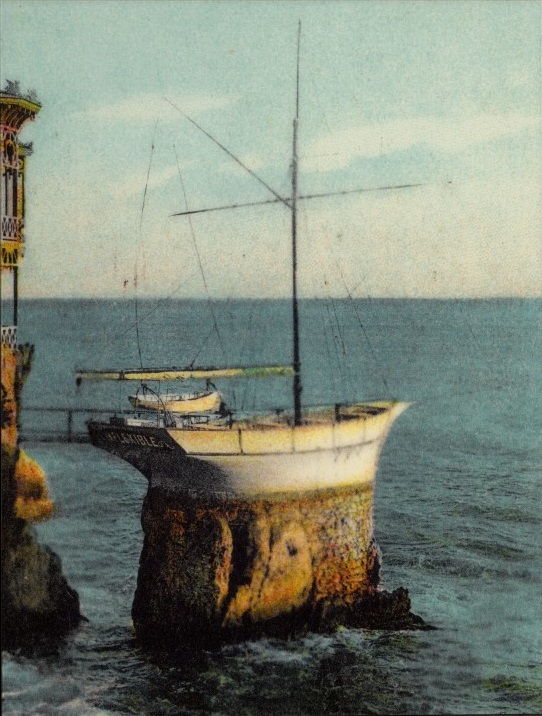
01 Marine Painting, Jules Achille Noël's Elegant figures on the beach, Tréport, with Footnotes #285

Jules Achille Noël, (FRENCH, 1815-1881)
Elegant figures on the beach, Tréport, c. 1875
Oil on panel
16.3 x 21.8cm (6 7/16 x 8 9/16in)
Oil on canvas

Estimated for £6,000 - £8,000 in June 2020

Le Tréport is a commune in the Seine-Maritime department in the Normandy region in north-eastern France.

A small fishing port and light industrial town situated in the Pays de Caux, some 21 miles (34 km) northeast of Dieppe. The mouth of the Bresle river meets the English Channel here, in between the high chalk cliffs and the pebbly beach. More on Le Tréport 

Jules Achille Noël, born Louis Assez Noël (24 February 1815, Quimper – 26 March 1881, Algiers) was a French landscape and maritime painter who worked primarily in Brittany and Normandy.

His family originally came from Lorraine. Some sources say that he was born there in 1810. He studied at the "Académie de Peinture et de Dessin" (Académie Charioux) in Brest. Afterwards, he went to Paris to seek his fortune and came under the influence of his fellow Breton painter Pierre-Julien Gilbert. After four years of struggling to earn his living, he returned to Brittany to teach drawing in Saint-Pol-de-Léon, Lorient and Nantes.

He had begun to participate in the Salon in 1840 and, in 1845, was one of several artists commissioned to provide engraved illustrations for a book on prisons. Eventually, his work attracted the attention of Prince Louis, Duke of Nemours, who obtained him a position as a Professor of Design at the Lycée Henri-IV, where he would teach from 1847 until his retirement in 1879. Albert Lynch and Félix Buhot were among his best-known students there.

During school vacations he would return to paint in Brittany. He was in ill-health at the time of his retirement, so he went to live with his daughter and her husband in Algeria and died there. More on Jules Achille Noël


Please visit my other blogs: Art Collector, Mythology, Marine Art, Portrait of a Lady, The Orientalist, Art of the Nude and The Canals of Venice, Middle East Artists, 365 Saints, 365 Days, and Biblical Icons, also visit my Boards on Pinterest

Images are copyright of their respective owners, assignees or others. Some Images may be subject to copyright

I don't own any of these images - credit is always given when due unless it is unknown to me. if I post your images without your permission, please tell me.

I do not sell art, art prints, framed posters or reproductions. Ads are shown only to compensate the hosting expenses.

If you enjoyed this post, please share with friends and family.

Thank you for visiting my blog and also for liking its posts and pages.

Please note that the content of this post primarily consists of articles available from Wikipedia or other free sources online.

01 Marine Painting, Ester Almqvist's Gothenburg Harbour with Boats in the Ice, With Footnotes #384


Ester Almqvist (Swedish, 1869 - 1934)
Gothenburg Harbour with Boats in the Ice, c. 1916
Oil on canvas
62,50 x 89,50 cm
Gothenburg Museum of Art 

The municipally-owned Port of Gothenburg is the largest port in the Nordic countries. The port is situated on both sides of the estuary of Göta älv in Gothenburg. The north shore, Norra Älvstranden, is on Hisingen island and the south shore, Södra Älvstranden, is on the mainland. It is a combined river and coastal port. More on the Port of Gothenburg

Ester Dorothea Almqvist (3 November 1869 – 11 June 1934) was a Swedish artist who was a pioneer of Expressionist painting in Sweden.

Almqvist was born in Bromma but spent her childhood in Stockholm, where her parents taught in a school for Christian missionaries. She is the female artist who is represented with most artworks in the collections of Malmö Konstmuseum, a total of 2,083 pieces. She had specified in her will that her collection of oil and watercolour paintings, charcoal, pastel and ink drawings, graphic pages and sketchbooks should be donated to that particular museum. Her father, a priest, died when she was nine. Her mother worked as a private tutor and book seller for the sake of providing for her family. Almqvist was born with a deformed spine that limited her mobility throughout her life but also gave her freedom to study art instead of being confined to housework.

She attended the Technical School in Stockholm, graduating in 1891, and she studied art privately with the painter Gustaf Cederström. She continued her art studies at the Valand Art Academy in Gothenburg (1892–1893) and then at the Konstnärsförbundets skola in Stockholm (1894–1895). Her teachers included Per Hasselberg and Bruno Liljefors. While in school, she supported herself by commercial book illustration work. Later, she was a member of the women's association Nya Idun. More on Ester Dorothea Almqvist


Please visit my other blogs: Art Collector, Mythology, Marine Art, Portrait of a Lady, The Orientalist, Art of the Nude and The Canals of Venice, Middle East Artists, 365 Saints, 365 Days, and Biblical Icons, also visit my Boards on Pinterest

Images are copyright of their respective owners, assignees or others. Some Images may be subject to copyright

I don't own any of these images - credit is always given when due unless it is unknown to me. if I post your images without your permission, please tell me.

I do not sell art, art prints, framed posters or reproductions. Ads are shown only to compensate the hosting expenses.

If you enjoyed this post, please share with friends and family.

Thank you for visiting my blog and also for liking its posts and pages.

Please note that the content of this post primarily consists of articles available from Wikipedia or other free sources online.


01 Marine Painting - Vasilios Chatzis' Byzantine naval battle, with Footnotes #386

Vasilios Chatzis (Greek, 1870-1915)
Byzantine naval battle
Oil on card
25 x 22.5 cm
Private collection

Sold for £6,312.50 in May 2020

"Two years ago, Vassilios Hatzis undertook to bring back to life an entire historical era, and since then has been engaged in the depiction of the Byzantine fleet. Since there are no previous studies in this field to assist him in his work, his historical research has been, and still is, rather painstaking." More on this painting

Vasileios Hatzis or Vassileios Chatzis (1870 – 1915) was a Greek painter who was best known for his seascapes.

Vasileios Hatzis was born in 1870 in Kastoria. His family was involved in shipping, and he spent his childhood in Patras. From 1886 to 1893 he studied at the Athens School of Fine Arts . During the Balkan Wars of 1912–13 the government assigned him to the navy, where he portrayed action scenes of the Greek fleet. He died in Athens in 1915

Hatzis is primarily known for his seascapes, but also painted landscapes and genre scenes from the life of farmers and fishermen. His work includes both academic and en plein air styles. The influence of impressionism may be detected in his work. He first exhibited in Athens in 1899, and his works were shown in group exhibitions in Athens (1902, 1907, 1909, 1910) and Alexandria (1903, 1906). A solo exhibition was held soon after his death at the Zappeion hall in Athens that showed more than 260 works. More on Vasileios Hatzis 


Please visit my other blogs: Art Collector, Mythology, Marine Art, Portrait of a Lady, The Orientalist, Art of the Nude and The Canals of Venice, Middle East Artists, 365 Saints, 365 Days, and Biblical Icons, also visit my Boards on Pinterest

Images are copyright of their respective owners, assignees or others. Some Images may be subject to copyright

I don't own any of these images - credit is always given when due unless it is unknown to me. if I post your images without your permission, please tell me.

I do not sell art, art prints, framed posters or reproductions. Ads are shown only to compensate the hosting expenses.

If you enjoyed this post, please share with friends and family.

Thank you for visiting my blog and also for liking its posts and pages.

Please note that the content of this post primarily consists of articles available from Wikipedia or other free sources online.

01 Marine Painting - Johan Tirén's Return of the Fishermen, with Footnotes, #385

Johan tirén, "amatörfiskare på hemfärd" (return of the "fishermen").
Johan Tirén, (1853-1911)
Return of the Fishermen
Oil on canvas
81 x 65 cm.
Private collection

Sold for 5,300 USD in June 2020

Johan Tirén (12 October 1853, Själevad - 24 August 1911, Länna Parish, Uppland) was a Swedish painter who specialized in scenes of the rural life in Northern Sweden.

He originally attended the Tekniska skolan in Stockholm then spent the years 1877 to 1880 at the Royal Swedish Academy of Fine Arts, where he won a Royal Medal in 1880. 

After studying in Norrland in 1881, he was able to obtain a scholarship and used it to make a study trip; visiting the Netherlands, Belgium, Paris and Upper Bavaria. While in Rome, he received orders from the Academy Director to begin studies in Munich. Instead he returned to Paris and studied with Jean-Léon Gérôme, but found himself uninspired to paint by what he saw there. When his travel allowance was not extended, he settled in Jämtland, where he painted landscapes and scenes from the lives of the Sami people. More on Johan Tirén


Please visit my other blogs: Art Collector, Mythology, Marine Art, Portrait of a Lady, The Orientalist, Art of the Nude and The Canals of Venice, Middle East Artists, 365 Saints, 365 Days, and Biblical Icons, also visit my Boards on Pinterest

Images are copyright of their respective owners, assignees or others. Some Images may be subject to copyright

I don't own any of these images - credit is always given when due unless it is unknown to me. if I post your images without your permission, please tell me.

I do not sell art, art prints, framed posters or reproductions. Ads are shown only to compensate the hosting expenses.

If you enjoyed this post, please share with friends and family.

Thank you for visiting my blog and also for liking its posts and pages.

Please note that the content of this post primarily consists of articles available from Wikipedia or other free sources online.


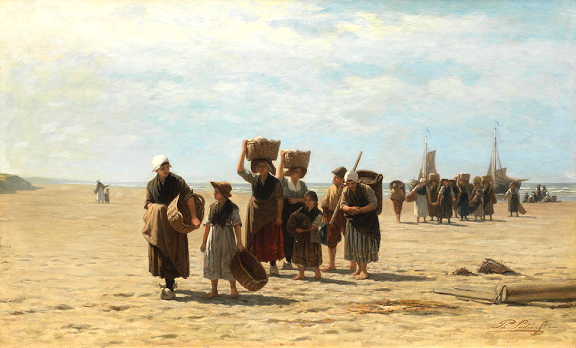
01 Marine Painting - Philip Lodewijk Jacob Frederik Sadée's Bringing in the catch, with Footnotes #383

Philip Lodewijk Jacob Frederik Sadée, (DUTCH, 1837-1904)
Bringing in the catch
Oil on canvas
81 x 130.5cm (31 7/8 x 51 3/8in)
Private collection

Estimated for £30,000 - £50,000 in June 2020

Philip Lodewijk Jacob Frederik Sadée (7 February 1837 The Hague – 14 December 1904 The Hague) was an artist who belonged to the Hague School.

Sadée started painting at the age of 20. He studied in The Hague both at the Academy and in the studio of J E J van den Berg (1802–1861). In 1866 with his fellow student Julius van de Sande Bakhuyzen. Sadée travelled to Düsseldorf where he studied for some months. He began painting biblical scenes and history paintings and later he focused on daily life. In Scheveningen he came into contact with the fisherman's life. Here he was fascinated with the beach and the dunes, which were a source of inspiration for him. Typical of Sadée are the bright colors.

Sadée travelled widely, he painted in the Pas de Calais and travelled in France, Germany, Belgium and Italy. Sadée exhibited in Amsterdam, Rotterdam and The Hague in the years 1853–1903, and was elected to the Arte et Amicitiae in Amsterdam. He taught at the Academy in The Hague and numbered Hendrikus M. Horrix (1845–1923) amongst his pupils. More on Philip Lodewijk Jacob Frederik Sadée


Please visit my other blogs: Art Collector, Mythology, Marine Art, Portrait of a Lady, The Orientalist, Art of the Nude and The Canals of Venice, Middle East Artists, 365 Saints and 365 Days, also visit my Boards on Pinterest

Images are copyright of their respective owners, assignees or others. Some Images may be subject to copyright

I don't own any of these images - credit is always given when due unless it is unknown to me. if I post your images without your permission, please tell me.

I do not sell art, art prints, framed posters or reproductions. Ads are shown only to compensate the hosting expenses.

If you enjoyed this post, please share with friends and family.

Thank you for visiting my blog and also for liking its posts and pages.

Please note that the content of this post primarily consists of articles available from Wikipedia or other free sources online.


01 Marine Painting - Newell Convers Wyeth's The Raft of Odysseus, with Footnotes #381

Newell Convers Wyeth (1882-1945)
The Raft of Odysseus (Neptune Battles with Odysseus), c. 1929
Oil on canvas
48 x 38 in. (121.9 x 96.5 cm.)
Private collection

Sold for USD 425,000 in May 2016

A vivid jewel tone palette covers much of the canvas, with striking turquoises, emeralds and violets applied in brushwork that suggests movement in both the intense swelling of the sea and storm clouds swarming above. The ominous dark clouds are a stark contrast to the white foam of the wave that looms over Odysseus. The composition echoes Pyle’s teachings as well; Odysseus, the main protagonist in the story, is in the foreground as he clings to the raft with its broken mast jutting out from the water, while Neptune is positioned at a diagonal that continues from Odysseus through the wave to the upper right. The result of Wyeth’s adept work in The Raft of Odysseus (Neptune Battles with Odysseus) is a powerful image that brings to life for readers the mythical drama of this significant piece of literature. More on this painting

Newell Convers Wyeth (October 22, 1882 – October 19, 1945), known as N. C. Wyeth, was an American artist and illustrator. He was the pupil of artist Howard Pyle and became one of America's greatest illustrators. During his lifetime, Wyeth created more than 3,000 paintings and illustrated 112 books, 25 of them for Scribner's, the Scribner Classics, which is the work for which he is best known. The first of these, Treasure Island, was one of his masterpieces and the proceeds paid for his studio. Wyeth was a realist painter at a time when the camera and photography began to compete with his craft. Sometimes seen as melodramatic, his illustrations were designed to be understood quickly. Wyeth, who was both a painter and an illustrator, understood the difference, and said in 1908, "Painting and illustration cannot be mixed—one cannot merge from one into the other."

He is the father of Andrew Wyeth and the grandfather of Jamie Wyeth, both well-known American painters. More on Newell Convers Wyeth


Please visit my other blogs: Art Collector, Mythology, Marine Art, Portrait of a Lady, The Orientalist, Art of the Nude and The Canals of Venice, Middle East Artists, 365 Saints, 365 Days, and Biblical Icons, also visit my Boards on Pinterest

Images are copyright of their respective owners, assignees or others. Some Images may be subject to copyright

I don't own any of these images - credit is always given when due unless it is unknown to me. if I post your images without your permission, please tell me.

I do not sell art, art prints, framed posters or reproductions. Ads are shown only to compensate the hosting expenses.

If you enjoyed this post, please share with friends and family.

Thank you for visiting my blog and also for liking its posts and pages.

Please note that the content of this post primarily consists of articles available from Wikipedia or other free sources online.

01 Marine Painting - Raoul Dufy's THE PIER IN LE HAVRE, with Footnotes, #379

Raoul Dufy, 1877 - 1953,
THE PIER IN LE HAVRE, circa 1924-25.
Oil on canvas
65.1 x 81 cm; 25⅝ x 31⅞ in.
Private collection

Sold for 200,000 EUR in June 2020

In 1885, the Florentine father named Guéroult installed the Bains de la Falaise on the current site of the regatta palace. The establishment was very popular with residents. They took advantage of beach huts, canvas tents and the pier that allowed high tide to reach the sea without stepping on the pebbles. The Sainte-Adresse pier was a source of inspiration for many painters at the start of the 20th century. 

Raoul Dufy was born in Le Havre, a city that remained a constant source of inspiration for his painting. While he continued to paint the harbour and its activity between 1900 and 1904, Dufy also began showing interest in seaside recreation as early as 1901. The busy pier with people strolling out to the sea remained a focus of his work until the 1920s. While the early versions on this subject are marked by lively strokes similar to certain works by Boudin, Dufy soon turned his attention to the geometry of wood constructions, the shapes of which could be conveyed by variations in colour. More on this painting

Raoul Dufy (3 June 1877 – 23 March 1953) was a French Fauvist painter, brother of Jean Dufy. He developed a colorful, decorative style that became fashionable for designs of ceramics and textiles, as well as decorative schemes for public buildings. He is noted for scenes of open-air social events. He was also a draftsman, printmaker, book illustrator, scenic designer, a designer of furniture, and a planner of public spaces. More on Raoul Dufy


Please visit my other blogs: Art Collector, Mythology, Marine Art, Portrait of a Lady, The Orientalist, Art of the Nude and The Canals of Venice, Middle East Artists, 365 Saints, 365 Days, and Biblical Icons, also visit my Boards on Pinterest

Images are copyright of their respective owners, assignees or others. Some Images may be subject to copyright

I don't own any of these images - credit is always given when due unless it is unknown to me. if I post your images without your permission, please tell me.

I do not sell art, art prints, framed posters or reproductions. Ads are shown only to compensate the hosting expenses.

If you enjoyed this post, please share with friends and family.

Thank you for visiting my blog and also for liking its posts and pages.

Please note that the content of this post primarily consists of articles available from Wikipedia or other free sources online.

01 Marine Painting - Willem Hendrik Eickelberg's BUSY FISHERFOLK, with Footnotes #380

Willem Hendrik Eickelberg, Dutch, 1845 - 1920
BUSY FISHERFOLK 
Oil on canvas
21⅜ by 28½in.; 54.3 by 72.4 cm
Private collection

Estimated for 6,000 - 8,000 USD in October 2020

Willem Hendrik Eickelberg was born in Amsterdam, The Netherlands in 1845. Although he never obtained the recognition he deserved from a larger public, we know a lot of works from his hand have survived the years. He recieved his education at the Royal Academy of Arts in Amsterdam, after which he started working on landscapes, cityviews and beaches in an impressionistic style. Occasionally his winter landscapes can be viewed as highly idealized and even romantic. His cityscapes and beach scenes are depicted in a more realistic way and tend to give an impression of his time of living perfectly. Until 1878 Eickelberg lived and worked as a painter in Amsterdam. After having lived in a number of other cities, he settled down in Blaricum(1904) and eventually in Hilversum. More on Willem Hendrik Eickelberg


Images are copyright of their respective owners, assignees or others. Some Images may be subject to copyright

I don't own any of these images - credit is always given when due unless it is unknown to me. if I post your images without your permission, please tell me.

I do not sell art, art prints, framed posters or reproductions. Ads are shown only to compensate the hosting expenses.

If you enjoyed this post, please share with friends and family.

Thank you for visiting my blog and also for liking its posts and pages.

Please note that the content of this post primarily consists of articles available from Wikipedia or other free sources online.

04 Marine Photographs - Kasia Derwinska's Neighborhood, House with the ocean view, Summer shelter and Now or never, with Footnotes #377

Kasia Derwinska, Spain
Neighborhood
Color, Digital, Manipulated, Photo, Paint on Paper
19.7 W x 19.7 H x 0 in

Priced at C$1,280 as of May, 2023

Kasia Derwinska, Spain
House with the ocean view
Photography, Color on Paper
33.5 W x 33.5 H x 0 D in

Priced at C$1,663 as of May, 2023

Kasia Derwinska, Spain
Summer shelter
Mixed Media, Digital on Paper
15.7 W x 15.7 H x 0 D in

Priced at C$1,003 as of May, 2023

Kasia Derwinska, Spain
Now or never
Photography, Color on Paper
15.7 W x 15.7 H x 0 D in

Priced at C$977 as of May, 2023

Kasia Derwinska "Photography is my way of communicating with the world. In my work, I talk about own experiences, thoughts, doubts, fears and hopes trying to reflect my own life's path. In addition to my experiences, my creations are inspired by night dreams as since childhood I remember most of them and I believe that dreams are the most simbolic language of our subconscious, a guide to navigate in the modern world. I am autodidactic and I don´t recognize myself as a photographer. I use photography as a tool, like a brush for painting or an instrument to play music. My work is an attempt to connect substantiality of the world that surrounds us with elusiveness of feelings and thoughts. For that reason I describe my creations as building a bridge between the visible and the invisible. My works are divided in four basic series: fairytales and fantasies, conceptual black and white, night dreams, and the color serie called "who sings, frightens away his fears"  More on Kasia Derwinska


Please visit my other blogs: Art Collector, Mythology, Marine Art, Portrait of a Lady, The Orientalist, Art of the Nude and The Canals of Venice, Middle East Artists, 365 Saints, 365 Days, and Biblical Icons, also visit my Boards on Pinterest

Images are copyright of their respective owners, assignees or others. Some Images may be subject to copyright

I don't own any of these images - credit is always given when due unless it is unknown to me. if I post your images without your permission, please tell me.

I do not sell art, art prints, framed posters or reproductions. Ads are shown only to compensate the hosting expenses.

If you enjoyed this post, please share with friends and family.

Thank you for visiting my blog and also for liking its posts and pages.

Please note that the content of this post primarily consists of articles available from Wikipedia or other free sources online.


01 Marine Painting - Pierre Puvis de Chavannes' Le pauvre pêcheur/ The Poor Fisherman, with Footnotes #376

Pierre Puvis de Chavannes, (1824–1898) 
Le pauvre pêcheur/ The Poor Fisherman, c. 1881
Oil on canvas
Height: 155.5 cm (61.2 in); Width: 192.5 cm (75.7 in)
Musée d'Orsay

The Poor Fisherman was the first of Puvis de Chavannes' paintings to be bought by the State. But the work sparked a lively reaction at the Salon of 1881 and was not bought until 1887 when it was again shown to the public. It took six years for a national museum to dare to show this radical painting that was so unrealistic in the light of the conventions of the time.

Without recourse to literal description, Puvis intended to give a view of desolation and resignation by painting a widower and his two children in a bleak landscape. The choice of the fisherman has obvious Biblical resonances. In 1881, the synthetic nature of the painting, its refusal of any modelling and traditional perspective, and its range of greenish hues, ranged most of the critics against the artist.

The writer Huysmans compared it to a picture from missal or the dull, flat frescoes of the past. On the other hand, some artists of the younger generation, from Seurat to Gauguin and Maurice Denis, not to mention Picasso, were enthusiastic over the extreme, poignant bareness of this silent image. Puvis became the leading light of the new style of painting. More on this painting

Pierre Puvis de Chavannes (14 December 1824 – 24 October 1898) was a French painter best known for his mural painting, who came to be known as 'the painter for France'. He became the co-founder and president of the Société Nationale des Beaux-Arts, and his work influenced many other artists, notably Robert Genin. Puvis de Chavannes was a prominent painter in the early Third Republic. Émile Zola described his work as "an art made of reason, passion, and will" More on Pierre Puvis de Chavannes


Please visit my other blogs: Art Collector, Mythology, Marine Art, Portrait of a Lady, The Orientalist, Art of the Nude and The Canals of Venice, Middle East Artists, 365 Saints, 365 Days, and Biblical Icons, also visit my Boards on Pinterest

Images are copyright of their respective owners, assignees or others. Some Images may be subject to copyright

I don't own any of these images - credit is always given when due unless it is unknown to me. if I post your images without your permission, please tell me.

I do not sell art, art prints, framed posters or reproductions. Ads are shown only to compensate the hosting expenses.

If you enjoyed this post, please share with friends and family.

Thank you for visiting my blog and also for liking its posts and pages.

Please note that the content of this post primarily consists of articles available from Wikipedia or other free sources online.

01 Marine Work - Elger Esser's Nice, with Footnotes #376

Elger Esser (German, born 1967)
Nice
Chromogenic print
71¼ by 54⅜ in. (181 by 138.1 cm.)
Private collection

Sold for 12,500 USD on April 3, 2020

Nice is the prefecture of the Alpes-Maritimes department in France. Located on the French Riviera, the southeastern coast of France on the Mediterranean Sea, at the foot of the French Alps, Nice is the second-largest French city on the Mediterranean coast and second-largest city in the Provence-Alpes-Côte d'Azur region after Marseille. 

The clear air and soft light have particularly appealed to notable painters, such as Marc Chagall, Henri Matisse, Niki de Saint Phalle and Arman. Their work is commemorated in many of the city's museums. More on Nice

Elger Esser is a German artist known for his lyrical photographs which recall the works of early photographers as well as 19th-century painters such as Caspar David Friedrich. Characterized by their golden light, archaic subject matter, and mellowed sublimity, Esser draws inspiration from the soft palette of antique postcards, as evinced in his work Nocturnes à Giverny (2013). “I am interested in capturing and preserving subjective memories, time and tranquility,” the artist explained. 

Born on May 11, 1967 in Stuttgart, Germany, Esser grew up in Rome but returned to Germany as a young man to work as a commercial photographer. In 1991, he enrolled in the Kunstakademie Düsseldorf, where he studied under Bernd and Hilla Becher. Fundamentally different from the famed members of the Düsseldorf School, including Andreas Gursky, Esser’s work espouses a craftsman-based heritage rather than a conceptual deconstruction of the medium. Currently living and working in Düsseldorf, Germany, Esser’s works are in the collections of the Solomon R. Guggenheim Museum in New York, the Rijksmuseum in Amsterdam, and the Centre Georges Pompidou in Paris, among others. More on Elger Esser


Please visit my other blogs: Art Collector, Mythology, Marine Art, Portrait of a Lady, The Orientalist, Art of the Nude and The Canals of Venice, Middle East Artists, 365 Saints, 365 Days, and Biblical Icons, also visit my Boards on Pinterest

Images are copyright of their respective owners, assignees or others. Some Images may be subject to copyright

I don't own any of these images - credit is always given when due unless it is unknown to me. if I post your images without your permission, please tell me.

I do not sell art, art prints, framed posters or reproductions. Ads are shown only to compensate the hosting expenses.

If you enjoyed this post, please share with friends and family.

Thank you for visiting my blog and also for liking its posts and pages.

Please note that the content of this post primarily consists of articles available from Wikipedia or other free sources online.

A note to the readers of Zaidan Gallery

      A note to the readers of Zaidan Gallery It is with great sadness that we share the news that the author of this blog,  Henry Zaidan (1...