Showing posts with label Jr. Show all posts

05 Classic Works of Art, Marine Paintings - With Footnotes, #48

Thomas Buttersworth, Jr,  (1807-1842)
Chasing a Pirate Ship
Oil on canvas
15 x 20 in
Private collection

Thomas Buttersworth, Jr. (1807-1842), was named after his father, the well known marine painter Thomas Buttersworth Senior (1766-1841), who was to have a considerable influence on his son's painting career.

There exist few details about Thomas Junior's private life. What is known is that in the late 1830's he was living with his wife Gertude in Lambeth, and in early 1838 his daughter, also Gertrude, was born.

The family had moved to Greenwich by 1841, and this is where their son, also named Thomas, was born in March of that year. Thomas Buttersworth Junior died in Greenwich on November 25, 1842 at the very early age of thirty five. More on Thomas Buttersworth, Jr. 

Edward Moran, (American, 1829-1901)
Galleon at Sunset
Oil on canvas laid on board
20 x 36 inches (50.8 x 91.4 cm)
Private collection


Edward Moran (August 19, 1829 in Bolton, Lancashire, England – June 8, 1901 in New York City) was an American artist of maritime paintings. Moran was born in England on August 19, 1829. Following in the footsteps of his father's profession, he learned to operate a hand-loom at a young age, though he would often be found sketching with charcoal on the white fabric instead of plying the shuttle. His family first emigrated to Maryland in 1844, and then to Philadelphia a year later.

It was in Philadelphia around 1845 that Edward apprenticed under James Hamilton and landscape painter Paul Weber; Hamilton guided Moran specifically in the style of marine paintings. In the 1850s Moran began to make a name for himself in the Philadelphia artistic scene; working in the same studio as his younger brother, famous American painter Thomas Moran, Edward received commissions and even completed some lithographic work. In 1862, he traveled to London and became a pupil in the Royal Academy. 

In 1885, at the height of his career, Moran began on what would be considered his most important work - a series of 13 paintings representing the Marine History of the United States. He chose to have thirteen paintings in the series because of the significance of the number in American history (13 colonies, 13 stars and stripes on the original US flag, etc.). The subjects include Leif Ericsson, Christopher Columbus, Hernando de Soto, Henry Hudson, and Admiral Dewey, among others.[3] Not long after their completion, the series was displayed at the 1893 World's Fair in Chicago. More on Edward Moran

Alfred Thompson Bricher, (American, 1837-1908)
Sails at Sunset
Watercolor on paper laid on board
20 x 28 inches (50.8 x 71.1 cm)
Private collection


Alfred Thompson Bricher (April 10, 1837 – September 30, 1908) was a painter associated with White Mountain art and the Hudson River School. Bricher was born in Portsmouth, New Hampshire. He was educated in an academy at Newburyport, Massachusetts. He began his career as a businessman in Boston, Massachusetts. When not working, he studied at the Lowell Institute. He attained noteworthy skill in making landscape studies from nature, and after 1858 devoted himself to the art as a profession. He opened a studio in Boston, and met with some success there. In 1868 he moved to New York City. In 1873 he was chosen a member of the American Watercolor Society. In the 1870s, he primarily did maritime themed paintings, with attention to watercolor paintings of landscape, marine, and coastwise scenery. He often spent summers in Grand Manan, where he produced such notable works as Morning at Grand Manan (1878). In 1879, Bricher was elected into the National Academy of Design as an Associate member. More on Alfred Thompson Bricher

John Bellany, R.A., 1942-2013
BOATS IN HARBOUR, PORT SETON 
Oil on canvas
152.5 by 152.5cm., 60 by 60in.
Private collection

Cockenzie and Port Seton is a unified town in East Lothian, Scotland. It grew from what were initially two small fishing villages. The older parts of the town, between the two harbours, retain a more traditional feel and look, similar to many other small fishing villages on the east coast of Scotland. Although the fishing industry has declined in recent years the harbour at Port Seton still retains a small fleet of vessels, mainly fishing for prawns. More on Cockenzie and Port Seton

John Bellany CBE, RA (18 June 1942 – 28 August 2013) was born in Port Seton, a coastal town in East Lothian, Scotland. Born into a fishing family, both his father and paternal grandfather captained fishing boats.

Regarded as one of the most notable British artists of the 20th century, he was viewed as an outstanding student at Edinburgh College of Art from 1960 to 65, during this time gaining the Andrew Grant Scholarship in 1962, taking him to Paris. He went on to win the Burstain Award to attend the Royal College of Art in London in 1965.


He moved to London where he was the visiting Lecturer at the Royal College of Art. It was during this period that he separated from his first wife that his reputation for being a heavy drinker began. From 1978 until 1984, Bellany was Lecturer in Painting at Goldsmith College of Art. He remarried in 1978, but his second wife spent long periods of time in hospital suffering with schizophrenia which contributed to his increased bouts of heavy drinking, a “curse” that was to persist throughout his life.


In 1988 he survived a pioneering liver transplant. John Bellany died in 2013, he was found in his studio clutching his paintbrush. More on John Bellany


Elle Hanley, United States
Anchor yourself 
 Giclée print on natural white, matte cotton rag
24 H x 36 W x 0.1 in
Private collection

Elle Hanley is an american fine art photographer currently living and working in Seattle. her work is creative and varied focusing mainly on capturing beauty and emotion in a still shot of time.

She began photography two years ago as an artistic outlet and it grew into a full fledged devotion. She was drawn in particular to self portraiture for the control it gave over the image outcome and has since grown into a self portrait artist. Elle enjoys the challenges in creating something vintage and timeless from a thoroughly modern process and the contradiction between the two is a strong theme throughout her work.  More on Elle Hanley

Elle Hanley, United States
Anchor yourself 

Detail


Images are copyright of their respective owners, assignees or others

We do not sell art, art prints, framed posters or reproductions. Ads are shown only to compensate the hosting expenses.


If you enjoyed this post, please share with friends and family.


08 Classic Works of Art, Marine Paintings - With Footnotes, #46

Thomas Buttersworth, Jr, (1807-1842)
Chasing a Pirate Ship
Oil on canvas
15 x 20 in
Private collection

Thomas Buttersworth, Jr. (1807-1842), was named after his father, the well known marine painter Thomas Buttersworth Senior (1766-1841), who was to have a considerable influence on his son's painting career.

There exist few details about Thomas Junior's private life. What is known is that in the late 1830's he was living with his wife Gertude in Lambeth, and in early 1838 his daughter, also Gertrude, was born.

The family had moved to Greenwich by 1841, and this is where their son, also named Thomas, was born in March of that year. Thomas Buttersworth Junior died in Greenwich on November 25, 1842 at the very early age of thirty five. More on Thomas Buttersworth, Jr.

James R. Webb, (British, 1825-1895)
'Cadiz' 
Oil on canvas
61 x 92.1cm (24 x 36 1/4in).
Private collection

Cádiz is a city and port in southwestern Spain. It is the capital of the province of Cádiz, one of eight which make up the autonomous community of Andalusia. Cádiz, is the oldest continuously inhabited city in Spain and one of the oldest in western Europe, founded by the Phoenicians. Cádiz has been a principal home port of the Spanish Navy since the accession of the Spanish Bourbons in the 18th century. 

The older part of Cádiz within the remnants of the city walls is  characterized by the antiquity of its various quarters. The Old City's street plan consists of narrow winding alleys connecting large plazas. In addition, the city is dotted with numerous parks where exotic plants flourish, including giant trees supposedly brought to Spain by Columbus from the New World. More on Cádiz

James R Webb (1825–1895) was a British painter specialising in marine views and landscapes. He lived all his life in Chelsea, London. He exhibited in London at the Royal Academy and the British Institute between 1850 and 1888, and many of his works still hang in London in the collections of the Victoria and Albert Museum and the Tate Gallery. Other works are found in a large number of provincial galleries. Webb was a pupil of Clarkson Frederick Stanfield. His father Archibald Webb and his brother Byron Webb were also noted painters. More on James R Webb

William Dudley Brunett Ward Jr.
Maine Fishing Boats
oil on canvas
20 x 26 in
Private collection

RICHARD HAYLEY LEVER, American (1876-1958) 
Douarnenez, Brittany, circa 1908 
Oil on canvas
8 x 10 1/4 inches
Private collection

Douarnenez, is a commune in the Finistère department of Brittany in north-western France. It is located at the mouth of the Pouldavid River, an estuary on the southern shore of Douarnenez Bay in the Atlantic Ocean. It has fish canning facilities (sardines and mackerel) for which the town became famous.


The island of Tristan off Douarnenez can be reached by foot at low tide. It is linked to the legend of Tristan and Iseult from the times of King Arthur. More on Douarnenez

Richard Hayley Lever (28 September 1875 – 6 December 1958) was an Australian-American painter, etcher, lecturer and art teacher. He excelled in painting classes at Prince Alfred College under James Ashton and on leaving school continued to study under Ashton at his Norwood art school. He was a charter member of the Adelaide Easel Club in 1892.

Lever left to England in 1899 to further his career in painting. He moved to St. Ives, a fishing port and artistic colony on the Cornish coast. In St. Ives, Lever shared a studio with Frederick Waugh, and studied painting techniques under the Impressionists Olsson and Algernon Talmage. Lever also painted in the French port villages of Douarnenez and Concarneau, Brittany, directly across the English Channel from St. Ives.

RICHARD HAYLEY LEVER, American (1876-1958) 
Douarnenez Brittany
Oil on board
16 x 20 inches
Private collection

Lever arrived in New York City in 1912 and painted views of the Hudson River, Times Square and Central Park. Upon discovering the American east coast, he painted in Gloucester, MA for several summers and at Marblehead, MA. From 1919 to 1931, Lever taught art classes at the Art Students League of New York where he maintained a Gloucester studio and often traveled to paint on Nantucket and Martha's Vineyard. In 1924, Lever was commissioned to paint a portrait of the presidential yacht, Mayflower, which was subsequently presented to President Calvin Coolidge in the Cabinet Room of the White House. 

In later life, Lever was inflicted with arthritis in his right hand, which prevented him from further travel and forced him to concentrate on still-life subjects instead. As his arthritis advanced, he taught himself to paint with his left hand. However, following the death of his wife Aida in 1949, Lever was confined to his home, where he continued to paint from 1953 until his death. More on Richard Hayley Lever


Mo Dafeng, Chinese, b. 1957 
Vanish Twilight in Newport 
Oil on canvas 
20 x 30 inches
Private collection


Mo Dafeng, Chinese, b. 1957. His love of the American landscape, the fog-shrouded coast and all things romantic are informed and illuminated by his youth and education in China. Born in Shanghai the son of an art professor at the Art Academy of China, and educated at the People's Liberation Army Art Institute in Beijing, Mo was one of the few artists ever honored with shows at both the National Theater and the National Gallery in Beijing.

He only came to the U.S. in 1987. His boats and lighthouses and even trains appear out of a mist, like a vision taking shape. It gives his work a lyrical, haunting quality that was celebrated in exhibitions both here and in Asia. More on Mo Dafeng

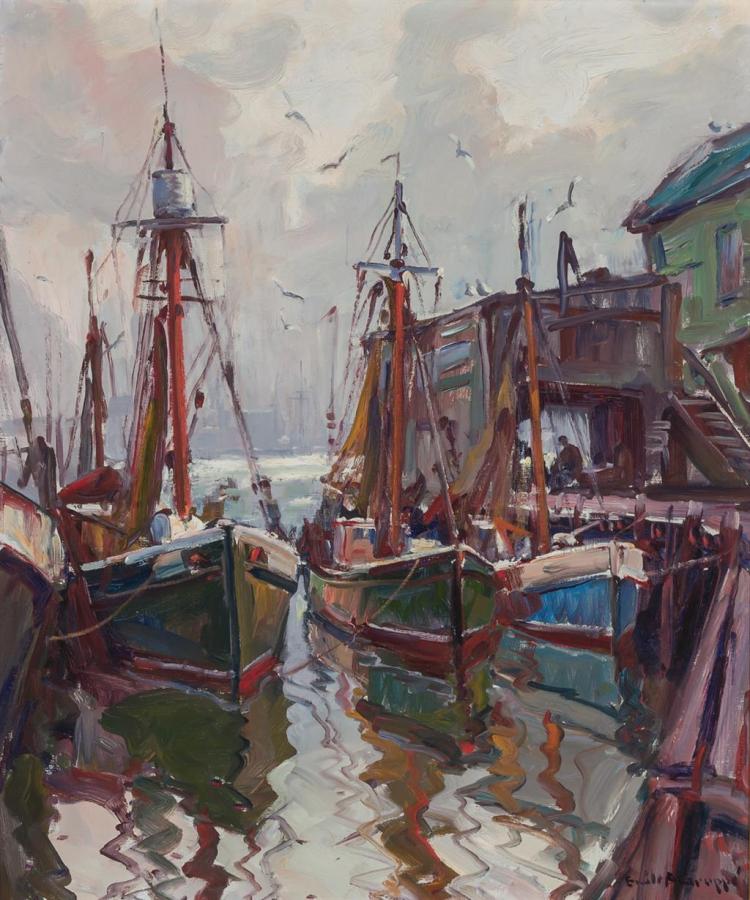
EMILE ALBERT GRUPPE, American (1896-1978) 
Italian Docks
Oil on canvas
25 x 30 inches
Private collection

Emile Albert Gruppé (1896–1978) was an American painter born in Rochester, New York to Helen and Charles P. Gruppé. He lived the early years of his life in the Netherlands as his father Charles Paul Gruppe, painted with the Hague school of art and acted as a dealer for the Dutch painters in the US. The family returned permanently to the states around 1913 when rumblings of World War I were brewing. All of Emile’s siblings established themselves in the arts.

Although Gruppe is best known for his variety of impressionistic landscapes, he also painted figures and portraits. His modern style was largely inherited from the French Impressionist Monet.

Gruppe's paintings are often seen in major auction galleries, such as Sotheby's, Christies, and Skinners. More on Emile Albert Gruppé

Kurt Craemer, German, 1912-1961 
Fish Carrier, c. 1947 
Signed Craemer and dated 47 (ll) 
Oil on burlap 
40 x 32 inches
Private collection

Kurt Craemer (born March 2, 1912 in Saarbrücken , † October 1, 1961 in the province of Salerno) was a German painter , designer and illustrator .

Craemer was from 1928 onwards at the Cologne Werkschule. His first trip to Italy was in 1932 where he found his affinity to the Latin-Italian world. When his teacher Paul Klee had to leave the academy in 1933, and a rude tone of communication and Nazi customs were introduced in the academy, Craemer went into exile. Craemer went to Ascona , Siena and Ischia and in 1934 he spent time in Positano. There were always short visits to Dusseldorf.

In 1938 he buried his father in Dusseldorf and returned immediately to Ischia. There he stayed in the artists' colony. In 1939 Craemer brought his mother to Italy and solved the last roots to his country of origin.

That year Kurt Craemer fell ill with polio , came to Naples, and was paralyzed to the hip after a long sickbed. The new beginning in late 1939, now sitting in a wheelchair in Florence. With his friend Karli, who was twenty years his senior, he moved into the boarding house of his sister Bandini in Piazza Santo Spirito. The escape from the war brought him back to Positano, his choice as permanent residence. There he maintained contacts with the resident German and American artists and writers.

In 1952 and 1958 Craemer took part in the Biennale di Venezia . His only German post-war exhibition, initiated in 1953 by Wolfgang Cordan , took place in the Düsseldorf gallery Hella Nebelung . In the spring of 1961 he had an exhibition in the United States.

He died in a car accident on the Cilento coast, on the way to the hospital.

Craemer's work, is an important chapter in the history of the art of the province of Salerno. In 2012, the city celebrated Positano with a centenary celebration of Kurt Craemer, an artist of love for Positano. who spent most of his life there. In the exhibition "Il Sud Antico di Kurt Craemer" thirty selected works of the entire period were donated in Positano, by nephew Craemers, Cristian Stegen, the province of Salerno. More on Kurt Craemer


Images are copyright of their respective owners, assignees or others

We do not sell art, art prints, framed posters or reproductions. Ads are shown only to compensate the hosting expenses.

If you enjoyed this post, please share with friends and family.

A note to the readers of Zaidan Gallery

      A note to the readers of Zaidan Gallery It is with great sadness that we share the news that the author of this blog,  Henry Zaidan (1...