Showing posts with label Thomas Buttersworth. Show all posts

05 Classic Works of Art, Marine Paintings - With Footnotes, #48

Thomas Buttersworth, Jr,  (1807-1842)
Chasing a Pirate Ship
Oil on canvas
15 x 20 in
Private collection

Thomas Buttersworth, Jr. (1807-1842), was named after his father, the well known marine painter Thomas Buttersworth Senior (1766-1841), who was to have a considerable influence on his son's painting career.

There exist few details about Thomas Junior's private life. What is known is that in the late 1830's he was living with his wife Gertude in Lambeth, and in early 1838 his daughter, also Gertrude, was born.

The family had moved to Greenwich by 1841, and this is where their son, also named Thomas, was born in March of that year. Thomas Buttersworth Junior died in Greenwich on November 25, 1842 at the very early age of thirty five. More on Thomas Buttersworth, Jr. 

Edward Moran, (American, 1829-1901)
Galleon at Sunset
Oil on canvas laid on board
20 x 36 inches (50.8 x 91.4 cm)
Private collection


Edward Moran (August 19, 1829 in Bolton, Lancashire, England – June 8, 1901 in New York City) was an American artist of maritime paintings. Moran was born in England on August 19, 1829. Following in the footsteps of his father's profession, he learned to operate a hand-loom at a young age, though he would often be found sketching with charcoal on the white fabric instead of plying the shuttle. His family first emigrated to Maryland in 1844, and then to Philadelphia a year later.

It was in Philadelphia around 1845 that Edward apprenticed under James Hamilton and landscape painter Paul Weber; Hamilton guided Moran specifically in the style of marine paintings. In the 1850s Moran began to make a name for himself in the Philadelphia artistic scene; working in the same studio as his younger brother, famous American painter Thomas Moran, Edward received commissions and even completed some lithographic work. In 1862, he traveled to London and became a pupil in the Royal Academy. 

In 1885, at the height of his career, Moran began on what would be considered his most important work - a series of 13 paintings representing the Marine History of the United States. He chose to have thirteen paintings in the series because of the significance of the number in American history (13 colonies, 13 stars and stripes on the original US flag, etc.). The subjects include Leif Ericsson, Christopher Columbus, Hernando de Soto, Henry Hudson, and Admiral Dewey, among others.[3] Not long after their completion, the series was displayed at the 1893 World's Fair in Chicago. More on Edward Moran

Alfred Thompson Bricher, (American, 1837-1908)
Sails at Sunset
Watercolor on paper laid on board
20 x 28 inches (50.8 x 71.1 cm)
Private collection


Alfred Thompson Bricher (April 10, 1837 – September 30, 1908) was a painter associated with White Mountain art and the Hudson River School. Bricher was born in Portsmouth, New Hampshire. He was educated in an academy at Newburyport, Massachusetts. He began his career as a businessman in Boston, Massachusetts. When not working, he studied at the Lowell Institute. He attained noteworthy skill in making landscape studies from nature, and after 1858 devoted himself to the art as a profession. He opened a studio in Boston, and met with some success there. In 1868 he moved to New York City. In 1873 he was chosen a member of the American Watercolor Society. In the 1870s, he primarily did maritime themed paintings, with attention to watercolor paintings of landscape, marine, and coastwise scenery. He often spent summers in Grand Manan, where he produced such notable works as Morning at Grand Manan (1878). In 1879, Bricher was elected into the National Academy of Design as an Associate member. More on Alfred Thompson Bricher

John Bellany, R.A., 1942-2013
BOATS IN HARBOUR, PORT SETON 
Oil on canvas
152.5 by 152.5cm., 60 by 60in.
Private collection

Cockenzie and Port Seton is a unified town in East Lothian, Scotland. It grew from what were initially two small fishing villages. The older parts of the town, between the two harbours, retain a more traditional feel and look, similar to many other small fishing villages on the east coast of Scotland. Although the fishing industry has declined in recent years the harbour at Port Seton still retains a small fleet of vessels, mainly fishing for prawns. More on Cockenzie and Port Seton

John Bellany CBE, RA (18 June 1942 – 28 August 2013) was born in Port Seton, a coastal town in East Lothian, Scotland. Born into a fishing family, both his father and paternal grandfather captained fishing boats.

Regarded as one of the most notable British artists of the 20th century, he was viewed as an outstanding student at Edinburgh College of Art from 1960 to 65, during this time gaining the Andrew Grant Scholarship in 1962, taking him to Paris. He went on to win the Burstain Award to attend the Royal College of Art in London in 1965.


He moved to London where he was the visiting Lecturer at the Royal College of Art. It was during this period that he separated from his first wife that his reputation for being a heavy drinker began. From 1978 until 1984, Bellany was Lecturer in Painting at Goldsmith College of Art. He remarried in 1978, but his second wife spent long periods of time in hospital suffering with schizophrenia which contributed to his increased bouts of heavy drinking, a “curse” that was to persist throughout his life.


In 1988 he survived a pioneering liver transplant. John Bellany died in 2013, he was found in his studio clutching his paintbrush. More on John Bellany


Elle Hanley, United States
Anchor yourself 
 Giclée print on natural white, matte cotton rag
24 H x 36 W x 0.1 in
Private collection

Elle Hanley is an american fine art photographer currently living and working in Seattle. her work is creative and varied focusing mainly on capturing beauty and emotion in a still shot of time.

She began photography two years ago as an artistic outlet and it grew into a full fledged devotion. She was drawn in particular to self portraiture for the control it gave over the image outcome and has since grown into a self portrait artist. Elle enjoys the challenges in creating something vintage and timeless from a thoroughly modern process and the contradiction between the two is a strong theme throughout her work.  More on Elle Hanley

Elle Hanley, United States
Anchor yourself 

Detail


Images are copyright of their respective owners, assignees or others

We do not sell art, art prints, framed posters or reproductions. Ads are shown only to compensate the hosting expenses.


If you enjoyed this post, please share with friends and family.


08 Classic Works of Art, Marine Paintings - With Footnotes, #46

Thomas Buttersworth, Jr, (1807-1842)
Chasing a Pirate Ship
Oil on canvas
15 x 20 in
Private collection

Thomas Buttersworth, Jr. (1807-1842), was named after his father, the well known marine painter Thomas Buttersworth Senior (1766-1841), who was to have a considerable influence on his son's painting career.

There exist few details about Thomas Junior's private life. What is known is that in the late 1830's he was living with his wife Gertude in Lambeth, and in early 1838 his daughter, also Gertrude, was born.

The family had moved to Greenwich by 1841, and this is where their son, also named Thomas, was born in March of that year. Thomas Buttersworth Junior died in Greenwich on November 25, 1842 at the very early age of thirty five. More on Thomas Buttersworth, Jr.

James R. Webb, (British, 1825-1895)
'Cadiz' 
Oil on canvas
61 x 92.1cm (24 x 36 1/4in).
Private collection

Cádiz is a city and port in southwestern Spain. It is the capital of the province of Cádiz, one of eight which make up the autonomous community of Andalusia. Cádiz, is the oldest continuously inhabited city in Spain and one of the oldest in western Europe, founded by the Phoenicians. Cádiz has been a principal home port of the Spanish Navy since the accession of the Spanish Bourbons in the 18th century. 

The older part of Cádiz within the remnants of the city walls is  characterized by the antiquity of its various quarters. The Old City's street plan consists of narrow winding alleys connecting large plazas. In addition, the city is dotted with numerous parks where exotic plants flourish, including giant trees supposedly brought to Spain by Columbus from the New World. More on Cádiz

James R Webb (1825–1895) was a British painter specialising in marine views and landscapes. He lived all his life in Chelsea, London. He exhibited in London at the Royal Academy and the British Institute between 1850 and 1888, and many of his works still hang in London in the collections of the Victoria and Albert Museum and the Tate Gallery. Other works are found in a large number of provincial galleries. Webb was a pupil of Clarkson Frederick Stanfield. His father Archibald Webb and his brother Byron Webb were also noted painters. More on James R Webb

William Dudley Brunett Ward Jr.
Maine Fishing Boats
oil on canvas
20 x 26 in
Private collection

RICHARD HAYLEY LEVER, American (1876-1958) 
Douarnenez, Brittany, circa 1908 
Oil on canvas
8 x 10 1/4 inches
Private collection

Douarnenez, is a commune in the Finistère department of Brittany in north-western France. It is located at the mouth of the Pouldavid River, an estuary on the southern shore of Douarnenez Bay in the Atlantic Ocean. It has fish canning facilities (sardines and mackerel) for which the town became famous.


The island of Tristan off Douarnenez can be reached by foot at low tide. It is linked to the legend of Tristan and Iseult from the times of King Arthur. More on Douarnenez

Richard Hayley Lever (28 September 1875 – 6 December 1958) was an Australian-American painter, etcher, lecturer and art teacher. He excelled in painting classes at Prince Alfred College under James Ashton and on leaving school continued to study under Ashton at his Norwood art school. He was a charter member of the Adelaide Easel Club in 1892.

Lever left to England in 1899 to further his career in painting. He moved to St. Ives, a fishing port and artistic colony on the Cornish coast. In St. Ives, Lever shared a studio with Frederick Waugh, and studied painting techniques under the Impressionists Olsson and Algernon Talmage. Lever also painted in the French port villages of Douarnenez and Concarneau, Brittany, directly across the English Channel from St. Ives.

RICHARD HAYLEY LEVER, American (1876-1958) 
Douarnenez Brittany
Oil on board
16 x 20 inches
Private collection

Lever arrived in New York City in 1912 and painted views of the Hudson River, Times Square and Central Park. Upon discovering the American east coast, he painted in Gloucester, MA for several summers and at Marblehead, MA. From 1919 to 1931, Lever taught art classes at the Art Students League of New York where he maintained a Gloucester studio and often traveled to paint on Nantucket and Martha's Vineyard. In 1924, Lever was commissioned to paint a portrait of the presidential yacht, Mayflower, which was subsequently presented to President Calvin Coolidge in the Cabinet Room of the White House. 

In later life, Lever was inflicted with arthritis in his right hand, which prevented him from further travel and forced him to concentrate on still-life subjects instead. As his arthritis advanced, he taught himself to paint with his left hand. However, following the death of his wife Aida in 1949, Lever was confined to his home, where he continued to paint from 1953 until his death. More on Richard Hayley Lever


Mo Dafeng, Chinese, b. 1957 
Vanish Twilight in Newport 
Oil on canvas 
20 x 30 inches
Private collection


Mo Dafeng, Chinese, b. 1957. His love of the American landscape, the fog-shrouded coast and all things romantic are informed and illuminated by his youth and education in China. Born in Shanghai the son of an art professor at the Art Academy of China, and educated at the People's Liberation Army Art Institute in Beijing, Mo was one of the few artists ever honored with shows at both the National Theater and the National Gallery in Beijing.

He only came to the U.S. in 1987. His boats and lighthouses and even trains appear out of a mist, like a vision taking shape. It gives his work a lyrical, haunting quality that was celebrated in exhibitions both here and in Asia. More on Mo Dafeng

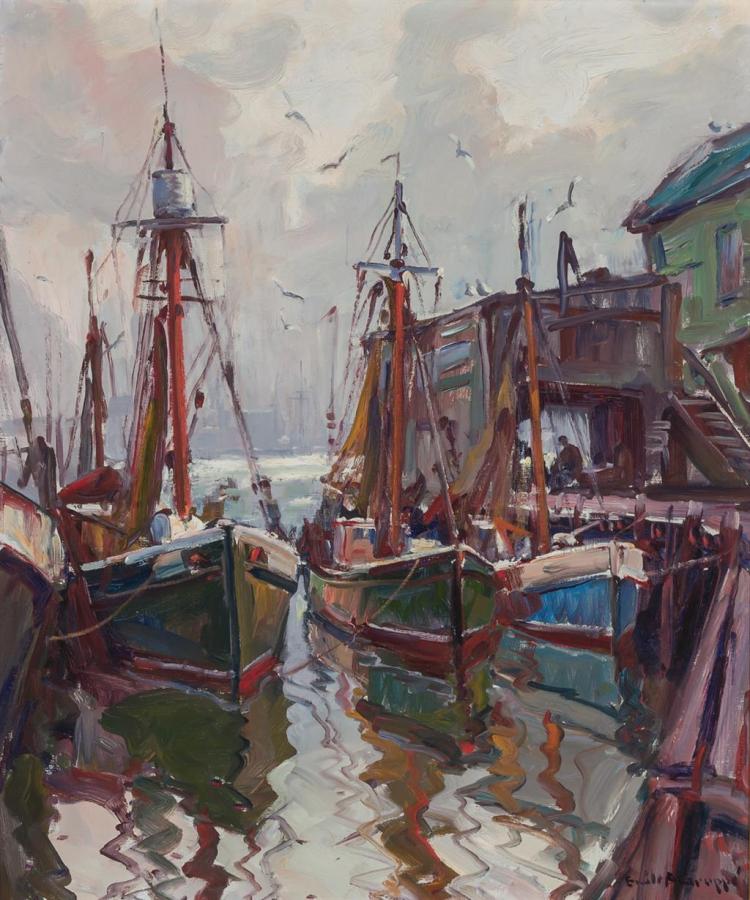
EMILE ALBERT GRUPPE, American (1896-1978) 
Italian Docks
Oil on canvas
25 x 30 inches
Private collection

Emile Albert Gruppé (1896–1978) was an American painter born in Rochester, New York to Helen and Charles P. Gruppé. He lived the early years of his life in the Netherlands as his father Charles Paul Gruppe, painted with the Hague school of art and acted as a dealer for the Dutch painters in the US. The family returned permanently to the states around 1913 when rumblings of World War I were brewing. All of Emile’s siblings established themselves in the arts.

Although Gruppe is best known for his variety of impressionistic landscapes, he also painted figures and portraits. His modern style was largely inherited from the French Impressionist Monet.

Gruppe's paintings are often seen in major auction galleries, such as Sotheby's, Christies, and Skinners. More on Emile Albert Gruppé

Kurt Craemer, German, 1912-1961 
Fish Carrier, c. 1947 
Signed Craemer and dated 47 (ll) 
Oil on burlap 
40 x 32 inches
Private collection

Kurt Craemer (born March 2, 1912 in Saarbrücken , † October 1, 1961 in the province of Salerno) was a German painter , designer and illustrator .

Craemer was from 1928 onwards at the Cologne Werkschule. His first trip to Italy was in 1932 where he found his affinity to the Latin-Italian world. When his teacher Paul Klee had to leave the academy in 1933, and a rude tone of communication and Nazi customs were introduced in the academy, Craemer went into exile. Craemer went to Ascona , Siena and Ischia and in 1934 he spent time in Positano. There were always short visits to Dusseldorf.

In 1938 he buried his father in Dusseldorf and returned immediately to Ischia. There he stayed in the artists' colony. In 1939 Craemer brought his mother to Italy and solved the last roots to his country of origin.

That year Kurt Craemer fell ill with polio , came to Naples, and was paralyzed to the hip after a long sickbed. The new beginning in late 1939, now sitting in a wheelchair in Florence. With his friend Karli, who was twenty years his senior, he moved into the boarding house of his sister Bandini in Piazza Santo Spirito. The escape from the war brought him back to Positano, his choice as permanent residence. There he maintained contacts with the resident German and American artists and writers.

In 1952 and 1958 Craemer took part in the Biennale di Venezia . His only German post-war exhibition, initiated in 1953 by Wolfgang Cordan , took place in the Düsseldorf gallery Hella Nebelung . In the spring of 1961 he had an exhibition in the United States.

He died in a car accident on the Cilento coast, on the way to the hospital.

Craemer's work, is an important chapter in the history of the art of the province of Salerno. In 2012, the city celebrated Positano with a centenary celebration of Kurt Craemer, an artist of love for Positano. who spent most of his life there. In the exhibition "Il Sud Antico di Kurt Craemer" thirty selected works of the entire period were donated in Positano, by nephew Craemers, Cristian Stegen, the province of Salerno. More on Kurt Craemer


Images are copyright of their respective owners, assignees or others

We do not sell art, art prints, framed posters or reproductions. Ads are shown only to compensate the hosting expenses.

If you enjoyed this post, please share with friends and family.

11 Classic Works of Art, Marine Paintings - With Footnotes, #43

Montague Dawson, RMSA, FRSA (1890–1973)
Heave To - A Baltimore Clipper in Action with a Coasting Slaver
oil on canvas
28 x 42 in. (71.1 x 106.7 cm.)
Private collection

Baltimore Clipper is the colloquial name for fast sailing ships built on the mid-Atlantic seaboard of the United States of America, especially at the port of Baltimore, Maryland. The name is most commonly applied to two-masted schooners and brigantines. More on Baltimore Clipper

The coastwise slave trade referred to the domestic slave trade in the United States that shipped slaves by water from the Upper South to major markets, especially New Orleans.

Montague Dawson RMSA, FRSA (1890–1973) was a British painter who was renowned as a maritime artist. His most famous paintings depict sailing ships, usually clippers or warships of the 18th and 19th centuries. Montague was the son of a keen yachtsman and the grandson of the marine painter Henry Dawson (18111878), born in Chiswick, London. Much of his childhood was spent on Southampton Water where he was able to indulge his interest in the study of ships. For a brief period around 1910 Dawson worked for a commercial art studio in Bedford Row, London, but with the outbreak of the First World War he joined the Royal Navy. Whilst serving with the Navy in Falmouth he met Charles Napier Hemy (18411917), who considerably influenced his work. In 1924 Dawson was the official artist for an Expedition to the South Seas by the steam yacht St.George. During the expedition he provided illustrated reports to the Graphic magazine.

After the War, Dawson established himself as a professional marine artist, concentrating on historical subjects and portraits of deep-water sailing ships. During the Second World War, he was employed as a war artist. Dawson exhibited regularly at the Royal Society of Marine Artists, of which he became a member, from 1946 to 1964, and occasionally at the Royal Academy between 1917 and 1936. By the 1930s he was considered one of the greatest living marine artists, whose patrons included two American Presidents, Dwight D Eisenhower and Lyndon B Johnson, as well as the British Royal Family. Also in the 1930s, he moved to Milford-Upon-Sea in Hampshire, living there for many years. Dawson is noted for the strict accuracy in the nautical detail of his paintings which often sell for six figures.

The work of Montague Dawson is represented in the National Maritime Museum, Greenwich and the Royal Naval Museum, Portsmouth. More on Montague Dawson

Thomas Bush Hardy, 1842 - 1897
Sailing ships at sea
Oil on canvas
51 x 76 cm
Private collection

Thomas Bush Hardy (1842, Sheffield – 1897, Maida Vale, London) was a British marine painter and watercolourist. As a young man he travelled in the Netherlands and Italy. In 1884 Hardy was elected a Member of the Royal Society of British Artists. He exhibited with the Society and also at the Royal Academy.
His paintings feature coastal scenes in England and the Netherlands, the French Channel ports and the Venetian Lagoon.
Hardy had nine children. His son Dudley Hardy was a painter, illustrator and poster designer. His daughter Dorothy received an MBE after working as a nurse in the First World War. He died on 15 December 1897 in Maida Vale, London. More on Thomas Bush Hardy

Thomas Buttersworth, (5 May 1768 – November 1842)
Mersey River Scene With Lighthouse
oil on canvas
17" x 21"
Private collection

The River Mersey is a river in the North West of England. Its name is derived from the Anglo-Saxon language and translates as "boundary river". The river may have been the border between the ancient kingdoms of Mercia and Northumbria and for centuries it formed part of the boundary between the historic counties of Lancashire and Cheshire. More on The River Mersey

Thomas Buttersworth (5 May 1768 – November 1842) was an English seaman of the Napoleonic wars period who became a marine painter. He produced works to commission, and was little exhibited during his lifetime.

Butterworth was born on the Isle of Wight. He enlisted in the Royal Navy in London in 1795, and served on HMS Caroline during the wars with France, before being invalided home from Minorca in 1800.

The National Maritime Museum in London has 27 watercolours by him, several of which are mounted on sheets from 18th century printed signal and muster books. He went on to paint numerous naval battle scenes and pictures such as the ‘'Inshore Squadron off Cadiz in 1797'’ which are thought to show scenes he witnessed. On being appointed Marine Painter to the East India Company he painted ship portraits on commission. It had been thought that he died in 1830, but recent research has found that he painted Queen Victoria’s visit to Edinburgh in 1842 before he died in London later that yearMore Thomas Buttersworth 

Lyonel Charles Feininger, (July 17, 1871 – January 13, 1956) 
Harbor with Lighthouse
watercolor and pen
9 1/2 x 14 in (24.1 x 35.6 cm)
Private collection

Lyonel Charles Feininger (July 17, 1871 – January 13, 1956) was a German-American painter, and a leading exponent of Expressionism. He also worked as a caricaturist and comic strip artist. He was born and grew up in New York City, traveling to Germany at 16 to study and perfect his art. He started his career as a cartoonist in 1894 and met with much success in this area. He was also a commercial caricaturist for 20 years for magazines and newspapers in the USA and Germany. At the age of 36, he started to work as a fine artist. He also produced a large body of photographic works between 1928 and the mid 1950s, but he kept these primarily within his circle of friends. He was also a pianist and composer, with several piano compositions and fugues for organ extant. More on Lyonel Charles Feininger

Arthur Melville, A.R.S.A., R.S.W. A.R.S., 1858-1904
A SPANISH FISHING VILLAGE, THE HARBOUR AT PUERTA DE PASAJES
Watercolour
51 by 61cm., 20 by 24in.
Private collection

Melville loved the glimmering white sunlight of Spain, refracted from water, white-washed walls and red-tiled roofs. He visited Spain throughout his career, Melville returned to Spain several times and the present watercolour was made in 1897 and exhibited the following year at the Royal Institute of Painters in Watercolour. Melville painted at least five oils at Pasajes and several beautiful watercolours. In the 1890s Melville was at the peak of his artistic talent and a master of watercolour painting, adopting a wonderfully energetic use of the medium which is almost Impressionistic in its description of forms and mood. More on this painting

Arthur Melville (1858–1904) was a Scottish painter, best remembered for his Orientalist subjects. He was born in Guthrie, Angus in 1858 and brought up in East Lothian. He attended the Royal Scottish Academy Schools before studying in Paris and Greece. The colour-sense which is so notable a feature of his work developed during his travels in Persia, Egypt and Turkey between 1880 and 1882. To convey strong Middle Eastern light, he developed a technique of using watercolour on a base of wet paper with gouache applied to it.

Melville, little known during his lifetime, was one of the most powerful influences in the contemporary art of his day, especially in his broad decorative treatment with water-colour, which influenced the Glasgow Boys. Though his vivid impressions of color and movement are apparently recorded with feverish haste, they are the result of careful deliberation and selection. He was at his best in his watercolors of Eastern life and colour and his Venetian scenes, but he also painted several striking portraits in oils. More on Arthur Melville

William Lees Judson, (1842 - 1928 Los Angeles, CA)
''Old San Pedro'', boats in a harbor with figures
Oil on canvas
24'' H x 30'' W 
Private collection


Historic Downtown San Pedro, California, has been home to the United States Navy since the Mexican War. On August 6, 1846, Commodore Robert F. Stockton, on the frigate Congress, put ashore the ship's Marines and they captured San Pedro. On August 11, a group of sailors and Marines marched from San Pedro and captured Los Angeles. In 1914, the US Navy placed the first US Submarines on the West Coast at San Pedro and developed a base in San Pedro. In 1919, President Wilson transfered 200 warships to the West Coast. On August 9, 1919, the ships moved north to what would become the new battleship anchorage, The new anchorage was San Pedro, the Port of Los Angeles Harbor, and the Port of Long Beach in San Pedro Bay, California. More on San Pedro


William Lees Judson was born in 1842 in Manchester, England, and moved to the United States with his parents when he was ten years old. After serving four years with the Illinois volunteers during the American Civil War, Judson studied art in New York and Paris. He settled in London, Ontario, where he became a successful portrait painter and art teacher.[He moved to Chicago in 1890 but, suffering from failing health, he moved to Los Angeles in 1893. He settled on the banks of the Arroyo Seco in the Garvanza section of Los Angeles and became part of an influential scene of artists in the Arroyo. Soon after his arrival, Judson was at the forefront of the Arroyo Guild of Craftsmen, a group of artists, sculptors and architects who fueled Southern California’s Arts and Crafts Movement. The beauty of the area stirred Judson to switch from portrait painting to landscapes, and his work attracted such favorable attention that in 1896 he was offered a professorship in drawing and painting at the University of Southern California. In the late 1890s, he founded the Los Angeles College of Fine Arts at his home in Garvanza. He died at his home in the studio building in October 1928. More on William Lees Judson 

Attributed to Edward William Cooke
Fishing and coastal vista looking towards a volcano, possibly Stromboli
Oil on canvas
26x36cm
Private collection

Stromboli is a small island off the north coast of Sicily, containing one of the three active volcanoes in Italy. This name is derived from the Ancient Greek name Strongulē which was given to it because of its round swelling form. The volcano has erupted many times and is constantly active with minor eruptions, often visible from many points on the island and from the surrounding sea, giving rise to the island's nickname "Lighthouse of the Mediterranean". More on Stromboli

Edward William Cooke, R.A., F.R.S., F.Z.S., F.S.A., F.G.S. (27 March 1811 – 4 January 1880) was an English landscape and marine painter, and gardener. Cooke was born in Pentonville, London. He was raised in the company of artists. He was a precocious draughtsman and a skilled engraver from an early age, displayed an equal preference for marine subjects and published his "Shipping and Craft" a series of accomplished engravings when he was 18, in 1829. Cooke began painting in oils in 1833, and first exhibited at the Royal Academy and British Institution in 1835, by which time his style was essentially formed.


He went on to travel and paint with great industry at home and abroad, indulging his love of the 17th-century Dutch marine artists with a visit to the Netherlands in 1837. He returned regularly over the next 23 years, studying the effects of the coastal landscape and light, as well as the works of the country's Old Masters, resulting in highly successful paintings. He went on to travel in Scandinavia, Spain, North Africa and, above all, to Venice. In 1858, he was elected into the National Academy of Design as an Honorary Academician. . More Edward William Cooke

Edward Atkinson Hornel, 1864-1933
CHILDREN FISHING, c. 1893
Oil on canvas
26 by 30.5cm., 10 by 12in.
Private collection

Edward Atkinson Hornel (1864–1933) was a Scottish painter of landscapes, flowers, and foliage, with children. He was born in Australia, of Scottish parents, but was brought up and lived practically all his life in Scotland. He studied for three years at the art school at Edinburgh, and for two years at Antwerp . Returning from Antwerp in 1885, he met George Henry and associated himself with the Glasgow Boys.

Hornel and Henry worked side by side to achieve decorative splendor of color, Hornel boldly and freely employing texture effects produced by loading and scraping, roughening, smoothing, and staining. In 1893–94 the two artists spent a year and a half in Japan, where Hornel learned much about decorative design and spacing. Towards the close of the nineties his colors, while preserving their glow and richness, became more refined and more atmospheric, and his drawing more naturalistic. In 1901 he declined election to the Royal Scottish Academy. A member of Glasgow Art Club, Hornel exhibited in the club's annual exhibitions. More on Edward Atkinson Hornel

Robert Gemmell Hutchison, R.S.A., R.S.W., 1855-1936
A BASKET OF HERRING
Oil on canvas
76 by 63.5 cm., 30 by 25in.
Private collection

Robert Gemmell Hutchison RSA RSW (1855–1936) was a Scottish landscape artist, specialising in coastal scenes. He belongs to the school of British Impressionism.

He was born in Edinburgh on 1 July 1855. He was educated in Edinburgh. After first training as a seal-engraver he was encouraged to pursue oil painting.. He set up his own studio in 1878 and was instantly successful, exhibiting at the Royal Scottish Academy in 1879 and at the Royal Academy in 1881. He shifted quickly from empty seascapes, largely of the Fife coast, to genre paintings, usually of young girls sitting on the coast.


He was elected an associate of the Royal Scottish Academy in 1903 and a full member in 1911. He was also elected to the Royal Society of British Artists, the Royal Institute of Oil Painters and the Royal Scottish Society of Painters in Watercolour. In later life he lived at 14 Craighall Terrace in Musselburgh, east of Edinburgh. He returned to Edinburgh in 1912. In the 1930s he spent time with his daughter at her home in Coldingham, painting at St. Abbs. He died at his daughter’s house on 22 August 1936. More on Robert Gemmell Hutchison

George Gardner Symons, (1863 - 1930 Laguna Beach, CA)

Panoramic coastal seascape

Oil on canvas laid to canvas

10'' H x 20'' W
Private collection

George Gardner Symons (1861-1930) was an American impressionist painter. He was born in either 1861 or 1863 in Chicago, Illinois. Attending the School of the Art Institute of Chicago, Symons also studied in Europe and won awards at the National Academy of Design and the Corcoran Gallery of Art. Symons was one of the plein-air painters who built their studios in Laguna Beach, California during the early 1900s. He died in Hillside, New Jersey in 1930. More on George Gardner Symons 

Peter Ellenshaw (1913 - 2007 Santa Barbara, CA)

Rocky coastal, c. 1963

Oil on canvas

25'' H x 50.5'' W
Private collection

William Samuel Cook "Peter" Ellenshaw (May 24, 1913 – February 12, 2007) was an English matte designer and special effects creator who worked on many Disney features. Born in London, he moved to America in 1953.

His first worked in matte painting for producer Alexander Korda on such films as Things to Come (1936), and later on such Powell and Pressburger productions as Black Narcissus (1947) assisting his mentor W. (Walter) Percy Day. A few years later, while still based in Europe, he began to work for Hollywood studios. He worked for MGM on Quo Vadis (1951), but his most extensive association was with Walt Disney Studios beginning with their first completely live action feature film, Treasure Island (1950). He went on to work on 20,000 Leagues Under the Sea (1954) and Mary Poppins (1964), for which he won an Academy Award. He retired after his work on The Black Hole (1979), but contributed matte paintings for Dick Tracy (1990). 

After Peter Ellenshaw retired from the film business, he dedicated his life to his passion for painting. Numerous works were created, of both Disney and non-Disney themed subjects, which have been highly collected. He was named a Disney Legend in 1993. More on Peter Ellenshaw


Images are copyright of their respective owners, assignees or others

We do not sell art, art prints, framed posters or reproductions. Ads are shown only to compensate the hosting expenses.

If you enjoyed this post, please share with friends and family.

15 Classic Works of Art, Marine Paintings by Fabienne Delacroix, Joaquin Sorolla, Charles Rosner, Charles Rosner, Louis Papaluca, Tomaso De Simone, Thomas Buttersworth, Johan-Barthold Jongkind Montague Dawson, Raymond A. Massey and James Edward Buttersworth, - With Footnotes, #35

Leslie Arthur Wilcox, British, 1904-1982 
The USS 'United States' Engaging the HMS 'Macedonian' , c. 1977
Oil on canvas 
24 x 36 inches
Private collection

The battle between these two frigates was fought near Madeira on October 25, 1812, the 'United States' being commanded by Steven Decater. After a long, bloody battle, the 'United States' captured the 'Macedonian' and escorted her to Newport, the first British warship ever brought into an American harbor. The British frigate was later recommissoned by the US Navy as the USS 'Macedonian' and remained in service until 1836. More on this painting

Leslie Arthur Wilcox, RI, RSMA (13 March 1904 – 11 January 1982) was an eminent British artist known mainly as a marine artist working in oils. He was also a watercolourist, illustrator, poster artist, marine model-maker and author. He was for some years Honorary Secretary of the Royal Society of Marine Artists and a member of the Royal Institute of Painters in Water Colours. His works are in many collections around the world, including the National Maritime Museum, Greenwich, and the Royal Collection. He wrote and illustrated two books on maritime history: Mr Pepys' Navy (1966 G. Bell & Sons Ltd., London) and Anson's Voyage (1969 G. Bell & Sons, Ltd., London). More on Leslie Arthur Wilcox


Montague Dawson RMSA, FRSA (1890–1973) 
The Torrens in California Waters
oil on canvas
28 × 42 in
Private collection

Torrens (1875 – 1910) was a clipper ship designed to carry passengers and cargo between London and Port Adelaide, South Australia. She was the fastest ship to sail on that route

It is likely that the vessel was named in honour of Colonel Robert Torrens, a principal exponent of the economic benefits of nineteenth-century colonial trade. 

The Torrens was aimed at the upper end of the market – accommodation was first and second class passengers only. Apart from the crew, she carried "a surgeon, a stewardess and a good cow"

She lost her foremast and main topmast in 1891, and while being refitting in Pernambuco a fire broke out on board. On the evening of 11 January 1899 she struck an iceberg some 40 km south west of the Crozet Islands and limped into Adelaide dismasted, with her bow stoved in. In 1906 the Torrens was sold for £1,500 (she cost £27,257 to build) to an Italian shipping line, but after running her ashore, she was sent to the shipbreakers. They were however so taken by her aesthetic appearance that they refused to break her up, and repaired her instead. But it was not long before she again ran aground. She was finally broken up at Genoa in 1910. More on the Torrens 

Montague Dawson RMSA, FRSA (1890–1973) was a British painter who was renowned as a maritime artist. His most famous paintings depict sailing ships, usually clippers or warships of the 18th and 19th centuries. Montague was the son of a keen yachtsman and the grandson of the marine painter Henry Dawson (18111878), born in Chiswick, London. Much of his childhood was spent on Southampton Water where he was able to indulge his interest in the study of ships. For a brief period around 1910 Dawson worked for a commercial art studio in Bedford Row, London, but with the outbreak of the First World War he joined the Royal Navy. Whilst serving with the Navy in Falmouth he met Charles Napier Hemy (18411917), who considerably influenced his work. In 1924 Dawson was the official artist for an Expedition to the South Seas by the steam yacht St.George. During the expedition he provided illustrated reports to the Graphic magazine.

After the War, Dawson established himself as a professional marine artist, concentrating on historical subjects and portraits of deep-water sailing ships. During the Second World War, he was employed as a war artist. Dawson exhibited regularly at the Royal Society of Marine Artists, of which he became a member, from 1946 to 1964, and occasionally at the Royal Academy between 1917 and 1936. By the 1930s he was considered one of the greatest living marine artists, whose patrons included two American Presidents, Dwight D Eisenhower and Lyndon B Johnson, as well as the British Royal Family. Also in the 1930s, he moved to Milford-Upon-Sea in Hampshire, living there for many years. Dawson is noted for the strict accuracy in the nautical detail of his paintings which often sell for six figures.

The work of Montague Dawson is represented in the National Maritime Museum, Greenwich and the Royal Naval Museum, Portsmouth. More on Montague Dawson


James E. Buttersworth, 1817 to 1894.
The Clipper Ship "Flying Cloud" off the Needles, Isle of Wight, 1859-1860.
Oil on canvas
Private collection

The Needles is a row of three distinctive stacks of chalk that rise about 30m out of the sea off the western extremity of the Isle of Wight, United Kingdom, close to Alum Bay, and part of Totland, the westernmost Civil Parish of the Isle of Wight. The Needles Lighthouse stands at the outer, western end of the formation. Built in 1859, it has been automated since 1994.

The formation takes its name from a fourth needle-shaped pillar called Lot's Wife, that collapsed in a storm in 1764. The remaining rocks are not at all needle-like, but the name has stuck. More on The Needles

The Flying Cloud of 1851 was the most famous of the extreme clippers built by Donald McKay in East Boston, Massachusetts. The Flying Cloud was purchased at launching by Grinnell, Minturn & Co., of New York, for $90,000, which represented a huge profit for Train & Co. Within six weeks she sailed from New York and made San Francisco 'round Cape Horn in 89 days, 21 hours under the command of Captain Josiah Perkins Creesy. In the early days of the California Gold Rush, it took more than 200 days for a ship to travel from New York to San Francisco.. On the 31st of July, during the trip, she made 374 miles in 24 hours. In 1853 she beat her own record by 13 hours, a world beating record that stood for 136 years, until 1989 when the breakthrough-designed sailboat Thursday's Child completed the passage in 80 days, 20 hours.

James Edward Buttersworth (British/American, 1817-1894)
The American clipper ship Flying Cloud, c. 1854
Oil on canvas
20 x 30 in
Private collection

The American clipper ship Flying Cloud, Scudding in a Gale of Wind off Cape Horn
on her record-breaking voyage to San Francisco around Cape Horn in 89 days, April 20th 1854.

Apparently, Flying Cloud and her record breaking passage between New York and San Francisco was one of James E. Buttersworth's favorite clipper ship subjects. In addition to this one, and the one sold at these sale rooms last year [Bonhams, Important Maritime Paintings & Decorative Arts, January 2013, Sale 20482, Lot 113] (below), the one listed in the Grassby book, Ship, Sea & Sky, and another one listed in the Schaefer (further down) book makes four paintings, all the same size and period, circa 1854. More on this painting

Cape Horn, named after the city of Hoorn in the Netherlands, is the southernmost headland of the Tierra del Fuego archipelago of southern Chile, and is located on the small Hornos Island. Although not the most southerly point of South America, Cape Horn marks the northern boundary of the Drake Passage and marks where the Atlantic and Pacific Oceans meet.

For decades, Cape Horn was a major milestone on the clipper route, by which sailing ships carried trade around the world. The waters around Cape Horn are particularly hazardous, owing to strong winds, large waves, strong currents and icebergs; these dangers have made it notorious as a sailors' graveyard.

The need for ships to round Cape Horn was greatly reduced by the opening of the Panama Canal in 1914. More on Cape Horn

James Edward Buttersworth (British/American, 1817-1894)
The clipper ship Flying Cloud coming out of a hurricane, circa 1855
Oil on canvas
20 x 30 in. (50.8 x 76.2 cm.)
Private collection

The Flying Cloud's achievement was remarkable under any terms. But, was all the more unusual because her navigator was a woman, Eleanor Creesy. She was one of the first navigators to exploit the insights of Matthew Fontaine Maury, most notably the course recommended in his Sailing Directions. With her husband, ship captain Josiah Perkins Creesy More on Flying Cloud

James Edward Buttersworth (British/American, 1817-1894)
The Clipper "Flying Cloud" off Cape Horn, circa 1855
Oil on board 
Height: 50.8 cm (20 in.), Width: 76.2 cm (30 in.) 
Private collection

Cape Horn, see above

James E. Buttersworth, 1817 to 1894, see below

Raymond A. Massey 
Flying Cloud Entering Hong Kong 1851
Print, Edition: 250
26 1/2" x 21"
Private collection

Victoria Harbour is a natural landform harbour situated between Hong Kong Island and Kowloon in Hong Kong. The harbour's deep, sheltered waters and strategic location on the South China Sea were instrumental in Hong Kong's establishment as a British colony and its subsequent development as a trading centre. More on Victoria Harbour

Born in Newscastle-on-Tyne, England, Raymond A. Massey is a self-taught artist who came to the United States when he was 10 and made his home in Buffalo, New York since the age of 14. A member of the Nautical Research Guild, he was elected an artist member of the American Society of Marine Artists, which was established in 1978 to encourage the preservation and appreciation of maritime history through art. 

Massey’s works have appeared in numerous art shows and galleries from coast-to-coast in the United Stares, and Canada. 

He is also published a number of books, and once wrote about historic Buffalo for the Buffalo Courier Express and illustrated historic Buffalo features in that newspaper. More on Raymond A. Massey 


Johan-Barthold Jongkind, 1819-1891. Paris.
Dutch landscape with a caulking barge, c. 1857.
Louvre

Johan Barthold Jongkind (3 June 1819 – 9 February 1891) was a Dutch painter and printmaker. He painted marine landscapes in a free manner and is regarded as a forerunner of Impressionism. Jongkind was born in the Netherlands. Trained at the art academy in The Hague, in 1846 he moved to Montparnasse in Paris, France where he studied under Eugène Isabey and François-Édouard Picot. Two years later, the Paris Salon accepted his work for its exhibition, and he received acclaim from critic Charles Baudelaire and later on from Émile Zola. He was to experience little success, however, and he suffered bouts of depression complicated by alcoholism.

Jongkind returned to live in Rotterdam in 1855, and remained there until 1860. Back in Paris, in 1861 he rented a studio on the rue de Chevreuse in Montparnasse where some of his paintings began to show glimpses of the Impressionist style to come. In 1862 he met in Normandy, in the famous ferme Saint-Siméon in Honfleur, with some of his artist friends, such as Alfred Sisley, Eugène Boudin, and the young Claude Monet, to all of whom Jongkind served as a mentor. Monet later referred to him as "...a quiet man with such a talent that is beyond words" and credited the "definitive education" of his own eye to Jongkind. In 1863 Jongkind exhibited at the first Salon des Refusés. He was invited to participate in the first exhibition of the Impressionist group in 1874, but he declined. He died in 1891 in Saint-Égrève. More


Thomas Buttersworth, Jr. (1807-1842), British
Yachting off Torquay
Oil on canvas
12 x 16 in
Private collection


Torquay  is a seaside town in Devon, England, part of the unitary authority area of Torbay. The town's economy was initially based upon fishing and agriculture, but in the early 19th century it began to develop into a fashionable seaside resort, initially frequented by members of the Royal Navy during the Napoleonic Wars while the Royal Navy anchored in the bay. Later, as the town's fame spread, it was popular with Victorian society. Renowned for its healthful climate, the town earned the nickname the English Riviera.

The writer Agatha Christie was born in the town and lived there during her early years and there is an "Agatha Christie Mile", a tour with plaques dedicated to her life and work. More on Torquay


Thomas Buttersworth, Jr. (1807-1842), was named after his father, the well known marine painter Thomas Buttersworth Senior (1766-1841), who was to have a considerable influence on his son's painting career.

There exist few details about Thomas Junior's private life. What is known is that in the late 1830's he was living with his wife Gertude in Lambeth, and in early 1838 his daughter, also Gertrude, was born.

The family had moved to Greenwich by 1841, and this is where their son, also named Thomas, was born in March of that year. Thomas Buttersworth Junior died in Greenwich on November 25, 1842 at the very early age of thirty five. More on Thomas Buttersworth, Jr.


C. HJALMAR (CAPPY) AMUNDSEN (American, Long Island, 1911-2010)
Dock scene
Oil on canvas
20''h, 26''w
Private collection


J.J. Enwright (pseudonym for Hjalmar "Cappy" Amundsen) was born Caspar Hjalmar Emerson III in  New York City in 1911, and in 1946 legally changed his name to Hjalmar Amundsen in honor of his great-uncle, explorer Roald Amundsen, who located the magnetic center of the South Pole the year his great-nephew was born. 

He was in his early twenties when he first began painting.  Amundsen loved the sea, and had a lifelong interest in sailing and fishing.  While growing up, Hjalmar and his father would drive to the East End of Long Island, and he'd go out in a fishing boat.  Later he bought a small boat and went out sailing and fishing as often as he could.  

As an adult, the young artist moved back to New York and spent time painting in and around Gloucester and Provincetown, Massachusetts.  In his early career, he is believed to have created up to 275 paintings a year over a period of six years under the name of Enwright, and it is now believed that J.J. Enwright and Hjalmar Amundsen is one and the same artist. 

In 1946 he moved to Sag Harbor, Long Island, New York. He opened a studio and lived in the same building, becoming a well-liked figure in the community.  He painted waterfront images, sailing ships, fishing boats, and the New England coastline. 

Cappy lived a bohemian lifestyle, making a living with his painting, but by the 1980s  times had become tough, and it was through the initiative of friends and the community that his house was restored.  He died in Brookhaven Memorial Hospital on January 18, 2001. More on  "Cappy" Amundsen


19th Century British school
Upper reaches of the River Thames, c. 1913
Oil on canvas
14ins x 18ins

19th Century British school - Oil painting - Upper reaches of the River Thames with a lighter to foreground and barges and masted vessels.


The River Thames is a river that flows through southern England, most notably through London. At 215 miles (346 km), it is the longest river entirely in England and the second longest in the United Kingdom. The lower reaches of the river are called the Tideway, derived from its long tidal reach up to Teddington Lock. It rises at Thames Head in Gloucestershire, and flows into the North Sea via the Thames Estuary. The Thames drains the whole of Greater London. More on The River Thames 

English school, dominant school of painting in England throughout the second half of the 18th century and the first half of the 19th. Its establishment marked the rise of a national tradition that began with the emergence of native artists whose works were no longer provincial but rivaled continental art in quality and ended by exercising considerable influence on the course of European painting. More on English school

Tomaso De Simone (Italian, c.1805-1888)
American ship in harbor, c. 1875
For ''Lewis L. Squire'', 
Gouache
18-1/2''h, 26-1/4''w. (Fine Art)
Private collection

Tomaso De Simone (c.1805-1888) was a Neapolitan port painter; and is considered to be one of the most important ship portraitists who practiced in the Italian seaport cities. The father of noted sea painter Antonio de Simone, Tomaso specialized in oils, the majority depicting warships and merchant vessels.

The architectural properties of Tomaso de Simone's paintings are exceptional. His hull shapes have fullness and flexibility, his rigging shows a wealth of detail. His portrait of the American continental navy frigate constellation was proven so accurate that it was used as a guide for restoration of the ship, still afloat today in Baltimore. 

Although not as prolific as his son, the works of Tomaso de Simone are arguably more important. In recent years, their value has increased dramatically as they become more rare and sought after by important museums and private collectors world wide. More on Tomaso De Simone

Louis Papaluca (Italian, 1890-1934)
M.Y. Happy Days, N.Y.Y.C. In Memory of First Voyage 1928
Watercolor
16ins x 27.5ins
Private collection

"M.Y. Happy Days, N.Y.Y.C. In Memory of First Voyage 1928"" - is a study of The New York Yacht Clubs steam yacht Happy Days in the Bay of Naples with Vesuvius to background.

Luigi Papaluca was the son of prolific marine artist Luca Papaluca (1890-1934), with whom his work is often confused. Both father and son were from Naples, Italy, and painted portraits of both historic and contemporary ships, but the father generally worked in gouache, while Luigi painted in oils. Luigi apparently emigrated to the U.S., producing work up until at least the 1960s. More on Luigi Papaluca

Charles Rosner (Italian, 1890-1934)
Beryl R.Y.S.
Gouache
23 x 15 in.
Private collection


Charles Rosner (American, Long Island, 1894-1975)
Clipper Ship Golden Eagle
Oil on canvas
24''h, 30''w.
Private collection

The U.S. Golden Eagle was an extreme clipper, built at Medford, Massachusetts, and launched on November 9, 1852. She weighed 1121 tons, had a length of 192 feet, a beam of 36 feet, a 22-foot depth of hold, a gilded eagle on the wing figurehead. 

She made a total of eight voyages from the East Coast around the Horn to San Francisco, the first out of Boston, the others out of New York. On the homeward leg of the last of these voyages, she sailed from San Francisco for Howland`s Island, where she loaded a cargo of guano, and from which she sailed about November 20, 1862, bound for Cork, for orders. On February 21, 1863 she was attacked and burned by the Confederate commerce raider CSS Alabama. Her owners, E. M. Robinson, of New Bedford, and John A. McGaw, of New York, claimed, and were allowed, insurance in the amount of $56,000 for the vessel, $30,000 for freight, and $27,522 for cargo. More on the Golden Eagle

Charles Rosner (German-American, 1894-1975) developed a fascination for sailing vessels while a child on holiday in various German seaports. He also served aboard them, accumulating five Cape Horn passages during his ocean career. After WW I he emigrated to Canada and thence to America, where his affinity for the sea propelled him into a commitment as a full-time marine painter of historic sailing vessels and other sea-faring subjects. More on Charles Rosner

Joaquin Sorolla (Soroia), 1863 - 1923
Walking along the seashore, c. 1911
Oil on Canvas
Joaquin Sorolei House Museum, Madrid

In the painting Sorolla depicted his wife Clotilde and eldest daughter Maria. "Walking along the seashore". Soria worked on the canvas in Valencia in 1909. He has just returned to Spain from America, where his personal exhibitions in New York, Buffalo and Boston were held with great success and where he created about 20 portraits, Including the then US President Taft . 

The women are graceful, dressed in elegant white dresses and fashionable shoes. The images are completed by beige hats, decorated with flowers, and a white umbrella, which is held by the older woman (Clotilde). More on this painting

Joaquín Sorolla y Bastida (27 February 1863 – 10 August 1923) was a Spanish painter. Sorolla excelled in the painting of portraits, landscapes, and monumental works of social and historical themes. His most typical works are characterized by a dexterous representation of the people and landscape under the sunlight of his native land. More on Joaquín Sorolla y Bastida

Fabienne Delacroix
Bord de l'eau à Dieppe
Acrylic on Board
8.5"x6.5"
Private collection

Dieppe is a coastal community in the Arrondissement of Dieppe in the Seine-Maritime department in the Normandy region of northern France. 

A port on the English Channel, at the mouth of the Arques river. Dieppe also has a popular pebbled beach, a 15th-century castle and the churches of Saint-Jacques and Saint-Remi. More on Dieppe

Fabienne Delacroix is the youngest child of the master naïf painter Michel Delacroix. She began to paint at the age of ten, working along side her father in his studio. Her talent was evident almost immediately. At twelve years old, her paintings were exhibited in a gallery in Carmel, California where the work completely sold out. In 2004, Fabienne began exhibiting on her own, and while her work can be linked stylistically to her father’s, she is very much an artist in her own right. She has a mastery of light and color that is similar to that of French Impressionists. Until recently, Fabienne was known mainly for her seascapes and pastoral landscapes. Fabienne continues to paint the French countryside, seaside and sometimes even Boston with her signature flair. She currently lives and works in Paris, France. More on Fabienne Delacroix

Naïve art is recognized, and often imitated, for its childlike simplicity and frankness.[4] Paintings of this kind typically have a flat rendering style with a rudimentary expression of perspective. More on Naïve art

Fabienne Delacroix
la jetée de Trouville
Acrylic on Board
10.5"x13.75"

Trouville-sur-Mer, commonly referred to as Trouville, is a commune in the Calvados department in the Normandy region in northwestern France.

Trouville-sur-Mer borders Deauville. This village of fishermen is a popular tourist attraction in Normandy.


Please visit my other blogs: Art CollectorMythologyMarine ArtPortrait of a Lady, The OrientalistArt of the Nude and The Canals of VeniceMiddle East Artists365 Saints and 365 Days, also visit my Boards on Pinterest

Images are copyright of their respective owners, assignees or others. Some Images may be subject to copyright

I don't own any of these images - credit is always given when due unless it is unknown to me. if I post your images without your permission, please tell me.

I do not sell art, art prints, framed posters or reproductions. Ads are shown only to compensate the hosting expenses.

If you enjoyed this post, please share with friends and family.

Thank you for visiting my blog and also for liking its posts and pages.

Please note that the content of this post primarily consists of articles available from Wikipedia or other free sources online.


A note to the readers of Zaidan Gallery

      A note to the readers of Zaidan Gallery It is with great sadness that we share the news that the author of this blog,  Henry Zaidan (1...