09 Paintings, Marine Art, On this date in 1620, English colonists aboard the Mayflower set sail for America, with Footnotes #310

Bernard Finnigan Gribble
The Building of 'Mayflower II', Brixham, Devon
Oil on board
H 76 x W 101 cm
Poole Museum

Bernard Emmanuel Finnigan Gribble was born at South Kensington, London on 10 May 1872. Bernard was educated at the College of St Francis Xavier, Bruges and in 1881. By 1891, Bernard was an 18-year-old artist, living at Sydney Street, Chelsea with his parents. During the Hispano-American War of 1898, Bernard was an artist-correspondent to 'The Queen' and 'Black & White' and was marine artist to the Worship Company of Shipwrights. 

A marine and portrait painter in oil and watercolour and who, although not a member, exhibited at the Ipswich Art Club He also exhibited at the Royal Academy from 10 Sidney Street, South Kensington in 1891. Purchasers of his paintings included President Franklin D. Roosevelt who purchased a painting showing the arrival of American destroyers at Queenstown in Ireland, during World War I and it hung in the Oval Office of the White House, other notable purchasers included Queen Mary, Kaiser Willhelm and Jackie Onassis. Gribble was also an illustrator, his work appearing in many leading magazines, and he illustrated several books, his work appearing on royal postcards and menus. 

Bernard Emmanuel Finnigan Gribble died at 60 Alexandra Road, Poole on 21 February 1962, aged 89. More on Bernard Emmanuel Finnigan Gribble

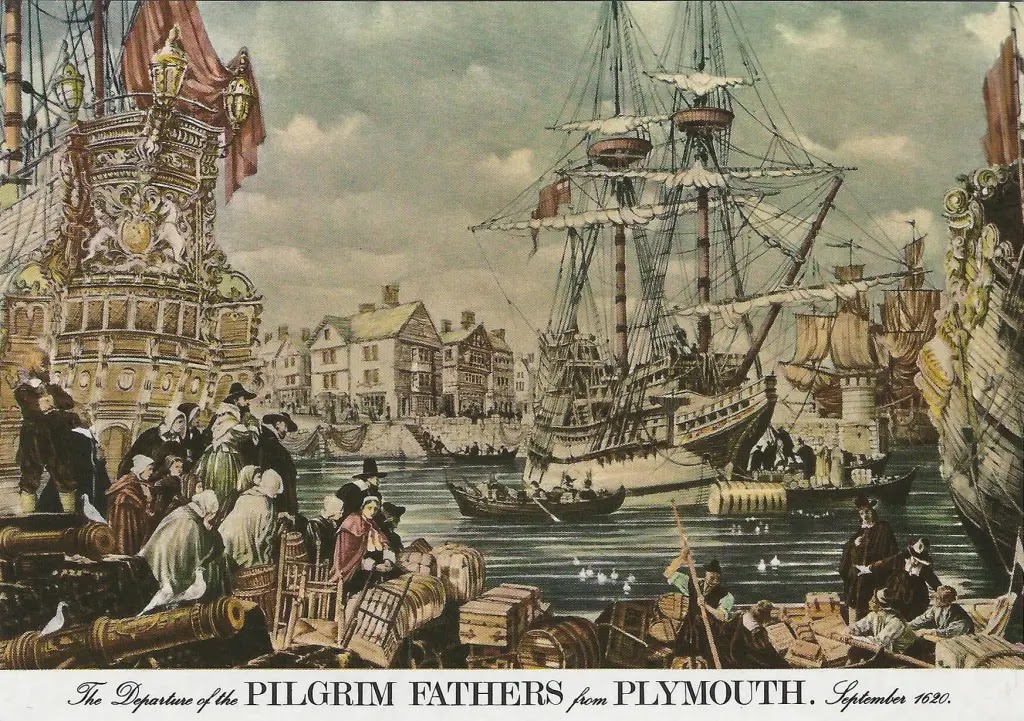
 ‘The departure of the Pilgrim Fathers from Plymouth, September 1620’. © Nicky Hughes.

Mayflower was an English ship that transported a group of English families, known today as the Pilgrims, from England to the New World in 1620. After a grueling 10 weeks at sea, Mayflower, with 102 passengers and a crew of about 30, reached what is today the United States, dropping anchor near the tip of Cape Cod, Massachusetts, on November 21, 1620.

Anthony Thompson
The 'Mayflower' Leaving to Plymouth, 1620, c. 1938
Oil on canvas
H 370 x W 380 cm (E)
Essex County Council

I've found no information on Anthony Thompson

Differing from their contemporaries, the Puritans (who sought to reform and purify the Church of England), the Pilgrims chose to separate themselves from the Church of England, which forced them to pray in private. They believed it was beyond redemption due to its resistance to reform and Roman Catholic past.


Robert Walter Weir (June 18, 1803 – May 1, 1889)
Embarkation of the Pilgrims
Oil on canvas
548 cm x 365 cm (216 inches x 144 inches; 18 feet x 12 feet)
U.S. Capitol Rotunda

Protestant pilgrims are shown on the deck of the ship Speedwell before their departure for the New World from Delft Haven, Holland, on July 22, 1620. William Brewster, holding the Bible, and pastor John Robinson leading Governor Carver, William Bradford, Miles Standish, and their families in prayer. The prominence of women and children suggests the importance of the family in the community. At the left side of the painting is a rainbow, which symbolizes hope and divine protection. More on this painting

Robert Walter Weir (June 18, 1803 – May 1, 1889) was an American artist and educator and is considered a painter of the Hudson River School. Weir was elected to the National Academy of Design in 1829 and was an instructor at the United States Military Academy. His best-known work is Embarkation of the Pilgrims in the United States Capitol rotunda in Washington, D.C.[2] More than 450 of his works are known, and he created many unsigned paintings that may never be attributed to him. More on Robert Walter Weir


Starting in 1608, a group of English families left England for the Netherlands, where they could worship freely. By 1620, the community determined to cross the Atlantic for America, which they considered a "new Promised Land", where they would establish Plymouth Colony

Bernard Gribble
The Pilgrim fathers Loading Up the Mayflower in 1620
Oil on canvas
I have no further description, at this time

After Edward Moran, (1829-1901)
Embarkation of the Pilgrims
Oil on canvas
17 5⁄8 x 29 1⁄4 in. (44.8 x 74.3 cm)
Private Collection

Edward Moran grew up in a family of weavers in Lancashire, England, where he learned to draw from a street artist. He sketched on the fabric on his weaving loom until his exasperated family told him to stop weaving and take up art. They moved to the United States in 1844 and lived in Philadelphia, where Moran studied with the artist James Hamilton. In 1868, Moran submitted a group of paintings to be shown at the Pennsylvania Academy. He was unhappy with the placement of his work, however, and on “varnishing day” cut one of his paintings from the canvas and painted over the rest with an opaque wash. The outraged directors demanded an apology and threatened to leave the damaged paintings in the exhibition. The scandal made its way into the newspapers and people clamored to see the infamous defaced paintings. Moran never apologized to the directors and eventually resigned as a member of the academy. More on 
Edward Moran

British School
Departure of the 'Mayflower', c. 1620
Oil on canvas
H 96.5 x W 116.5 cm
Southampton City Art Gallery

The painting showcases the departure of the Mayflower ship from England's shores as it embarks on its voyage to the New World, America. Against the backdrop of a breathtaking sunset and serene seascape, men, women, and children bid farewell to their homeland with mixed emotions. Puritans dressed in traditional attire are seen walking along the coastline carrying their belongings and walking sticks. Families cling together tightly, symbolizing unity and strength during this arduous journey towards an unknown future. This maritime masterpiece beautifully portrays both hope and trepidation as these Pilgrim Fathers set sail for Plymouth in search of religious freedom and new opportunities across vast oceans. The coastal landscape serves as a poignant reminder of what they leave behind - familiar faces, beloved homes, and cherished memories. More on this painting

The Pilgrims had originally hoped to reach America by early October using two ships, but delays and complications meant they could use only one, Mayflower.

Moran, Percy, 1862-1935
A fair Puritan/ Priscilla Mullins
Lithograph
Library of Congress Prints and Photographs Division Washington

Priscilla Mullins, it is believed, was born in or near Dorking, Surrey, England, and that she was in her teens in 1620 when she, her parents and her brother Joseph came to America on the Mayflower. Her parents and her brother died in the sickness that took so many lives during the first winter at Plymouth Colony, leaving her orphaned. Priscilla probably then moved in with the Brewster family. More on Priscilla Mullins

Edward Percy Moran (1862–1935), sometimes known as Percy Moran, was an American artist known for his scenes of American history.

He was born in Philadelphia on July 29, 1862, to Edward Moran, a notable artist who emigrated from England to the United States. He studied under his father and at the Pennsylvania Academy of Fine Arts and the National Academy of Design.

He was a painter of historical American subjects, and examples of his work are found in many prominent collections.

He died in New York City on March 25, 1935. More on Edward Percy Moran

Granville Perkins, Baltimore, MD
The Mayflower At Sea, c. 1880
Engraving

"with the stern of the little craft hove up on a mighty wave as she leans forward to dip the next hollow of the swelling ocean, and her sails standing out against the cloudy rays of the setting sun"

Granville Perkins (1830–1895) was an American illustrator and painter, best known for landscape and marine subjects. He contributed illustrations to numerous journals and books of the 1870s and 1880s. He also painted in oils and watercolors, and exhibited his work at the Pennsylvania Academy of the Fine Arts and the National Academy of Design.

Born in Baltimore, Maryland in 1830, Granville Perkins became a scene painter at the age of fifteen, working with the Ravel family on theatrical productions such as Mazulua, The Green Monster, and Jacko or the Brazilian Ape.

With the Ravels, Perkins traveled to Cuba, Jamaica, Yucatán, and Central America between 1851 and 1856. The paintings he based on these travels give evidence of his passion for tropical subjects.

Perkins studied art with the marine painter James Hamilton at the Pennsylvania Academy of the Fine Arts in Philadelphia. By 1860 he moved to New York City, where he would work as an illustrator for periodicals such as Harper's Weekly and Frank Leslie's Illustrated Newspaper.

In New York, Perkins exhibited paintings at the National Academy of Design between 1862 and 1883. In 1870, he again sought tropical subjects for his brush, this time traveling from New York to California and from there by ship around Cape Horn. 

Granville Perkins died in New York City in 1895. More on Granville Perkins

Jean Leon Gerome Ferris  (1863–1930)
The Mayflower Compact,1620
Oil on canvas
Private collection

Picture shows passengers of the Mayflower signing the "Mayflower Compact", including John Carver sitting at the head of the old chest on which they write, and a man Ferris identified as Winston, but who was probably Edward Winslow, holding the ink horn for John Alden, who signs his name. Myles Standish sits in a chair, turned to face the signers. In addition, Ferris singled out John Howland, William Bradford, Isaac Allerton, and a man only identified as Fuller, so either Samuel or Edward Fuller. Ferris chose to include Mary Chilton "as a representative of the sex that did most of the real work of the colony."

Though the exotic, and sometimes scandalous, subject matter of his paintings attracted disapproval, there can be no doubt that Jean-Léon Gérôme was a technical maestro; a master of the spectacular who prided himself on a meticulous attention to picture detail. One of the most famous French painters of his generation, he can be credited with bringing about a transformation in historical painting. He was, however, subject to fierce criticism and controversy (mainly from Realists and Expressionists) who viewed his blending of academic painting with genre painting as falling somewhere between two outmoded schools. Nevertheless, Gérôme, whose pictorial worlds could certainly not be relied upon for historical accuracy, captivated a public that was won over by the skill and theatricality of his art. In his later career Gérôme reinvented himself as a sculptor, but he remains best known for his spectacular historical narratives that were made even more popular through the photographic reproduction of his images. More on Jean-Léon Gérôme

Arriving in November, they had to survive unprepared through a harsh winter. As a result, only half of the original Pilgrims survived the first winter at Plymouth. If not for the help of local indigenous peoples to teach them food gathering and other survival skills, all of the colonists might have perished. The following year, those 53 who survived, celebrated the colony's first fall harvest along with 90 Wampanoag Native American people, an occasion declared in centuries later the first American Thanksgiving. Before disembarking the Mayflower, the Pilgrims wrote and signed the Mayflower Compact, an agreement that established a rudimentary government, in which each member would contribute to the safety and welfare of the planned settlement. As one of the earliest colonial vessels, the ship has become a cultural icon in the history of the United States. More on Mayflower


Please visit my other blogs: Art Collector, Mythology, Marine Art, Portrait of a Lady, The Orientalist, Art of the Nude and The Canals of Venice, Middle East Artists, 365 Saints, 365 Days, and Biblical Icons, also visit my Boards on Pinterest

Images are copyright of their respective owners, assignees or others. Some Images may be subject to copyright

I don't own any of these images - credit is always given when due unless it is unknown to me. if I post your images without your permission, please tell me.

I do not sell art, art prints, framed posters or reproductions. Ads are shown only to compensate the hosting expenses.

If you enjoyed this post, please share with friends and family.

Thank you for visiting my blog and also for liking its posts and pages.

Please note that the content of this post primarily consists of articles available from Wikipedia or other free sources online.


01 Marine Art, The Battle of the USS Monitor and CSS Merrimack (Virginia), With Footnotes #310

Julian Oliver Davidson (1853-94)
The Battle of Hampton Roads, c. 1862
The Monitor and Merrimac: The First Fight Between Ironclads
Oil on canvas
 Library of Congress

Julian Oliver Davidson (December 27, 1853–April 30, 1894) was a 19th-century American marine artist and illustrator from Nyack, New York. He best known works of the famous naval battles of the American Civil War. Davidson's works were exhibited at the Hudson River Museum, New-York Historical Society and the National Academy of Design in the 1870s and 1880s.

Davidson began drawing at the studio of Mauritz de Haas, a Dutch-American marine painter. He was introduced to painters of the Hudson River School including Winslow Homer, Albert Bierstadt and Frederick Church. He stayed there for three years.

Davidson specialized in the naval battles of the United States. He best known works of the famous naval battles of the American Civil War. In 1884, he was commissioned to provide illustrations of naval scenes for the four-volume work The Battles and Leaders of the Civil War. Recognized by the National Academy of Design, two of his greatest naval paintings, The Battle of Lake Champlain and The U.S. Frigate Constitution, 'Old Ironsides' Escaping From the British Fleet" were displayed at the National Academy of Design's annual art show.

The Battle of Lake Champlain (1884) hangs in the Key Bank Art Gallery in Plattsburgh, New York. He has exhibited at the Hudson River Museum, New-York Historical Society and the National Academy of Design. More on Julian Oliver Davidson

It was fought over two days, March 8–9, 1862, in Hampton Roads, in Virginia. The battle was a part of the effort of the Confederacy to break the Union blockade, which had cut off Virginia's largest cities and major industrial centers, Norfolk and Richmond, from international trade.

This battle was the first meeting in combat of ironclad warships, USS Monitor and CSS Virginia. On the first day of battle, they were opposed by several conventional, wooden-hulled ships of the Union Navy.

On that day, Virginia was able to destroy two ships of the federal flotilla, USS Congress and USS Cumberland, and was about to attack a third, USS Minnesota, which had run aground. However, the action was halted by darkness and falling tide, so Virginia retired to take care of her few wounded and repair her minimal battle damage.

Determined to complete the destruction of Minnesota, the Virginia returned the ship to the fray the next morning, March 9. During the night, however, the ironclad Monitor had arrived and had taken a position to defend Minnesota. When Virginia approached, Monitor intercepted her. The two ironclads fought for about three hours, with neither being able to inflict significant damage on the other. The duel ended indecisively, Virginia returning to her home at the Gosport Navy Yard for repairs and strengthening, and Monitor to her station defending Minnesota. The ships did not fight again, and the blockade remained in place.

The battle received worldwide attention, and it had immediate effects on navies around the world. The preeminent naval powers, Great Britain and France, halted further construction of wooden-hulled ships, and others followed suit. Although Britain and France had been engaged in an iron-clad arms race since the 1830s, the Battle of Hampton Roads signaled a new age of naval warfare had arrived for the whole world. A new type of warship, monitor, was produced on the principle of the original. The use of a small number of very heavy guns, mounted so that they could fire in all directions, was first demonstrated by Monitor but soon became standard in warships of all types. Shipbuilders also incorporated rams into the designs of warship hulls for the rest of the century. More on The Battle of the Monitor and Merrimack


Please visit my other blogs: Art Collector, Mythology, Marine Art, Portrait of a Lady, The Orientalist, Art of the Nude and The Canals of Venice, Middle East Artists, 365 Saints, 365 Days, and Biblical Icons, also visit my Boards on Pinterest

Images are copyright of their respective owners, assignees or others. Some Images may be subject to copyright

I don't own any of these images - credit is always given when due unless it is unknown to me. if I post your images without your permission, please tell me.

I do not sell art, art prints, framed posters or reproductions. Ads are shown only to compensate the hosting expenses.

If you enjoyed this post, please share with friends and family.

Thank you for visiting my blog and also for liking its posts and pages.

Please note that the content of this post primarily consists of articles available from Wikipedia or other free sources online.

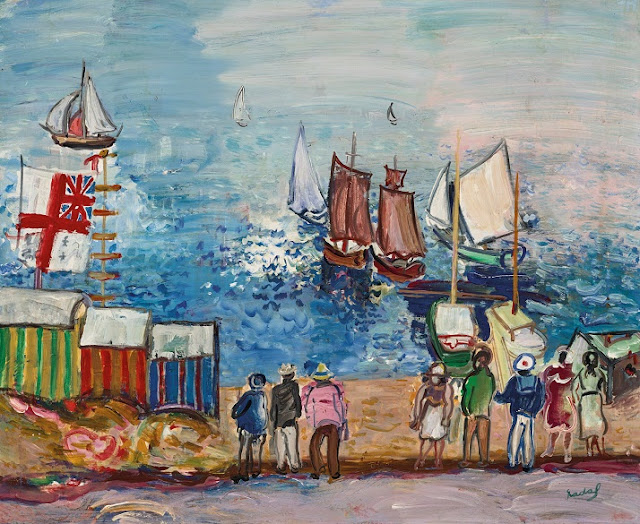
01 Painting, Marine Art, Carlos Nadal's Dieppe. With Footnotes #309

Carlos Nadal  (1917-1998)
Dieppe, la plage, c. 1973
Oil and acrylic on canvas
23 1⁄2 x 28 3⁄4 in. (60 x 73 cm.)
Private collection

Sold for £21,420 in Mar 2022

Dieppe is a coastal commune in the Seine-Maritime department in the Normandy region of northern France.

A port on the English Channel, at the mouth of the river Arques, famous for its scallops, and with a regular ferry service to Newhaven in England, Dieppe also has a popular pebbled beach, a 15th-century castle and the churches of Saint-Jacques and Saint-Remi. The mouth of the river Scie lies at Hautot-sur-Mer, directly to the west of Dieppe. More on Dieppe

At 0523 hours, 19 August 1942, Captain Denis Whitaker and the men of the Royal Hamilton Light Infantry listened as the hull of their flat-bottomed landing craft grated on the stone shingle of the broad beach fronting the French town of Dieppe. As the rising sun broke the horizon and revealed the outline of the town, Whitaker and his men peered over the ramp of the landing boat. They expected to see a town shattered by Royal Air Force bombs and Royal Navy shells, but to their shock they could see that even the storefront windowpanes were unbroken. Suddenly a hail of machine gun bullets peppered the side of the landing craft.

The Canadians had been promised that the town would be lightly defended. Instead they could see that Dieppe was a fortress, intact, and the Germans were ready and waiting. The ramp dropped and Whitaker and his men scrambled out onto the stony beach, bullets flying, bombs exploding. The bodies piled on top of one another. More on Dieppe: The Beaches of Hell

Carlos Nadal (24 April 1917 – 6 June 1998) was a Spanish painter of the Fauvist school

Nadal was born in Paris on 24 April 1917, but moved to Barcelona in 1921. His father, Santiago Nadal had a commercial design studio, where Carlos learnt to paint, and met modern artists including Henri Matisse, Raoul Dufy and Maurice Utrillo.

Nadal studied at the School of Arts and Crafts and the Senior Fine Art Academy of St George, both in Barcelona. He was conscripted into the Spanish Republican Army and fought in the Spanish Civil War, including imprisonment and escape from a concentration camp, before finally returning to his art studies.

Nadal was particularly influenced by Henri Matisse whom he met as a child, and Georges Braque who was a close acquaintance in the 1940s, and maintained a love of the Fauvist style.

His first solo exhibition was in 1942 at La Pinacoteca in Barcelona. His early work was mainly of scenes in Spain or Belgium but when established as a successful artist he travelled extensively, making paintings which often featured modes of transport as well as leisure scenes.

On 1 December 1948 he married Flore Augusta Zoe Joris a Belgian sculptor, moving with her to Brussels in 1949. In 1958. They moved residence between Brussels and Barcelona. He died in Barcelona on 6 June 1998. More on Carlos Nadal


Please visit my other blogs: Art Collector, Mythology, Marine Art, Portrait of a Lady, The Orientalist, Art of the Nude and The Canals of Venice, Middle East Artists, 365 Saints, 365 Days, and Biblical Icons, also visit my Boards on Pinterest

Images are copyright of their respective owners, assignees or others. Some Images may be subject to copyright

I don't own any of these images - credit is always given when due unless it is unknown to me. if I post your images without your permission, please tell me.

I do not sell art, art prints, framed posters or reproductions. Ads are shown only to compensate the hosting expenses.

If you enjoyed this post, please share with friends and family.

Thank you for visiting my blog and also for liking its posts and pages.

Please note that the content of this post primarily consists of articles available from Wikipedia or other free sources online.


01 Marine Art, James Browning Wyeth's Surf Watchers, with Footnotes #308

Jamie Wyeth, b.1946
Surf Watchers, c. 1976
Watercolor on paper
26½ by 40 in., 67.3 by 101.6 cm.
Private collection

Sold for 151,200 USD in May 2022

Surf Watchers depicts the artist’s wife, Phyllis Mills Wyeth, leaning out of the Dutch door at the front of their house on Monhegan Island in Maine, where the work was painted. More on this painting

James Browning Wyeth (born July 6, 1946) is a contemporary American realist painter, son of Andrew Wyeth, and grandson of N.C. Wyeth. He was raised in Chadds Ford Township, Pennsylvania, and is artistic heir to the Brandywine School tradition.

Early on, Wyeth became interested in oil painting. What inspired Wyeth most was not the subject matter or technique of his grandfather, but Jamie adopted a wider palette of colors.

Wyeth excels in drawing, lithography, etching, egg tempera, watercolor, and mixed media. Though grounded in this family’s artist tradition and subjects, and bound by the same solitude of his art, his wider travels and experiences have shaped a more rounded artist. In travels to Europe, he studied the Flemish and Dutch masters, and learned the intricate and exacting process of lithography, producing a substantial amount of graphic work.

Since the 1970s, Wyeth has often painted on corrugated cardboard, and now uses "archival" versions of the surface. He likes the rough striated effect it gives to his paintings, and he has also portrayed the material with great fidelity in depictions on conventional canvas. More on James Browning Wyeth


Please visit my other blogs: Art Collector, Mythology, Marine Art, Portrait of a Lady, The Orientalist, Art of the Nude and The Canals of Venice, Middle East Artists, 365 Saints, 365 Days, and Biblical Icons, also visit my Boards on Pinterest

Images are copyright of their respective owners, assignees or others. Some Images may be subject to copyright

I don't own any of these images - credit is always given when due unless it is unknown to me. if I post your images without your permission, please tell me.

I do not sell art, art prints, framed posters or reproductions. Ads are shown only to compensate the hosting expenses.

If you enjoyed this post, please share with friends and family.

Thank you for visiting my blog and also for liking its posts and pages.

Please note that the content of this post primarily consists of articles available from Wikipedia or other free sources online.

01 Marine Painting, John Jack Robert Charles Spurling's P. & O. Steamship 'Soudan, with Footnotes #288

John Jack Robert Charles Spurling, British, 1870-1933
P. & O. Steamship 'Soudan', c. 1918
Oil on canvas on board
12 x 18 inches (30.5 x 45.8 cm)
Private collection

Soudan SS was a British Cargo Steamer of 6,677 tons built in 1931 by Barclay Curle & Company, Glasgow, for the Peninsular & Oriental Steam Navigation Company as the SOUDAN SS. She was powered by a Steam turbine with Bauer Wach exhaust system. 

Soudan struck a mine and sank off Cape Town. The mine was probably one of the many laid by the Speybank (renamed Doggerbank), a British ship captured by the German and used as a minelayer. More on Soudan SS

John (Jack) Robert Charles Spurling (1870 – 31 May 1933) was an English painter noted for nautical themes, particularly sailing ships of the 19th and 20th centuries.

John Robert Charles "Jack" Spurling was the son of an importer and grew up near the London docks, where he learned to sketch as a pastime. At the age of 16 he first went to sea as an apprentice aboard Astoria. His life nearly ended when he fell from the main upper topsail yard to the deck, he instead spent six months in a Singapore hospital. He gained his second mate's certificate after some years aboard one of Devitt & Moore's sail training vessels, and around the same time learned the art of watercolor painting, and was soon receiving commissions from other seafarers. He finished his life at sea as a sailor with the Blue Anchor line of steamers.

Spurling's second love was the stage, and promising career as an actor but success as a painter intruded: In 1921 he met Frederick Arthur Hook (died 1935), editor of The Blue Peter: The Magazine of Sea Travel, Price 1/-,[2] a magazine for sailing enthusiasts. Hook purchased much of Spurling's portfolio of work, and contracted him to supply artwork for the covers of his magazine, the first being the issue of March 1923. More on John (Jack) Robert Charles Spurling


Please visit my other blogs: Art Collector, Mythology, Marine Art, Portrait of a Lady, The Orientalist, Art of the Nude and The Canals of Venice, Middle East Artists, 365 Saints, 365 Days, and Biblical Icons, also visit my Boards on Pinterest

Images are copyright of their respective owners, assignees or others. Some Images may be subject to copyright

I don't own any of these images - credit is always given when due unless it is unknown to me. if I post your images without your permission, please tell me.

I do not sell art, art prints, framed posters or reproductions. Ads are shown only to compensate the hosting expenses.

If you enjoyed this post, please share with friends and family.

Thank you for visiting my blog and also for liking its posts and pages.

Please note that the content of this post primarily consists of articles available from Wikipedia or other free sources online.


01 Marine Painting, Thomas Whitcombe's Action between Aigle & Sirene, with Footnotes #287

THOMAS WHITCOMBE (BRITISH, CIRCA 1752-1824)
Action between Aigle & Sirene, circa 1808
Oil on canvas
24 x 36in (61 x 91.5cm)
Private collection

This painting is unusual in depicting ships engaged in battle while carrying full sails, including their studded sails. It was difficult to man the guns and set the full complement of sails. Full sail was needed here because the ships were engaged in a chase. Aigle (a 5th rate ship with 36 guns; under the command of Captain George Wolf) was part of a 5 ship British squadron blockading Lovient on March 22, 1808. They sighted two French frigates, Sirene (38 guns, Captain Duperre) and Italienne (40 guns, Captain H. Mequet) returning to Larient, France having landed troops in Martinique. The Aigle braved the French shore batteries on the Basse des Bretons to lead off the French frigates. She came close enough to the French ships to open fire. The Italienne abandoned her attempt to reach Lorient and bore up under the guns of Groix. The Aigle chased the Sirene and forced her to run aground on the Pointe des Chats, on the east corner of Ile de Groix. Since Sirene was protected by powerful shore batteries, the British squadron had to withdraw. The Aigle had 22 killed or wounded including severely wounded Captain Wolf. The Sirene was subsequently re-floated and reached Lorient safely. In 1853 the Aigle was connected to a coal hulk and finally sold to be broken up in 1870. The artist Thomas Whitcombe is known for documenting the naval actions of the French Revolutionary wars. More on Aigle & Sirene

Thomas Whitcombe (possibly 19 May 1763 – c. 1824) was a prominent British maritime painter of the Napoleonic Wars. Among his work are over 150 actions of the Royal Navy, and he exhibited at the Royal Academy, the British Institution and the Royal Society of British Artists. His pictures are highly sought after today.

Thomas Whitcombe was born in London between 1752 and 19 May 1763. Little is known of his background or training, although speculation based on the locations depicted in his paintings may provide some clues.

It is known that he was in Bristol in 1787 and later travelled to the South Coast; there are few ports or harbours from this region that do not feature in his work. In 1789 he toured Wales and in 1813 he travelled to Devon, painting scenes around Plymouth harbour. During his career he also painted scenes showing the Cape of Good Hope, Madeira, Cuba and Cape Horn. Between 1783 and 1824 he lived in London, including addresses in Covent Garden and Somers Town during the course of his exhibiting career.

His date of death, like that of his birth is uncertain; it was not before 1824, and possibly as late as 1834.

His range of work embraced naval engagements, ship portraits, coastal scenes with shipping and ships at sea in fresh breezes and storms. The topography of the background is interesting and well observed and the depiction of the ships themselves detailed and technically very correct, a legacy of time spent in dockyards studying the subject matter. The backgrounds are delightfully atmospheric and, like many British marine artists of the 18th and 19th century, Whitcombe favoured a dark foreground. More on Thomas Whitcombe


Please visit my other blogs: Art Collector, Mythology, Marine Art, Portrait of a Lady, The Orientalist, Art of the Nude and The Canals of Venice, Middle East Artists, 365 Saints, 365 Days, and Biblical Icons, also visit my Boards on Pinterest

Images are copyright of their respective owners, assignees or others. Some Images may be subject to copyright

I don't own any of these images - credit is always given when due unless it is unknown to me. if I post your images without your permission, please tell me.

I do not sell art, art prints, framed posters or reproductions. Ads are shown only to compensate the hosting expenses.

If you enjoyed this post, please share with friends and family.

Thank you for visiting my blog and also for liking its posts and pages.

Please note that the content of this post primarily consists of articles available from Wikipedia or other free sources online.


01 Marine Painting, Edward William Cook's Zuider Zee fishing craft drying nets in the harbour of Spaarndam, with Footnotes #286

Edward William Cooke, RA (BRITISH, 1811-1880)
Detail; Zuider Zee fishing craft drying nets in the harbour of Spaarndam, c. 1847
Oil on canvas
46 x 91.5cm (18 1/8 x 36in)
Private collection

Edward William Cooke, RA (BRITISH, 1811-1880)
Zuider Zee fishing craft drying nets in the harbour of Spaarndam, c. 1847
Oil on canvas
46 x 91.5cm (18 1/8 x 36in)
Private collection

Sold for £12,562.50 in June 2020

Zuider Zee fishing craft were to feed the population in the surrounding areas. From 1850 onward, the market increased in size and Zuiderzee fishing became economically important to the Netherlands. Around 1900 there were about 2000 fishing boats, mostly small businesses with one boat per family. 

During the same period, substantial companies were on the rise in North sea fishing, threatening to outstrip the Zuiderzee fishermen.  The increasingly serious plans to close off and partly impolder the Zuiderzee discouraged the fishermen to make investments and modernize their ships. When in 1920 the Zuiderzee Works started, this spelled the end of Zuiderzee fishing.

There were many different types of fishing boats. Fishing methods, local sailing conditions, and local ship building traditions determined the appearance of the boats, of which the most well-known is the 'botter'. More on Zuider Zee


Spaarndam is a small village in the province of North Holland, the Netherlands, on the Spaarne river and the IJ lake. Spaarndam was created around a dam where the river Spaarne flows into the IJ. This dam was built here by count Floris V of Holland in 1285. The village collected toll at this dam, and people made their living from fishing. From 1812 to 1927, the western part of Spaarndam was an independent municipality. More on Spaarndam


Edward William Cooke, R.A., F.R.S., F.Z.S., F.S.A., F.G.S. (27 March 1811 – 4 January 1880) was an English landscape and marine painter, and gardener. Cooke was born in Pentonville, London. He was raised in the company of artists. He was a precocious draughtsman and a skilled engraver from an early age, displayed an equal preference for marine subjects and published his "Shipping and Craft" – a series of accomplished engravings – when he was 18, in 1829. Cooke began painting in oils in 1833, and first exhibited at the Royal Academy and British Institution in 1835, by which time his style was essentially formed.

He went on to travel and paint with great industry at home and abroad, indulging his love of the 17th-century Dutch marine artists with a visit to the Netherlands in 1837. He returned regularly over the next 23 years, studying the effects of the coastal landscape and light, as well as the works of the country's Old Masters, resulting in highly successful paintings. He went on to travel in Scandinavia, Spain, North Africa and, above all, to Venice. In 1858, he was elected into the National Academy of Design as an Honorary Academician. . More Edward William Cooke


Please visit my other blogs: Art Collector, Mythology, Marine Art, Portrait of a Lady, The Orientalist, Art of the Nude and The Canals of Venice, Middle East Artists, 365 Saints, 365 Days, and Biblical Icons, also visit my Boards on Pinterest

Images are copyright of their respective owners, assignees or others. Some Images may be subject to copyright

I don't own any of these images - credit is always given when due unless it is unknown to me. if I post your images without your permission, please tell me.

I do not sell art, art prints, framed posters or reproductions. Ads are shown only to compensate the hosting expenses.

If you enjoyed this post, please share with friends and family.

Thank you for visiting my blog and also for liking its posts and pages.

Please note that the content of this post primarily consists of articles available from Wikipedia or other free sources online.

01 Marine Painting, Jules Achille Noël's Elegant figures on the beach, Tréport, with Footnotes #285

Jules Achille Noël, (FRENCH, 1815-1881)
Elegant figures on the beach, Tréport, c. 1875
Oil on panel
16.3 x 21.8cm (6 7/16 x 8 9/16in)
Oil on canvas

Estimated for £6,000 - £8,000 in June 2020

Le Tréport is a commune in the Seine-Maritime department in the Normandy region in north-eastern France.

A small fishing port and light industrial town situated in the Pays de Caux, some 21 miles (34 km) northeast of Dieppe. The mouth of the Bresle river meets the English Channel here, in between the high chalk cliffs and the pebbly beach. More on Le Tréport 

Jules Achille Noël, born Louis Assez Noël (24 February 1815, Quimper – 26 March 1881, Algiers) was a French landscape and maritime painter who worked primarily in Brittany and Normandy.

His family originally came from Lorraine. Some sources say that he was born there in 1810. He studied at the "Académie de Peinture et de Dessin" (Académie Charioux) in Brest. Afterwards, he went to Paris to seek his fortune and came under the influence of his fellow Breton painter Pierre-Julien Gilbert. After four years of struggling to earn his living, he returned to Brittany to teach drawing in Saint-Pol-de-Léon, Lorient and Nantes.

He had begun to participate in the Salon in 1840 and, in 1845, was one of several artists commissioned to provide engraved illustrations for a book on prisons. Eventually, his work attracted the attention of Prince Louis, Duke of Nemours, who obtained him a position as a Professor of Design at the Lycée Henri-IV, where he would teach from 1847 until his retirement in 1879. Albert Lynch and Félix Buhot were among his best-known students there.

During school vacations he would return to paint in Brittany. He was in ill-health at the time of his retirement, so he went to live with his daughter and her husband in Algeria and died there. More on Jules Achille Noël


Please visit my other blogs: Art Collector, Mythology, Marine Art, Portrait of a Lady, The Orientalist, Art of the Nude and The Canals of Venice, Middle East Artists, 365 Saints, 365 Days, and Biblical Icons, also visit my Boards on Pinterest

Images are copyright of their respective owners, assignees or others. Some Images may be subject to copyright

I don't own any of these images - credit is always given when due unless it is unknown to me. if I post your images without your permission, please tell me.

I do not sell art, art prints, framed posters or reproductions. Ads are shown only to compensate the hosting expenses.

If you enjoyed this post, please share with friends and family.

Thank you for visiting my blog and also for liking its posts and pages.

Please note that the content of this post primarily consists of articles available from Wikipedia or other free sources online.

01 Marine Painting, Ester Almqvist's Gothenburg Harbour with Boats in the Ice, With Footnotes #384


Ester Almqvist (Swedish, 1869 - 1934)
Gothenburg Harbour with Boats in the Ice, c. 1916
Oil on canvas
62,50 x 89,50 cm
Gothenburg Museum of Art 

The municipally-owned Port of Gothenburg is the largest port in the Nordic countries. The port is situated on both sides of the estuary of Göta älv in Gothenburg. The north shore, Norra Älvstranden, is on Hisingen island and the south shore, Södra Älvstranden, is on the mainland. It is a combined river and coastal port. More on the Port of Gothenburg

Ester Dorothea Almqvist (3 November 1869 – 11 June 1934) was a Swedish artist who was a pioneer of Expressionist painting in Sweden.

Almqvist was born in Bromma but spent her childhood in Stockholm, where her parents taught in a school for Christian missionaries. She is the female artist who is represented with most artworks in the collections of Malmö Konstmuseum, a total of 2,083 pieces. She had specified in her will that her collection of oil and watercolour paintings, charcoal, pastel and ink drawings, graphic pages and sketchbooks should be donated to that particular museum. Her father, a priest, died when she was nine. Her mother worked as a private tutor and book seller for the sake of providing for her family. Almqvist was born with a deformed spine that limited her mobility throughout her life but also gave her freedom to study art instead of being confined to housework.

She attended the Technical School in Stockholm, graduating in 1891, and she studied art privately with the painter Gustaf Cederström. She continued her art studies at the Valand Art Academy in Gothenburg (1892–1893) and then at the Konstnärsförbundets skola in Stockholm (1894–1895). Her teachers included Per Hasselberg and Bruno Liljefors. While in school, she supported herself by commercial book illustration work. Later, she was a member of the women's association Nya Idun. More on Ester Dorothea Almqvist


Please visit my other blogs: Art Collector, Mythology, Marine Art, Portrait of a Lady, The Orientalist, Art of the Nude and The Canals of Venice, Middle East Artists, 365 Saints, 365 Days, and Biblical Icons, also visit my Boards on Pinterest

Images are copyright of their respective owners, assignees or others. Some Images may be subject to copyright

I don't own any of these images - credit is always given when due unless it is unknown to me. if I post your images without your permission, please tell me.

I do not sell art, art prints, framed posters or reproductions. Ads are shown only to compensate the hosting expenses.

If you enjoyed this post, please share with friends and family.

Thank you for visiting my blog and also for liking its posts and pages.

Please note that the content of this post primarily consists of articles available from Wikipedia or other free sources online.


01 Marine Painting - Vasilios Chatzis' Byzantine naval battle, with Footnotes #386

Vasilios Chatzis (Greek, 1870-1915)
Byzantine naval battle
Oil on card
25 x 22.5 cm
Private collection

Sold for £6,312.50 in May 2020

"Two years ago, Vassilios Hatzis undertook to bring back to life an entire historical era, and since then has been engaged in the depiction of the Byzantine fleet. Since there are no previous studies in this field to assist him in his work, his historical research has been, and still is, rather painstaking." More on this painting

Vasileios Hatzis or Vassileios Chatzis (1870 – 1915) was a Greek painter who was best known for his seascapes.

Vasileios Hatzis was born in 1870 in Kastoria. His family was involved in shipping, and he spent his childhood in Patras. From 1886 to 1893 he studied at the Athens School of Fine Arts . During the Balkan Wars of 1912–13 the government assigned him to the navy, where he portrayed action scenes of the Greek fleet. He died in Athens in 1915

Hatzis is primarily known for his seascapes, but also painted landscapes and genre scenes from the life of farmers and fishermen. His work includes both academic and en plein air styles. The influence of impressionism may be detected in his work. He first exhibited in Athens in 1899, and his works were shown in group exhibitions in Athens (1902, 1907, 1909, 1910) and Alexandria (1903, 1906). A solo exhibition was held soon after his death at the Zappeion hall in Athens that showed more than 260 works. More on Vasileios Hatzis 


Please visit my other blogs: Art Collector, Mythology, Marine Art, Portrait of a Lady, The Orientalist, Art of the Nude and The Canals of Venice, Middle East Artists, 365 Saints, 365 Days, and Biblical Icons, also visit my Boards on Pinterest

Images are copyright of their respective owners, assignees or others. Some Images may be subject to copyright

I don't own any of these images - credit is always given when due unless it is unknown to me. if I post your images without your permission, please tell me.

I do not sell art, art prints, framed posters or reproductions. Ads are shown only to compensate the hosting expenses.

If you enjoyed this post, please share with friends and family.

Thank you for visiting my blog and also for liking its posts and pages.

Please note that the content of this post primarily consists of articles available from Wikipedia or other free sources online.

01 Marine Painting - Johan Tirén's Return of the Fishermen, with Footnotes, #385

Johan tirén, "amatörfiskare på hemfärd" (return of the "fishermen").
Johan Tirén, (1853-1911)
Return of the Fishermen
Oil on canvas
81 x 65 cm.
Private collection

Sold for 5,300 USD in June 2020

Johan Tirén (12 October 1853, Själevad - 24 August 1911, Länna Parish, Uppland) was a Swedish painter who specialized in scenes of the rural life in Northern Sweden.

He originally attended the Tekniska skolan in Stockholm then spent the years 1877 to 1880 at the Royal Swedish Academy of Fine Arts, where he won a Royal Medal in 1880. 

After studying in Norrland in 1881, he was able to obtain a scholarship and used it to make a study trip; visiting the Netherlands, Belgium, Paris and Upper Bavaria. While in Rome, he received orders from the Academy Director to begin studies in Munich. Instead he returned to Paris and studied with Jean-Léon Gérôme, but found himself uninspired to paint by what he saw there. When his travel allowance was not extended, he settled in Jämtland, where he painted landscapes and scenes from the lives of the Sami people. More on Johan Tirén


Please visit my other blogs: Art Collector, Mythology, Marine Art, Portrait of a Lady, The Orientalist, Art of the Nude and The Canals of Venice, Middle East Artists, 365 Saints, 365 Days, and Biblical Icons, also visit my Boards on Pinterest

Images are copyright of their respective owners, assignees or others. Some Images may be subject to copyright

I don't own any of these images - credit is always given when due unless it is unknown to me. if I post your images without your permission, please tell me.

I do not sell art, art prints, framed posters or reproductions. Ads are shown only to compensate the hosting expenses.

If you enjoyed this post, please share with friends and family.

Thank you for visiting my blog and also for liking its posts and pages.

Please note that the content of this post primarily consists of articles available from Wikipedia or other free sources online.


A note to the readers of Zaidan Gallery

      A note to the readers of Zaidan Gallery It is with great sadness that we share the news that the author of this blog,  Henry Zaidan (1...